EN
EN  DE
DE  RU
RU  PT
PT  JA
JA  ES
ES  IT
IT ROBOT CELL GUARDING / INDUSTRIAL AUTOMATION SAFETY
How a 20×100 mm Mesh Pattern Changes the Layout Calculation
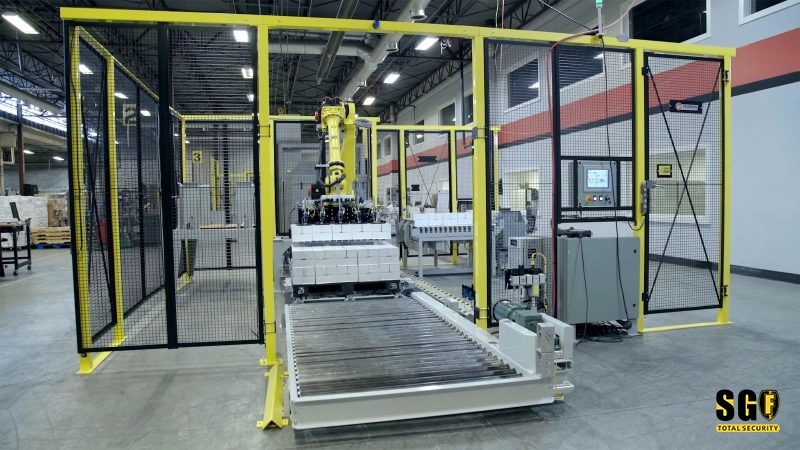
For large automation equipment, machine safety fencing is not only a guarding decision. It is a factory-layout decision. A narrow-slit 20×100 mm anti-finger-trap mesh can help an engineering team place the physical guarding solution much closer to the robot hazard zone—120 mm in the stated GBIM design—rather than losing valuable aisle and production space to a conventional 50×50 mm mesh arrangement that may require an 850 mm setback under the applicable ISO reach-distance calculation.
Why the Conventional 50×50 mm Mesh Creates a Space Problem
GBIM’s challenge is common in robot cell guarding: the equipment envelope is already large, while the forklift and pedestrian routes around it cannot simply be removed. With ordinary 50×50 mm wire mesh panels, the opening size can drive a larger calculated safety distance. In the stated design comparison, the fence must be held at least 850 mm from the danger point. Around a long automation cell, that perimeter quickly consumes floor area on every side, narrows material-handling routes, and reduces the usable production footprint.
| Layout consideration | Design implication for the GBIM project |
|---|---|
| Existing automation cell | Large equipment envelope requires a continuous machine perimeter guarding system without sacrificing access routes. |
| Conventional mesh | 50×50 mm openings may require an 850 mm setback in the applicable ISO reach-distance calculation. |
| Space at risk | Forklift and pedestrian safety routes become tighter, while several square metres of factory floor can be lost around each machine. |
| Targeted guarding geometry | 20×100 mm narrow-slit mesh supports a compact 120 mm design position in the stated application, subject to the complete risk assessment and applicable legal requirements. |
Product Fit: Narrow Openings, Defined Perimeter, Controlled Access
20×100 mm anti-finger-trap mesh for compact isolation
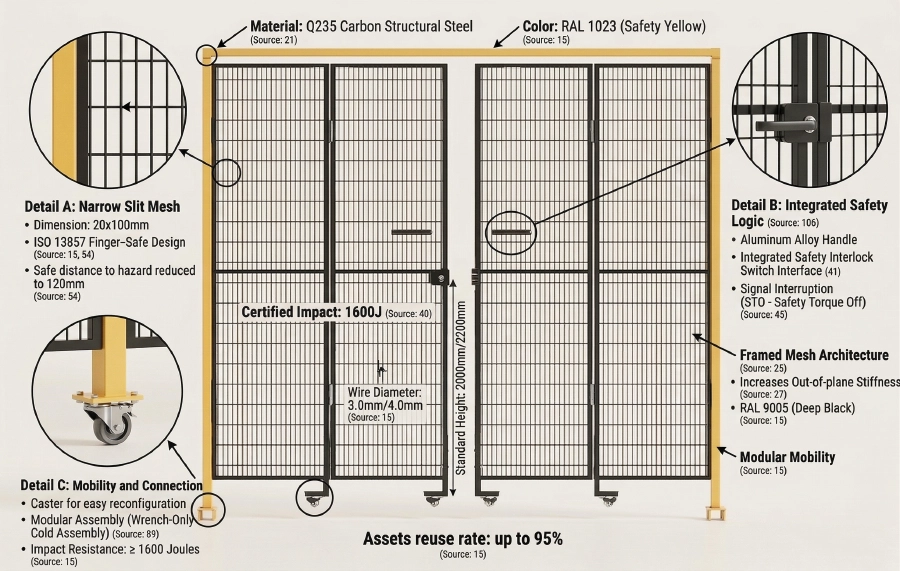
The key adaptation is the 20×100 mm extreme anti-finger-trap micro-mesh specified for this project. Its narrow dimension limits reach-through access toward moving robot mechanisms. That is the physical reason the design team can evaluate a much tighter guarding position. In the GBIM layout, the target is only 120 mm from the robot hazard source, compared with the 850 mm comparison distance for ordinary 50×50 mm mesh. The final distance remains an engineering responsibility: the complete robot safety assessment, opening measurement, hazard profile, and applicable ISO requirements must be checked before installation.
Safety gates that connect guarding with the risk-control system
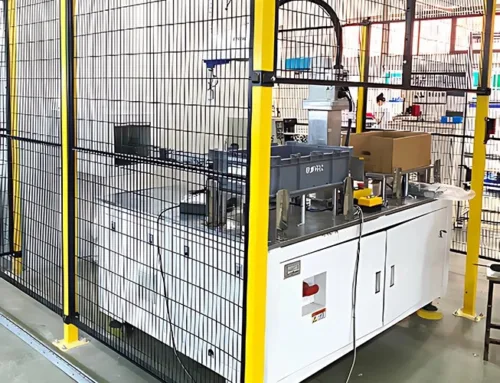
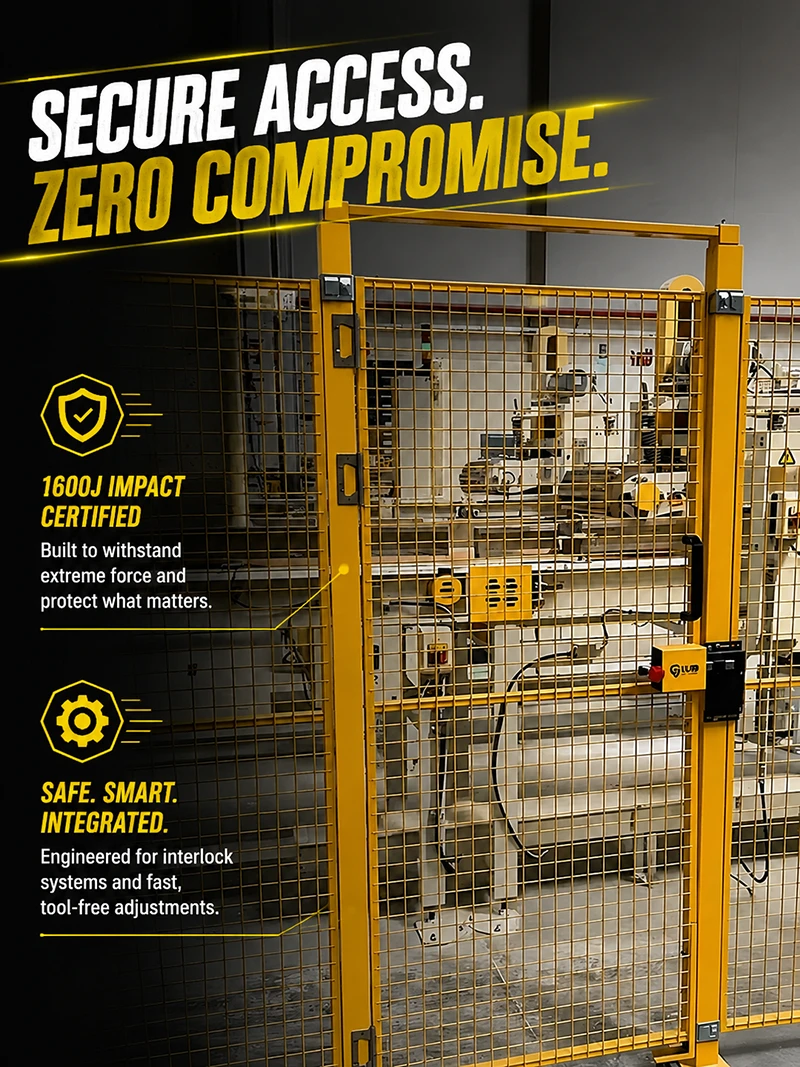
Compact machine guarding still needs a practical entry point for maintenance and changeover. The Mdfence system combines framed mesh gates with lock and interlock mounting provisions. The illustrated gate arrangement shows the access-control interface at the post, allowing the safeguarding design to be coordinated with safety interlock devices such as Omron D4NL or Pizzato FS series hardware where selected by the integrator. This supports controlled entry, clearer LOTO procedures, and less temptation for operators to bypass a poorly positioned or inconvenient gate.
Modular posts and bolted bases preserve future layout options
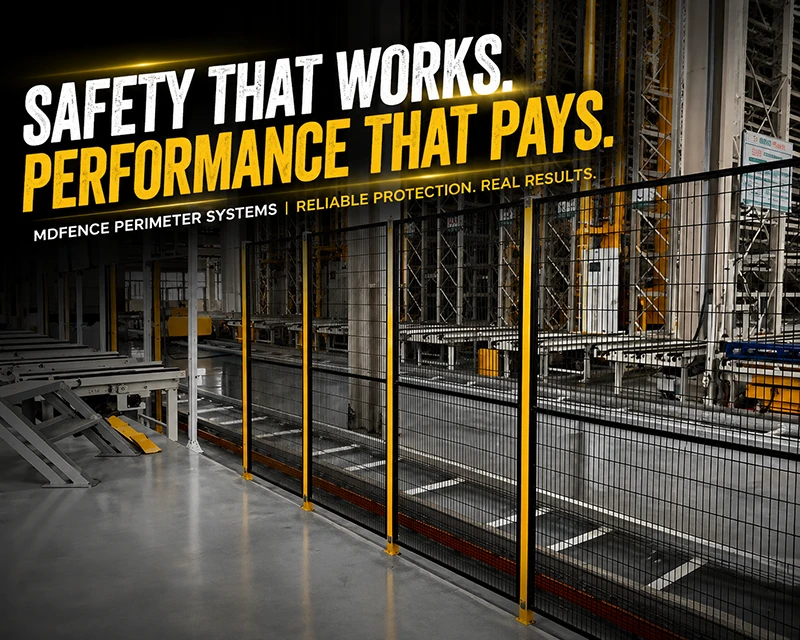
The space benefit is not limited to the initial installation. A modular safety barrier uses steel posts, framed mesh panels, floor-mounted base plates, and bolted connections rather than treating the entire guarding line as a permanent welded enclosure. The factory image shows the relationship between panels, posts, and the floor anchors around automation equipment. That configurable machine guard fencing can be extended, repositioned, or re-used when a dedicated manufacturing line changes. It also helps the project team separate robot cell guarding from adjacent forklift and pedestrian traffic with a defined, inspectable boundary.
Where the Compact Machine Guarding Approach Adds Value
- Robot cell guarding: Keep the enclosure close to the hazard boundary while maintaining a controlled hinged safety door and service route.
- Automated material handling safety: Protect conveyors, transfer points, and control cabinets without turning the surrounding forklift aisle into unused clearance.
- Machine perimeter guarding: Establish factory safety zoning around large CNC, assembly, welding, or palletizer cells with modular panels and fixed bases.
- Industrial automation safety: Give integrators a physical guarding layer that can be reviewed against OSHA machine guarding requirements, ISO 14120, and ANSI/RIA R15.06 robot safety expectations.
For GBIM, the commercial result is more than a smaller fence line. A compact automatic production cell can be offered to end customers with several square metres of expensive factory space preserved per machine. That recovered area can support a wider forklift route, an additional workstation, or future equipment capacity—an understated but substantial competitive advantage for the automation supplier.
What to Confirm Before Finalizing the Fence Position
Provide the robot layout, hazard points, access sides, door locations, material-flow routes, and the required safeguarding calculation. Then confirm the selected 20×100 mm mesh, panel height, Q235 carbon steel frame, 2.0 mm wall-thickness components where specified, RAL1023 yellow powder coating, gate hardware, and floor-fixing method. These details connect the space-saving objective to an auditable machine guarding safety fence design instead of relying on a generic panel size.
Plan a Smaller, Safer Automation Footprint
Send the robot cell drawing and the required clearance points. SGF can help map the narrow-slit mesh, safety fence posts, access gates, and interlock interfaces into a configurable guarding fence layout for review by your responsible safety engineer.