RU
RU  EN
EN  DE
DE  PT
PT  JA
JA  ES
ES  IT
IT Coastal port terminals · corrosion control
Salt-Spray Quay Terminals: Hot-Dip Galvanized Warehouse Guard Rails That Hold the Line Without Repainting
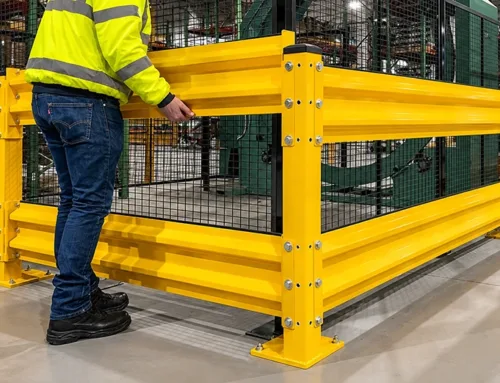
A container or bulk terminal is one of the harshest metal environments on an industrial site: salt spray carried on the wind, water thrown up along the quay edge, permanent high humidity, and a daily temperature swing that keeps condensation on every steel face. The vehicle routes, loading dock protection zones and pedestrian-vehicle separation lines in that yard need a physical steel barrier that is still there in year three, not a painted rail that has already lost its coating. Hsafety heavy duty guardrail is a bolted, floor mounted guardrail built on Q235 carbon steel corrugated rails, 1,000 mm high modules on 1,500 mm post spacing, with hot-dip galvanizing available as the finish. The finish is the decision that decides whether the barrier still functions after the first two salt seasons.
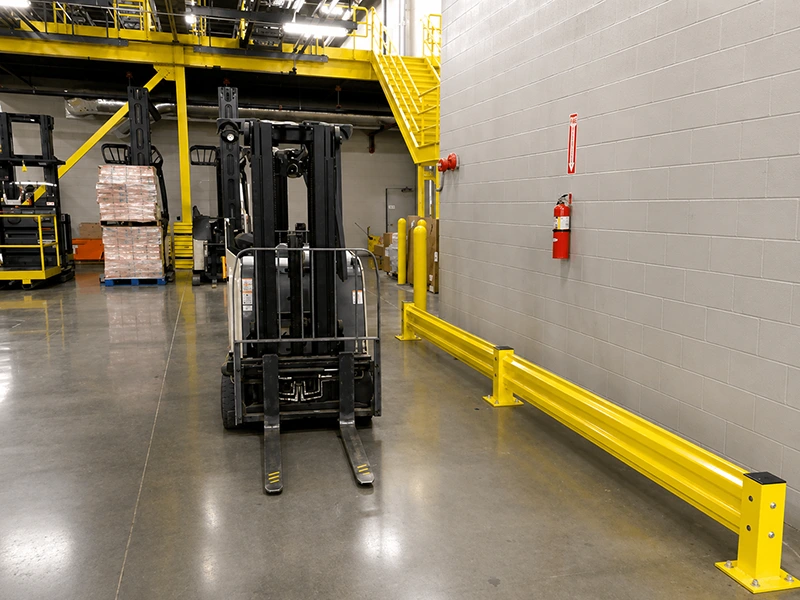
Why powder-coated rails fail first at a quay, and what changes with hot-dip galvanizing
The cheap specification in a coastal terminal is usually a powder coated guardrail or a site-painted steel pipe railing. Both rely on a film sitting on top of the steel. Salt spray gets under a chip or a bolt-scuff, moisture sits in the break, and the corrosion front runs along the rail from the inside. The paint lifts, the exposed steel weeps rust onto the apron, and the rail stops reading as a warning line just when the terminal needs it most. Maintenance is the second cost: repainting a live quay front means scaffolding, blasting, a paint window, and a section of the yard taken out of service. Meanwhile the rail is still a fixed obstacle for every tractor and straddle carrier in the fleet, so a weakened post is a struck-object and trip risk rather than passive protection.
Hot-dip galvanizing changes the mechanism rather than the colour. The steel is dipped in molten zinc, so the coating is metallurgically bonded to the base metal instead of sitting on a primer, and it protects the rail both as a barrier layer and by sacrificial action at cut edges, bolt holes and impact scratches. The practical result for a terminal is a hot-dip galvanized steel guard rail that does not depend on its paint film to stay in service, with a much smaller maintenance load than a repaint cycle. Reflective tape guard rail and post caps can be fitted where night operations and fog reduce visibility, and those accessories can be refreshed without recoating the beam.
| Specification item | Hsafety warehouse guard rails — coastal terminal reference |
|---|---|
| Материал | Q235 carbon steel guardrail (Q235 steel guardrail, welded and formed modular components) |
| Rail profile | Corrugated guard rail / W-beam guardrail profile, 2-rib or 3-rib thrie beam guardrail, single rail guardrail or double rail guardrail configuration |
| Rail geometry | Approx. 310 mm rail width, 85 mm wave height, 194 mm wave pitch (drawing revision to be locked before quotation) |
| Rail thickness | 3 mm or 4 mm |
| Module length | 1,500 mm standard panels, plus custom length guardrail panels (project records include 680 mm to 1,140 mm infill panels) to close a fixed run without a cut-and-weld splice |
| Post | 80 x 80 x 6 mm square post, 1,500 mm post spacing, post cap |
| Base plate | 160 x 160 x 16 mm guardrail base plate with anchor bolt guardrail fixing |
| Высота | 1,000 mm high guardrail, lower rail set above the apron for wash-down clearance |
| Отделка | Hot-dip galvanized finish as an option; powder coated guardrail with custom colour as an alternative for sheltered, inland areas |
| Visibility options | Reflective tape guard rail, yellow safety coating, LED warning board, end cap, blockout, bracket (options, to be confirmed per quotation) |
| Установка | Floor mounted installation; bolted guard rail system anchored into concrete, typically a slab of at least about 150 mm, confirmed against the terminal drawing |
Structure and finish decisions that keep a coastal barrier in service
At the quay the guardrail has to do two jobs at once. It has to survive the atmosphere, and it has to survive being hit. The layout below is a bolted configuration, which matters more in a salt environment than it does inland: a bolted guard rail system can be unbolted field-section by field-section, so a single deformed rail or scuffed post is replaced as a component, without welding or recoating the whole run.
Double corrugated rails on bolt-down posts, sized for a working apron
A double rail guardrail with 3 mm or 4 mm corrugated steel beams on 1,500 mm post spacing gives the yard one continuous 1,000 mm high steel line along the vehicle route. The corrugation is not decoration: the wave form stiffens the beam in the direction a tractor or forklift arrives, and it lets the rail deform locally while the flange and adjacent modules stay in place and keep separating the aisles. Every post carries a 160 x 160 x 16 mm base plate, so the load path goes down into the slab rather than sideways into a rack leg or a wall.
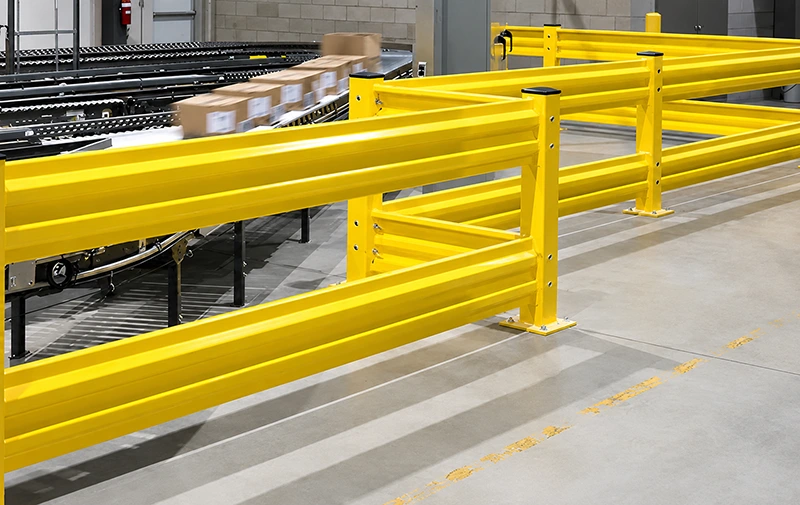
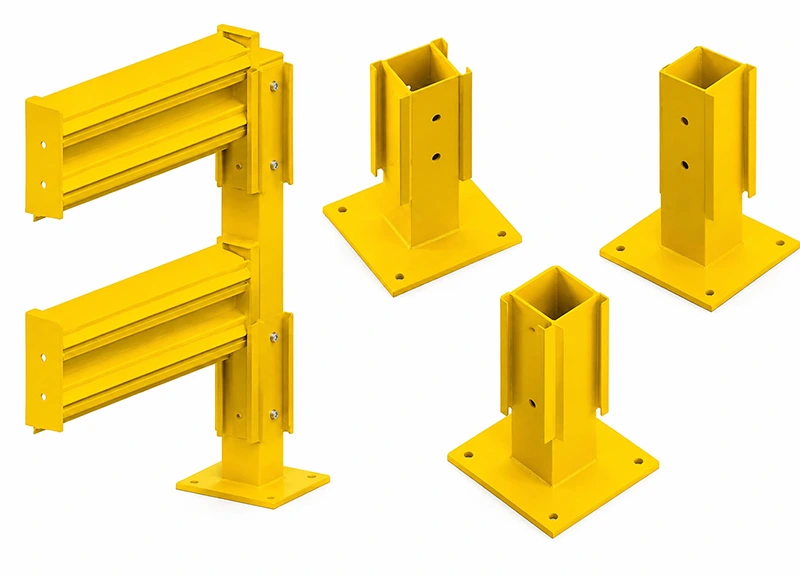
Component-level specification, so the finish is applied where it is exposed
Rails, posts, base plates, brackets and end caps are separate items, which lets the project specify the hot-dip galvanized finish on the components that stand in the weather and keep powder coating where a colour code or an operator visual standard is needed. A white-background component view makes the assembly easy to check at the quotation stage: number of beams, number of posts, base plate pattern, and how the infill panels close the odd metre at the end of a fixed berth length. It is also the drawing that shows a survey team exactly what has to be unbolted if a rail is replaced after an impact.
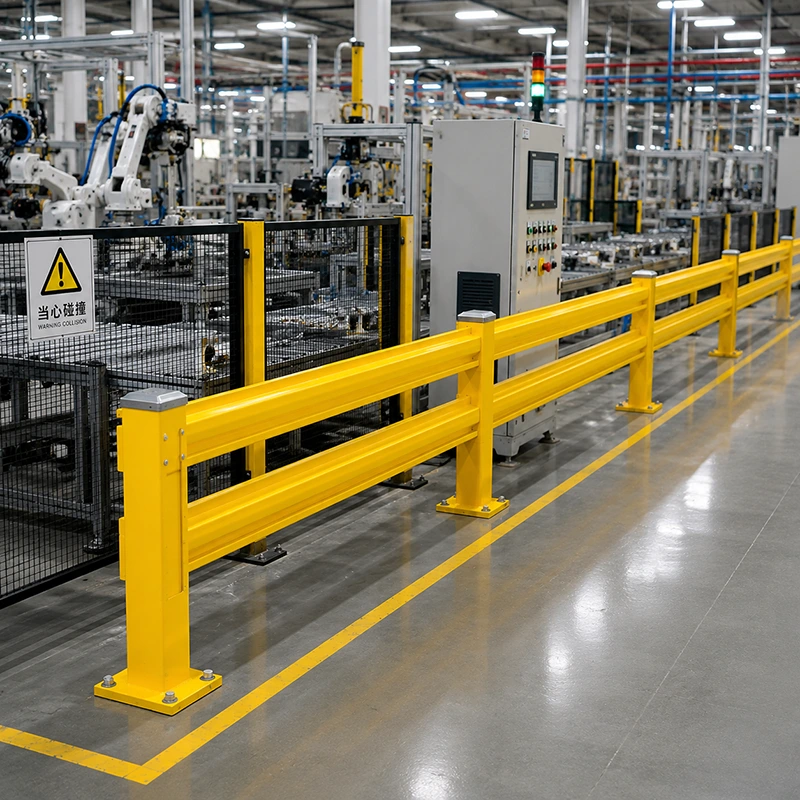
Anchored floor mounted installation, even where the rail runs past equipment
In a terminal the rail rarely runs in clean air. It follows a wall, a cable pit, a transfer point or a control cabinet, and it has to be installed without welding near live services. A floor mounted barrier that anchors with expansion bolts into the concrete and bolts the beams to the posts keeps hot work out of the installation, which is what makes a retrofit possible during a normal working window instead of a shutdown. The same configuration carries across equipment isolation barrier and machine guarding barrier applications where the yard and the maintenance workshop share a slab.
Two limits should be stated plainly before a quotation is issued. Hot-dip galvanizing is an option on this system, not a default, and Hsafety does not publish an independently certified salt-spray cycle or a coastal service-life figure. The coating specification, coating mass and any test evidence have to be confirmed against the project drawing and the buyer’s own acceptance criteria. Impact performance is the same story: the rails are built to deform and absorb, but rated collision protection has to come from an engineering check for the actual vehicle mass, speed and approach angle at that berth.
Where hot-dip galvanized guard rails earn their place at a port terminal
- Quay-edge and apron vehicle routes: a continuous industrial guard rail line between tractor lanes and the area where lashers and tally clerks stand.
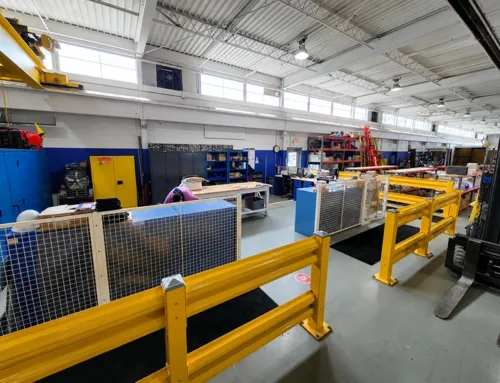
- Loading dock protection and ramp approaches, where reversing trailers and yard trucks repeatedly touch the same boundary.
- Rack end protection and rack uprights in the shed, keeping a steel barrier between a lift truck and a load-bearing column.
- Pedestrian-vehicle separation on walkways between the gate, the shed and the welfare block, where painted lines alone are not a boundary.
- Equipment isolation barrier around control cabinets, cable pits, transformers and pipework that cannot be relocated away from traffic.
- Outdoor storage and empty-container areas where a steel guard rail has to stay legible under reflective tape and post caps at night.
For a terminal, the value is not in one rail. It is in a repeatable specification that can be rolled out berth by berth, so the maintenance team holds one spare set of beams, posts and base plates instead of a set for each brand of barrier on site. That is where a hot-dip galvanized, bolted, modular guardrail starts to beat the cheapest first quote: fewer repaint campaigns, less coating breakdown to chase, and a barrier that still reads as a boundary after the third winter of salt.
What to send us with the terminal layout
Send the yard drawing with the run lengths and the exposure note: distance from the water, whether the rail sits at the quay edge or inside a shed, the slab thickness and finish, and the vehicle class using the route. Mark which runs need a hot-dip galvanized finish and which can stay powder coated, and note any run that must open for access or be lifted out for a crane or a container move. We will return a component layout with post spacing, base plate pattern, custom infill panel lengths, and the finish schedule to be confirmed against your specification.
Decide the finish before the first salt season, not after the first repaint
A terminal barrier specification that starts with the corrosion environment ends up costing less to keep than one that starts with the lowest rail price. Hot-dip galvanized corrugated steel guard rails, bolted modular assembly, floor mounted anchoring, and 1,500 mm modules with custom-length infill give the yard a boundary it can maintain component by component. Ask for a layout review on your own berth drawing and we will state exactly which parts are galvanized, which are powder coated, and what still has to be verified on site.