RU
 EN
 DE
 PT
 JA
 ES
 IT
ISO 13857 safety distance · machine guarding fence
Где на самом деле проходит линия ограждения: сетка 20 x 100 мм и обеспечиваемый ею отступ 120 мм
EHS reviews stall on one question: how far must the industrial safety fencing sit from the hazard? For a 20 x 100 mm finger safe mesh, the reach-through table in ISO 13857 returns a 120 mm safety distance. That number is derived from the opening, not chosen on site — and it is a floor, not a universal offset. Here is the derivation order, and the point where 120 mm stops applying.
Most guarding quotes arrive with a mesh photo and no opening dimension. The EHS team still has to sign a distance, so the fence gets pushed back by feel — usually a full metre — and the aisle, the AGV path or the maintenance walkway pays for it. Two weeks later the layout is reworked, or the panel is cut and welded on site and the drawing no longer matches the floor. On a tight line, that habit is what turns a guarding package into a layout problem and a source of unexpected production line downtime during installation.
Ширина проема, часть тела, которая может проникнуть, затем безопасное расстояние
Порядок имеет значение. Сначала считывают размер проёма, затем определяют часть тела, которая может пройти через него, и только после этого считывают расстояние. Отсчёт от уже понравившегося расстояния приводит к спецификации панелей, проёмы которых не выдерживают соответствующего значения. В строках ниже указанная последовательность соблюдена для типовых диапазонов ширины проёмов; местные редакции ISO 13857 и оценка риска всегда имеют приоритет над сводной таблицей.
| Ширина проёма | Часть тела, проходящая через проём, и соответствующее расстояние |
|---|---|
| 4 мм или меньше | Только кончик пальца; допустимое смещение составляет несколько миллиметров. Защита от касания обеспечена, но открытой площади слишком мало для видимости и воздухообмена на производственном участке. |
| От 4 до 6 мм | Кончик пальца; смещение остаётся в пределах первых десятков миллиметров. Ни для перчатки, ни для выполнения работы места нет. |
| От 6 до 8 мм | Пальец до первого сустава; смещение около 20 мм. |
| От 8 до 10 мм | Палец до первого сустава, более глубокое проникновение; требуемое расстояние увеличивается до значения 80 мм. |
| от 10 до 12 мм | Палец до первого сустава и часть кисти; диапазон 100 мм. |
| от 12 до 20 мм | Первый сустав пальца и часть кисти; в таблице указано 120 мм. В верхней части этого диапазона расположен паз 20 x 100 мм. |
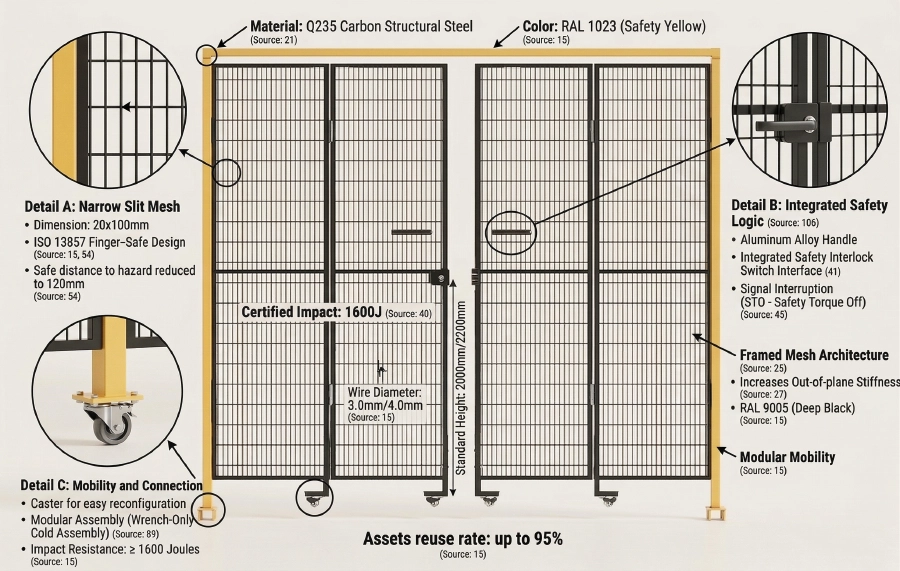
| Панель с пазом 20 x 100 мм | The 100 mm length is not the dimension the table reads — the 20 mm width is. Insertion stops at fingertip level, no hook and no grip, so the offset floor is 120 mm. |
| Паз шире 20 мм | В той же таблице за диапазоном 120 мм следующее допустимое расстояние составляет несколько сотен миллиметров. Панель с широким проёмом — это не более дешёвое средство защиты, а необходимость соблюдать увеличенное расстояние. |
Три детали, от которых зависит, сможет ли планировка обеспечить минимальное расстояние 120 мм
Узкий паз служит для обеспечения безопасного расстояния, а не является элементом визуального оформления
Only the narrow dimension of an opening is read against the reach-through table. A 20 mm wide slot admits the fingertip and stops before the first joint, so there is nothing to hook a finger behind and no grip to pull a hand towards a nip point. Run that 20 mm down the table and 120 mm is the permitted offset — a number you can put in a signature block next to a drawing number. The 100 mm length is what buys the sight line: the operator can watch the tool, chip and coolant stay in the cell, and the panel still behaves like a physical guarding solution rather than a solid wall. Wire diameters of 3.0 mm and 4.0 mm in a Q235 carbon steel frame keep the open area and the stiffness in the same panel.
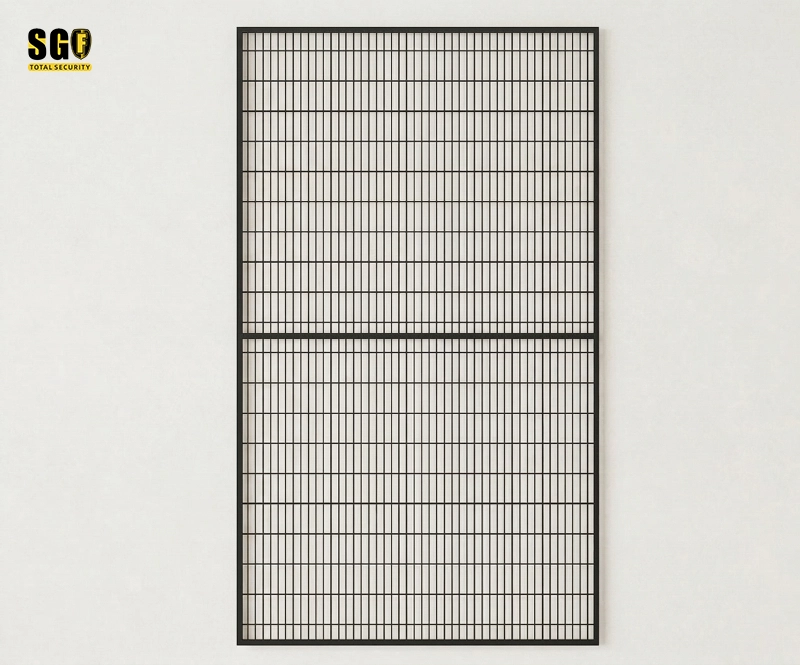
Именно стабильная геометрия панелей обеспечивает корректность расчетного значения.
An offset is only true for the opening as built. Posts are 60 x 60 mm square tube at 2.0 mm wall, base plates are anchored with expansion bolts into the slab, and every mesh panel is captured top and bottom by fixing rings instead of hanging from one clamp. Flat full weld with the bead dressed flat matters here for a second reason: the slot band has no burr for a glove or a wrist to catch on. A post that leans, or a frame that deflects under a pallet truck nudge, opens a 20 mm slot into a hand-sized gap — and the 120 mm you signed is no longer the distance in front of the hazard. That is the failure mode that hides until commissioning.
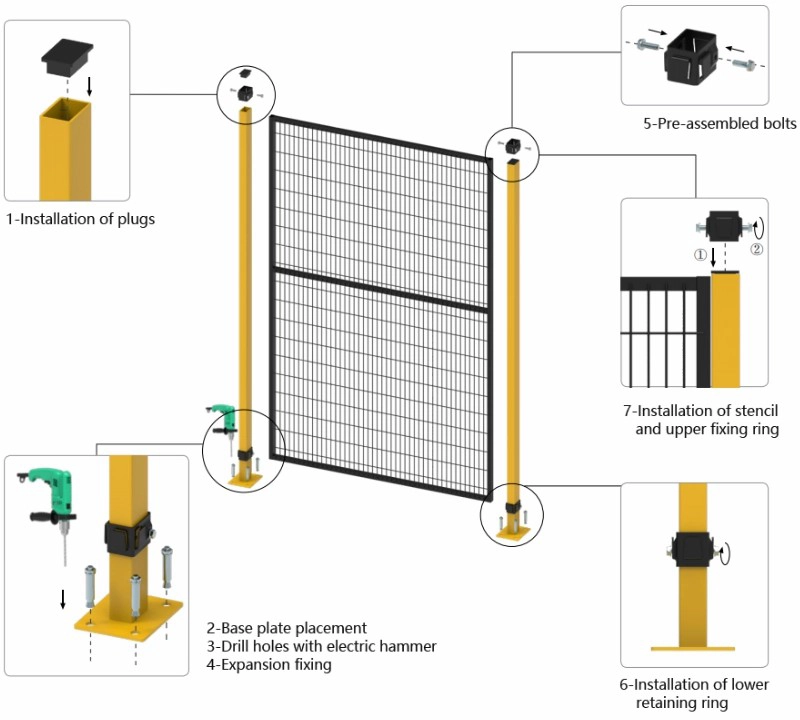
Сетка, безопасная для пальцев, не отменяет ни проверку высоты, ни проверку возможности перехвата через верх ограждения.
A 20 x 100 mm aperture answers exactly one question: reach through. It says nothing about reach over the top of the guard, reach around the end of a run, or reach through a hinged safety door. Those depend on how high the hazard sits above the floor and on the posture the task forces, which is why standard heights of 2000 mm and 2200 mm are a starting point and not a specification. A cell with a low nip point on a conveyor is a different conversation from one with a spindle at chest height, and the gate opening needs its own distance plus its own interlock. Where forklift or AGV traffic shares the aisle, panel impact resistance — rated at 1600J on these panels — belongs in the same review, because a deformed panel changes the geometry that the distance was calculated from.
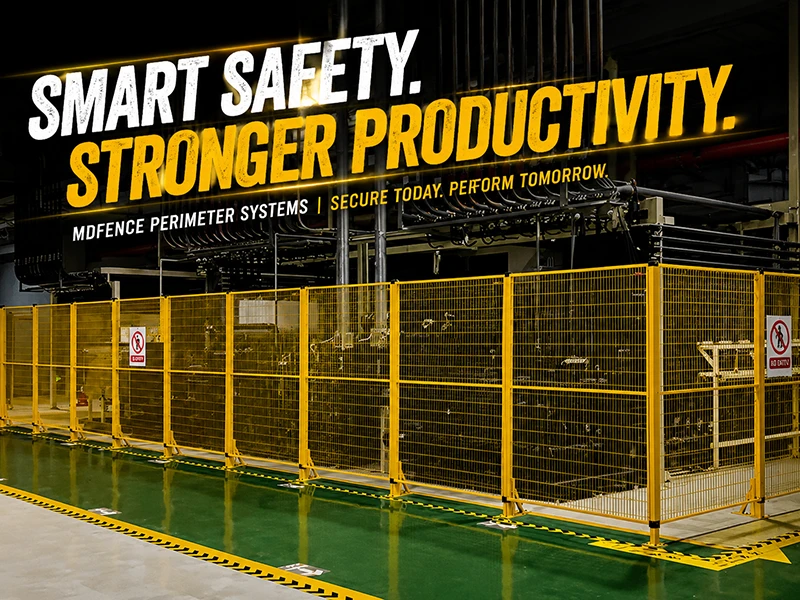
Где отметка пола 120 мм меняет планировку
- Ограждение роботизированной ячейки на линии, где разница между 120 мм и метром определяет, поместится ли вторая ячейка в проходе.
- Изоляция систем автоматизации и оборудования в ячейках, планировка которых была выполнена до установки ограждений.
- Защитные ограждения станков с ЧПУ и ограждение периметра станка, где оператору по-прежнему необходимо видеть инструмент через панель ограждения.
- Защитное ограждение конвейерной линии и защитное ограждение паллетоукладчика с низко расположенными местами зажима: здесь определяющей является проверка высоты, а не проверка параметров сетки.
- Защитное ограждение прессового цеха и защитные ячейки сварочного цеха, где блокируемая дверь является фактической границей защищаемой зоны.
- Защита складских стеллажей и интеллектуальное зонирование склада, где модульный защитный барьер должен допускать изменение конфигурации, а не требовать подрезки и повторной сварки.
Achieving equipment safety isolation in limited space is mostly an arithmetic exercise done early, with the opening, the body part and the distance written in that order. Compared with welded safety fencing, a modular frame keeps that arithmetic editable: move a run, add a panel, and the documented opening stays the same, so the distance does not have to be re-derived from scratch. This is the practical side of the modular vs welded safety fencing decision — not installation speed alone, but whether the safety distance survives the next layout change.
Сначала CAD: модель, перечень модулей на основе чертежей, таблица расчета расстояний.
Send the cell drawing or a marked-up photo of the equipment. You get the STEP and DWG models for posts, mesh panels, gates and base plates; a bill of materials generated from the drawing rather than typed by hand, with post count, panel modules, gate kits and anchor quantities; and the reach-through distance that the chosen opening supports, listed per run. Dropped into CAD before steel is ordered, that package shows the interference with conveyors, cable trays and door swing while it is still a modelling problem — which is the point where engineering hours are cheap and layout changes cost nothing on site.
Отправьте план компоновки и получите линию ограждения
Share the drawing with the hazard locations marked. We return the panel choice with its opening width, the ISO 13857 safety distance that opening supports, the height that closes the reach-over path above your hazard, and a numbered module list for the CAD check — so the number you sign is one you can defend at commissioning.