RU
RU  EN
EN  DE
DE  PT
PT  JA
JA  ES
ES  IT
IT WAREHOUSE FORKLIFT IMPACT PROTECTION
3-реберное ограждение для защиты торцов стеллажей: как складские команды сокращают простои из-за столкновений с вилочными погрузчиками
A 3-rib guardrail gives warehouse safety barrier planning a defined steel boundary around rack ends, walls, and equipment. For facilities dealing with repeated forklift contact, Hsafety combines corrugated steel beams, bolt-down posts, and custom lengths to protect assets and reduce accident downtime.
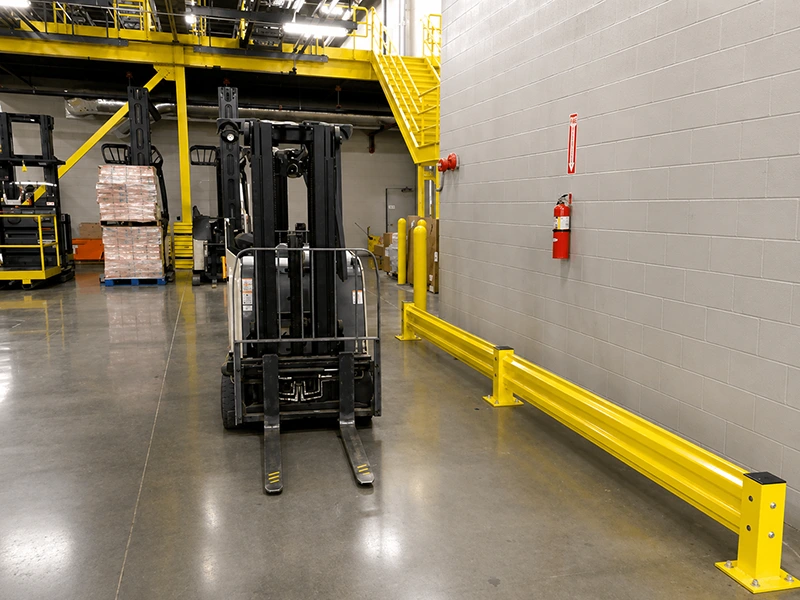
Why a warehouse needs more than a visible warning line
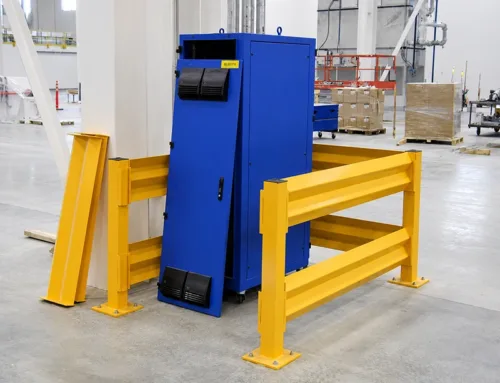
In a distribution center, a forklift does not need to strike a rack upright at high speed to create a costly event. A small steering error at an aisle end can bend a rack post, damage stored inventory, hit a wall, or disable a conveyor and its controls. The result is not only an asset repair bill. It can be a blocked aisle, emergency unloading, and production or dispatch downtime.
Steel pipe railing fabricated on site often creates uneven geometry and depends on welding, cutting, and repainting. Concrete bollards occupy isolated points rather than forming a continuous boundary. Rope or strap barriers provide visual separation but cannot provide meaningful collision protection. These older approaches leave gaps precisely where operators need a physical workplace safety barrier.
Hsafety is designed as an external protection layer. It sits outside the protected rack, machine, electrical cabinet, wall, or loading dock route, while a separate machine safety fence can handle internal machinery hazards. This division keeps the warehouse guardrail focused on forklift impact protection and pedestrian-vehicle separation.
| Требование проекта | Hsafety guardrail response |
|---|---|
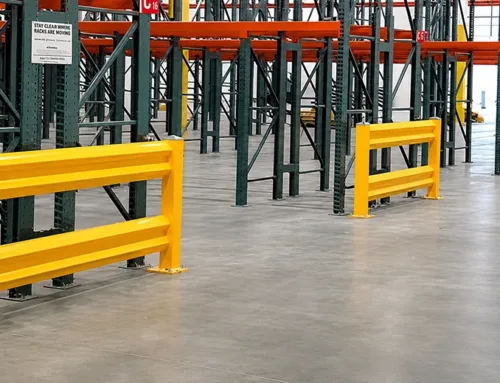
| Rack ends and structural posts exposed to forklifts | Double-rail or 3-rib guardrail configurations create a continuous steel guard rail in front of the impact zone. |
| Several protection runs with different dimensions | Modular bolted guard rail system with standard and custom-length guardrail sections. |
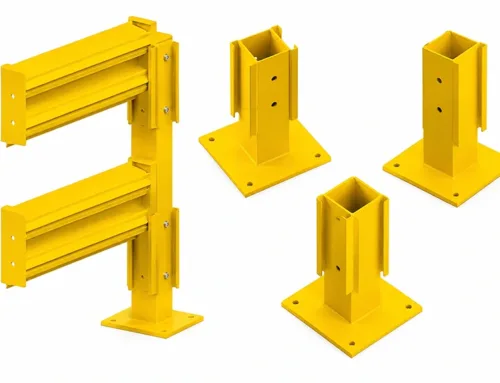
| Concrete floor installation without field welding | Square posts, base plates, anchor bolts, and floor-mounted installation for bolt-on assembly. |
| Cold storage, outdoor, or coastal exposure | Hot-dip galvanized steel is available for higher corrosion resistance and lower maintenance. |
| High-visibility traffic routes | Yellow safety coating, custom colors, and reflective tape guard rail options can support site visibility. |
Structure and project evidence behind the selection
Corrugated beams form a steel impact boundary
The corrugated profile adds formed ribs across the Q235 carbon steel beam, creating a defined load-bearing barrier rather than a flat sheet. Hsafety can be discussed as a 2-rib W-beam or 3-rib thrie-beam guardrail, with single-rail and double-rail layouts selected according to the risk area and engineering review. The product brief lists 3 mm and 4 mm thickness options; the 4 mm option is the relevant choice when the project calls for a heavier steel guard rail.
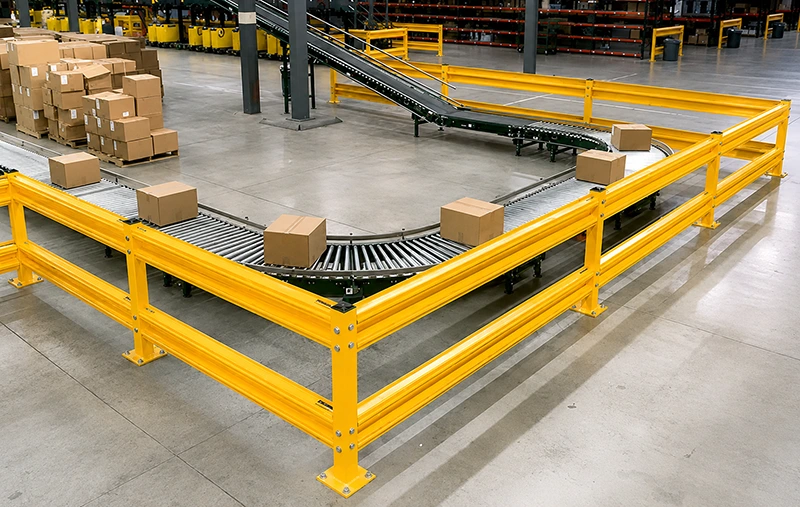
Custom lengths prevent weak geometry at rack ends
Protection should follow the asset edge, not stop at the nearest standard module. In documented custom case 15176, four runs measured 17,000 mm, 12,000 mm, 17,100 mm, and 11,900 mm at a common 1,000 mm height. The bill used 1,500 mm standard sections plus eight special sections from 680 mm to 1,140 mm, producing 72 beams and 42 posts. This is how a modular guardrail can close out multiple warehouse zones without forcing an oversized gap or an improvised site cut.
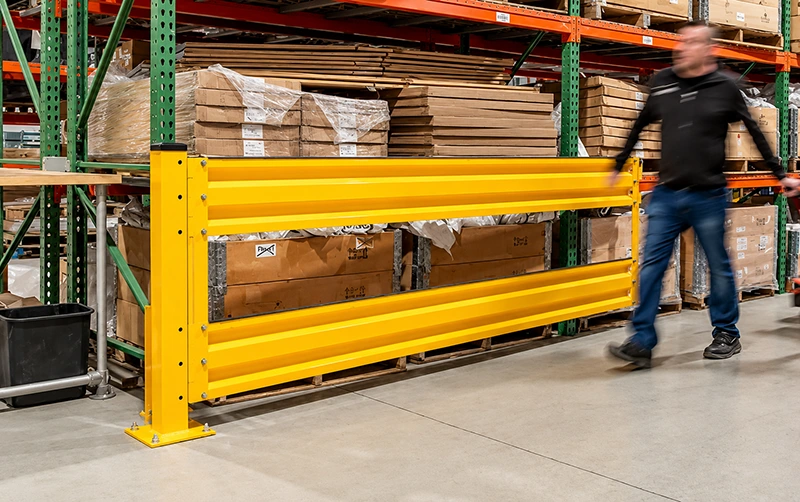
Posts and base plates transfer the boundary to the floor
In the same 15176 design, the 1,000 mm system used 80 × 80 × 6 mm square posts and 160 × 160 × 16 mm base plates. The 16 mm base plate is a substantial, heavy-duty option for a project that specified a 3-ton forklift at 10 km/h and a target load of approximately 16,680 N. That figure is a project design condition, not an independent impact certification; final anchor selection, concrete condition, spacing, and collision assessment must be confirmed against the site engineering requirements.
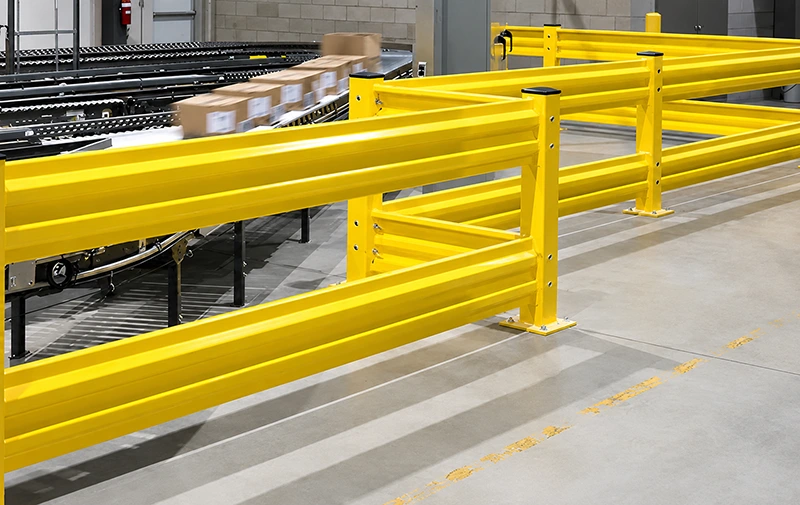
Where this warehouse safety barrier fits
- Rack end protection: shield pallet-racking uprights and the first bay at aisle entrances.
- Equipment isolation: create an asset protection guardrail around conveyors, electrical cabinets, pipework, robots, and production-line equipment.
- Защита погрузочных доков: define vehicle routes near dock edges, walls, and staging areas.
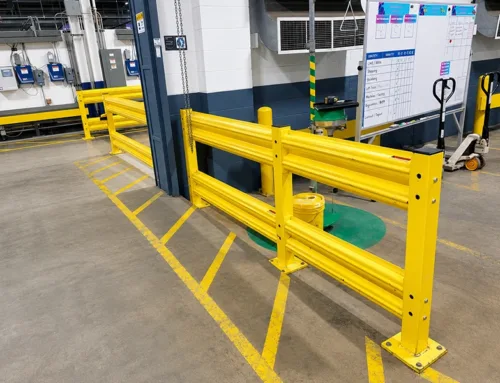
- Pedestrian-vehicle separation: establish a visible boundary between forklift areas and walking routes.
- Cold storage and humid sites: consider a hot-dip galvanized finish where condensation, outdoor exposure, or coastal air increases corrosion risk.
The visible yellow finish helps operators read the boundary, while the floor-mounted, bolted arrangement supports planned maintenance and section replacement. For lower-light areas, reflective tape guard rail options can be specified. Hsafety is a warehouse and industrial guard rail system, not a highway guardrail; outdoor or higher-energy applications require separate engineering selection.
Specify the guard rail around the asset, not just the aisle
Before quotation, provide the protected asset, forklift approach direction, required height, each straight or corner run, concrete floor condition, preferred rail configuration, finish, and access points. The design team can then match 3-rib guardrail, double rail guardrail, post spacing, custom length guardrail sections, base plates, brackets, end caps, and optional lift-out points to the actual layout. This keeps the product choice tied to collision protection instead of a generic barrier count.
Turn repeated forklift contact into a controlled protection plan
Send your rack, equipment, loading dock, or conveyor dimensions to review a Q235 steel guardrail layout with the appropriate thickness, post spacing, anchoring, and surface treatment. Hsafety can help convert irregular site measurements into a continuous warehouse guard rails system that protects assets and helps reduce accident downtime.