RU
RU  EN
EN  DE
DE  PT
PT  JA
JA  ES
ES  IT
IT 
Let’s talk about a specific kind of frustration. It’s the feeling a maintenance manager gets when they realize that to perform a critical 2-hour repair, they must first schedule a 4-hour job for a crew to unbolt and remove a section of “permanent” safety railing.
It’s the feeling a safety officer has when they see that same railing, now removed, leaving a gaping, unprotected hole next to an active forklift aisle for the entire day.
This is the “all or nothing” dilemma that many facilities face. For the sake of absolute safety, we install robust, bolted-down guardrails around our most critical equipment and operational zones. We do this for good reason. But in doing so, we inadvertently create a rigid system that clashes with the dynamic, ever-changing needs of maintenance, equipment change-outs, and material staging.
The result is a constant, low-level conflict between the teams responsible for safety and the teams responsible for operational uptime. We are forced into a series of bad compromises: Do we sacrifice efficiency for safety, or do we create temporary safety gaps for the sake of efficiency?
What if this entire premise is flawed? What if the problem isn’t that safety and efficiency are in conflict, but that we are using a one-dimensional tool to solve a three-dimensional problem?
Defining the “Ideal” Solution Before Seeking It
Before we look at any specific product, let’s act as engineers and define the characteristics of a perfect solution for an area that needs both steadfast protection and periodic access. What would it look like?
Uncompromising Security in its “Closed” State
The “removable” section, when in place, must provide the exact same, verifiable level of impact protection as its permanently fixed counterparts. There can be no weak link in the chain. Safety must be absolute, not approximate.
Effortless Transition in its “Open” State
The process of opening the access way should be simple, fast, and require minimal—or ideally, zero—tools. It should be a one-person job that takes minutes, not a team-based project that takes hours. Any barrier to removal will simply encourage unsafe workarounds.
Long-Term System Integrity
The mechanism that allows for removal must be incredibly durable. It cannot be a flimsy latch or a pin that wears out over time. It must be an industrial-grade component that withstands hundreds of open-close cycles without degrading the system’s overall structural integrity or protective capability.
When we use these three principles as a scorecard, the common “compromises” we see in facilities today fall short. A gap closed by a chain fails principle #1. A fully bolted section fails principle #2. A lightweight, temporary gate often fails principle #3.
The Power of Modularity: Introducing Engineered Flexibility
The only way to satisfy all three principles simultaneously is to move away from a “one-size-fits-all” installation and embrace a modular, systems-based approach.
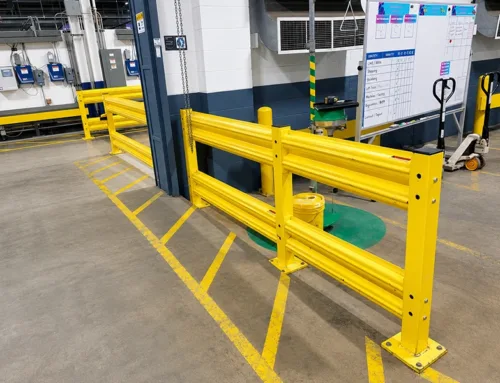
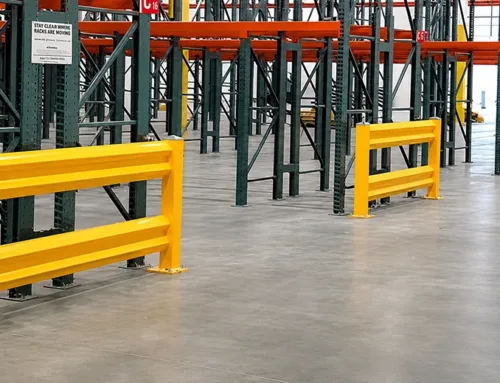
An intelligent safety barrier system is not just a collection of posts and rails. It is a toolkit of compatible components designed to solve specific problems. In this model, your baseline protection is the standard, тяжелое ограждение. It is the foundation of your safety perimeter, providing the permanent, impact-rated protection your facility requires.
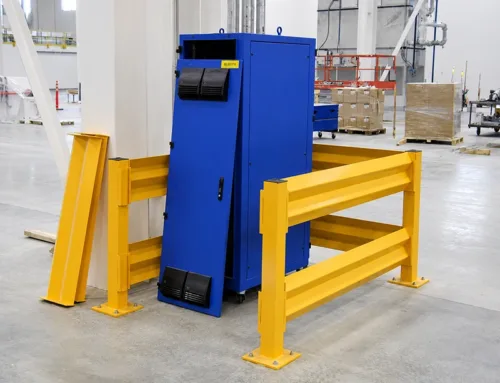
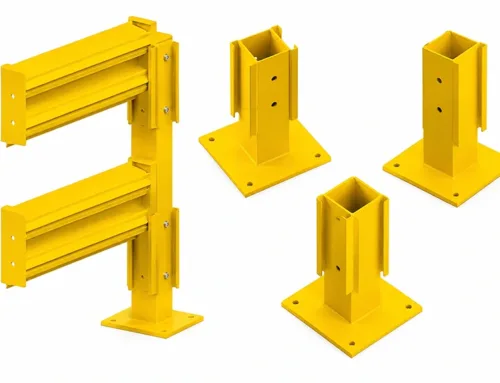
But for that specific 12-foot section in front of the main hydraulic press in your Houston facility, you integrate a Lift-Out rail section. This component uses the same robust posts and identical high-strength rails. The only difference is the connection point. Instead of being bolted directly to the post, the rails rest securely in heavy-gauge steel brackets that are themselves bolted to the post.
This design is not a compromise; it is an elegant solution.
- It satisfies Principle #1 because the тяжелое ограждение and post system remains the same, engineered to absorb the full impact force.
- It satisfies Principle #2 because a worker can simply lift the rail vertically out of the brackets to create an instant, wide-access path.
- It satisfies Principle #3 because the components—the solid steel brackets and rails—are designed for industrial longevity, with no complex mechanisms to wear out.
Stop Choosing and Start Designing
The chronic conflict between safety and operational access is not a problem you have to live with. It is a design challenge that has already been solved.
The solution is to stop thinking of your safety barrier as a monolithic fence and start thinking of it as a dynamic, modular system. By strategically combining permanent, bolted-in sections with tool-free, lift-out sections where needed, you can finally resolve the dilemma.
You can have absolute, engineering-grade safety every minute of every day, and you can have efficient, on-demand access without ever compromising that safety. You simply need the right tools for the job.