RU
RU  EN
EN  DE
DE  PT
PT  JA
JA  ES
ES  IT
IT 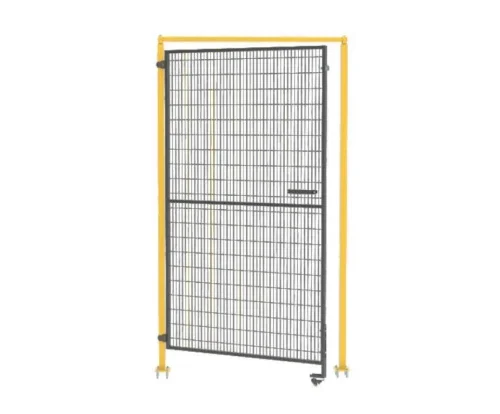

|
Tired of nuisance trips shutting down your high-speed assembly lines? In automated automotive manufacturing, optical sensors like light curtains only sense danger—they don’t stop it. When a CNC machining center throws a broken tool, or an AGV strays too close to a robotic welding station, light curtains won’t stop the physical impact. You need a hard perimeter that guarantees Safe Torque Off (STO) compliance while containing 1600 Joules of kinetic energy, ensuring your cycle times and personnel remain completely protected. |
The Illusion of Invisible Protection in Robotic Cells
For system integrators designing turnkey solutions, safety is non-negotiable. While light curtains are excellent for high-frequency manual loading stations, relying on them as the primary perimeter for a 6-axis industrial robot or a high-speed mechanical assembly machine is a critical engineering flaw. Optical sensors create an invisible boundary, but the hazards in an automotive plant are highly physical.
Physical Containment vs. Optical Sensing
The Assembly Line Pain Point (Before): Imagine a heavy payload slipping from a robotic gripper, or a weld spark flying from an automated automotive welding station. A light curtain will detect the breach and trigger an emergency stop, but the 200 lb flying metal part will pass right through the optical field, posing a lethal threat to operators in the adjacent material handling area. Furthermore, a rogue forklift in the warehouse AGV path can easily crash through an optical boundary, destroying a $100,000 robotic arm.
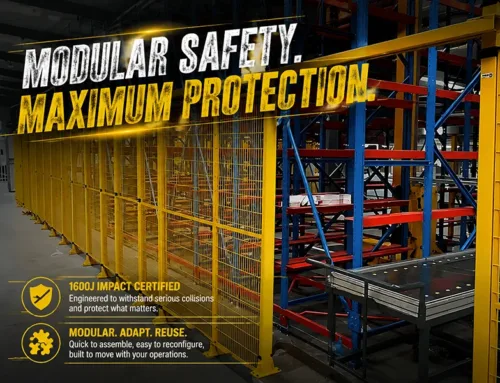
Our Engineering Logic (Why it works): To truly isolate automated production lines, you must deploy a physical Промышленные защитные ограждения system. The Mdfence system is engineered from Q235 cold-rolled carbon steel. Unlike flimsy aluminum profiles that snap under pressure, our framed panels feature a 20x30x1.5mm tubular steel frame with fully flattened welded wire mesh. This structural integrity is TUV-certified to absorb and dissipate up to 1600 Joules of impact energy.

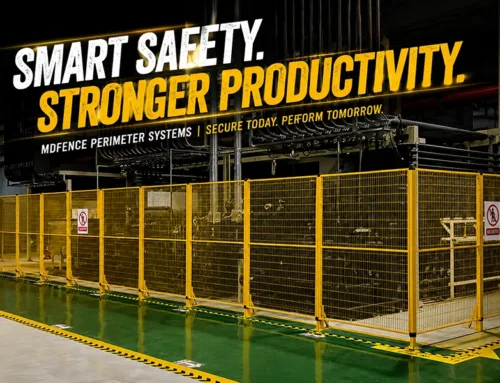
The Actual Benefit (After): Kinetic energy is contained within the cell. If a machine malfunctions, the shrapnel hits the Q235 steel mesh and drops to the floor. If a forklift miscalculates a turn, the heavy-duty 60x60mm posts (anchored by M10x70mm expansion bolts) take the hit, protecting your expensive automation equipment and keeping workers entirely out of harm’s way.
Eliminating Nuisance Trips to Maximize OEE
The Assembly Line Pain Point (Before): In a precision machining environment, coolant mist, flying metal chips, or even a worker brushing past the work cell can accidentally trip a light curtain. Every false trip sends a fault signal to the PLC, stopping the servo motors mid-cycle. Resetting the cell takes 10 to 15 minutes. In an automotive plant where every minute of downtime costs thousands of dollars, these “nuisance trips” devastate your Overall Equipment Effectiveness (OEE).
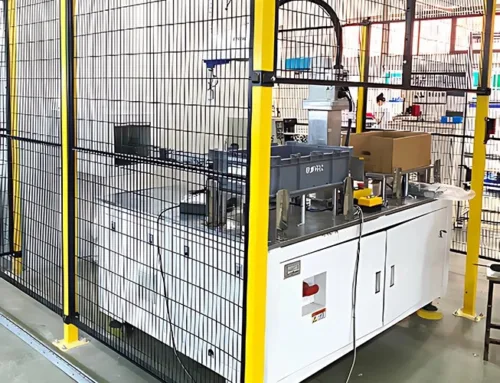
Our Engineering Logic (Why it works): Implementing Системы защиты машин establishes an unambiguous hard boundary. The Mdfence system utilizes a tight 20x100mm (0.78″ x 3.93″) mesh design. According to ISO 13857 standards for reach distances, this anti-climb, finger-safe aperture allows the fencing to be installed as close as 4.7 inches (120mm) to the hazard.
The Actual Benefit (After): You eliminate 100% of accidental sensor trips. The machine only stops when a technician intentionally opens an interlocked door. Furthermore, the 120mm clearance shrinks the required footprint of the robotic cell, freeing up valuable square footage for wider AGV paths or additional manufacturing lines.
Seamless Safety Interlock Integration for Turnkey Solutions
The Assembly Line Pain Point (Before): When system integrators use cheap, locally welded wire mesh, mounting safety switches (like Omron D4NL or Pizzato) becomes a nightmare. Installers have to drill into the posts on-site, destroying the powder coating and leaving raw steel exposed to rust. Over time, the frameless doors sag, causing the actuator keys to misalign with the safety switches. The result? The PLC refuses to clear the safety circuit, and the robot won’t start.
Our Engineering Logic (Why it works): Premium Панели ограждений для защиты машин must act as active components of your control system. Mdfence provides pre-engineered lock carriers specifically designed for industry-standard electronic interlocks. Our doors—whether hinged or sliding—are framed with rigid tubular steel and utilize heavy-duty caster wheels or top-bearing rails to prevent sagging.

The Actual Benefit (After): Zero on-site drilling. Zero hot work. The safety switches bolt directly onto the pre-fabricated mounting plates, ensuring perfect alignment for the life of the machine. Your commissioning time drops significantly, and the end-user gets a highly reliable STO safety circuit that never faults due to mechanical sagging.
Light Curtains vs. Physical Fencing: A Quick Comparison
| Характеристика | Optical Light Curtains | Mdfence Physical Guarding |
|---|---|---|
| Ударопрочность | 0 Joules (No physical barrier) | 1600 Joules (Stops 200 lbs at 12 mph) |
| Сдерживание обломков | Fails to stop weld sparks or CNC chips | Fully contains flying mechanical parts |
| Nuisance Trips | High (Triggered by dust, coolant, shadows) | Zero (Requires physical door opening) |
| Footprint Efficiency | Requires large calculation distance based on approach speed | Can be installed just 4.7 inches (120mm) from the hazard |
The Smart Hybrid: Integrating Fencing with Conveyors
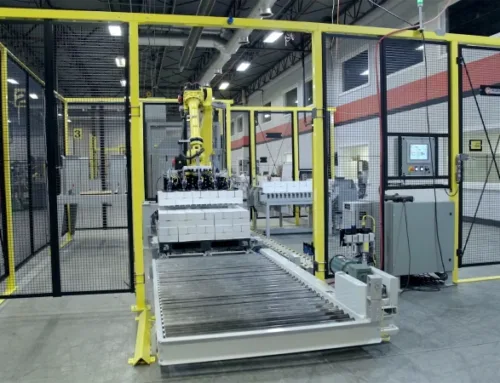
We don’t suggest eliminating optical sensors entirely. The most robust automated production lines use a hybrid approach. For areas where raw materials continuously enter the cell via conveyors, Защитные ограждения для роботов can be customized with “Tunnel Guards.” The physical fence covers 95% of the perimeter, while light curtains are mounted directly onto dedicated 80x80mm fencing posts at the conveyor infeed, allowing parts to pass while safely muting the circuit.

For areas with limited operational clearance—like tight aisles between CNC turning centers—our single or double sliding doors offer a zero-swing-radius solution, maintaining maximum forklift maneuverability without sacrificing ISO compliance.
Frequently Asked Questions (Automotive & Robotics Integration)
1. Can the fencing integrate seamlessly with our existing Omron or Pizzato safety interlocks?
Yes. We provide pre-engineered mounting plates (lock carriers) specifically designed for industry-standard switches like the Omron D4NL and Pizzato series. This eliminates on-site drilling, prevents rust, and ensures perfect alignment for your PLC’s Safe Torque Off (STO) circuits.
2. How close can we place the fence to a 6-axis robotic arm in a tight layout?
Thanks to our 20x100mm (0.78″ x 3.93″) anti-climb mesh design, the system exceeds ISO 13857 finger-safe standards. This allows you to install the Промышленное ограждение безопасности panels as close as 4.7 inches (120mm) to the hazard, saving valuable floor space compared to standard 50x50mm mesh.
3. Will the Q235 steel panels withstand a forklift impact in the AGV path?
Absolutely. The Mdfence system is built with Q235 cold-rolled carbon steel and anchored with M10x70mm expansion bolts. It is TUV-certified to withstand 1600 Joules of impact energy—equivalent to stopping a 220 lb (100 kg) object moving at 12 mph, effectively protecting your automation equipment from rogue vehicles.
4. How does the modular design help during automotive production line reconfigurations?
Because our system uses standardized bolt-on clips instead of field welding, panels can be removed or reconfigured in minutes using just an Allen wrench. This “cold assembly” means no hot work permits, no weld sparks near sensitive electronics, and 100% asset reusability when your manufacturing layout changes.
5. Can we use sliding doors for areas with limited clearance near CNC centers?
Yes. We offer both top-hung and bottom-roller sliding door systems that require zero swing radius. These are ideal for tight aisles between CNC machining centers or automated assembly lines, allowing easy access for maintenance without blocking adjacent AGV pathways.