RU
RU  EN
EN  DE
DE  PT
PT  JA
JA  ES
ES  IT
IT 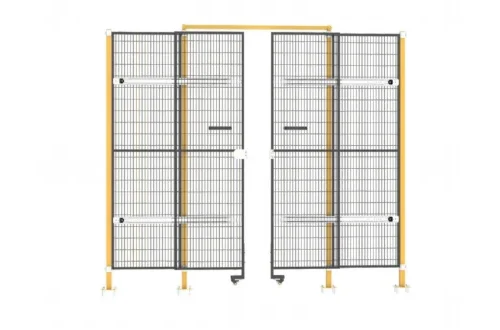
 |
Your multi-station assembly line is a masterpiece of engineering. But if the safety guarding is an afterthought, it becomes the single biggest point of failure during the final EHS audit. On-site fabrication, misaligned interlocks, and non-compliant openings don’t just cause delays; they jeopardize project sign-off and your reputation. It’s time to stop treating guarding as a commodity and start seeing it as a critical subsystem. |
The Hidden Risk in Assembly Line Guarding: When ‘Good Enough’ Fails Commissioning
As an automation system integrator, you live by tight deadlines and precise execution. The final phase of a project—commissioning—is where everything comes together. The robots are programmed, the PLCs are communicating, and the line is ready to run. But then the end-customer’s EHS manager arrives for the final safety audit and flags the machine guarding. The hinged door sags, causing the safety interlock to false-trip. A custom bracket, crudely welded on-site to hold a Pizzato switch, has sharp edges and has already started to rust where the coating was burned away. The opening for the conveyor is large enough for an operator to reach through, a clear violation of ISO 13857.
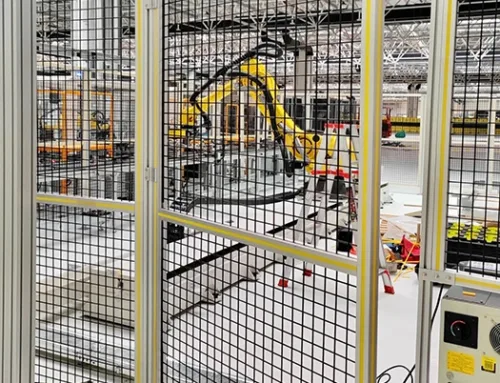
Suddenly, your project is on hold. What was supposed to be a simple protective barrier has become a source of non-compliance, requiring costly and time-consuming on-site rework. This is the predictable outcome of treating Ограждение машин для обеспечения безопасности as a low-priority bulk item instead of an engineered system.
Beyond Panels and Posts: Designing for Seamless Integration
A truly effective guarding solution for a multi-station line isn’t just about surrounding the equipment; it’s about integrating with it. The design must anticipate the complexities of the layout, the specifics of the safety circuit, and the operational needs of the end-user. This requires a systems-based approach that eliminates guesswork and on-site fabrication.
Eliminate Surprises with Design-Phase Verification
The root of on-site installation problems is poor planning. A modern guarding system should exist as a digital model before it becomes a physical reality. By providing comprehensive 3D CAD files, we enable you to import the entire guarding layout directly into your master assembly design. This allows your engineers to detect any interference with robot arms, cable trays, or maintenance access points during the design phase, not on the factory floor. The result is a Bill of Materials (BOM) that is 100% accurate and a physical installation that fits perfectly the first time.

From Physical Barrier to Active Safety Component
In a modern automated line, a guard door is not just a door; it’s a critical input to the safety PLC. The biggest integration headache is cleanly mounting the specified safety interlock switches—be it an Omron D4NL, a Pizzato, or a Schmersal. Our system solves this with a pre-engineered Safety Interlock Carrier. These are not just generic brackets; they are purpose-built mounting plates with pre-drilled holes that perfectly match the footprints of industry-standard switches. This “plug-and-play” approach eliminates on-site drilling and welding, ensures perfect alignment for reliable operation, and presents a professional, compliant solution to the EHS auditor.

Solving Complex Layouts: Corners, Conveyors, and Clear Access
Multi-station lines are rarely simple squares. They feature angled layouts, and multiple conveyors passing through the perimeter. A truly modular system accommodates this complexity with ease. Our components, including adjustable corner posts and custom-sized panels, allow for any configuration. For conveyor pass-throughs, we provide pre-fabricated Tunnel Guards designed to meet ISO 13857 safety distance requirements—allowing product to pass while preventing human access. Furthermore, a wide range of door options, from standard hinged doors to space-saving sliding and multi-panel folding doors, ensures that you can provide safe and efficient access for operators and maintenance personnel, no matter the spatial constraints.

The Result: Predictable Installation and First-Pass Acceptance
By shifting to an engineered guarding system, the entire workflow is transformed. The system arrives on-site flat-packed, with a clear installation plan. Assembly is a “cold work” process, requiring only standard hand tools—no hot work permits, no welding fumes, no risk of fire. Two technicians can assemble over 150 feet of fencing in a single day. Every panel aligns, every door swings true, and every safety switch bolts on perfectly. When the EHS manager arrives, they see a professional, robust, and compliant system. Your project passes the final acceptance test (FAT) without issue, allowing you to hand over the line on schedule and move on to your next project with confidence.

Engineered for the Realities of the Factory Floor
The value of a Mdfence system is built into every component, designed specifically to address the challenges of industrial automation environments.
| Component | Specification & Integrator Benefit |
| Posts & Panels | Constructed from heavy-gauge Q235 carbon steel with fully welded, framed mesh panels. Benefit: Superior rigidity and impact resistance. This isn’t flimsy wire mesh; it withstands accidental impacts from forklifts or ejected parts, protecting the high-value robotics inside and preventing costly line-down situations. |
| Mesh Sizing | Standard 20x100mm “finger-safe” mesh aperture. Benefit: This small opening allows the guarding to be placed as close as 120mm (approx. 4.7 inches) from the hazard, per ISO 13857. You can deliver a more compact and space-efficient work cell to your client, a powerful competitive advantage. |
| Modular Fasteners | A high-strength, captive bolt-and-clip system. Benefit: Rapid, non-destructive assembly. If the end-user needs to modify the line or relocate a machine, the guarding can be disassembled and reconfigured with 100% asset reuse, offering a long-term value your clients will appreciate. |
| Durable Coating | Industrial-grade electrostatic powder coating. Benefit: Resists corrosion from cutting fluids, wash-down chemicals, and ambient humidity. The guarding will maintain its professional appearance long after your team has left the site, reflecting the quality of your integration work. |
For system integrators building multi-station assembly lines, safety guarding should be a source of confidence, not a variable risk. By choosing an engineered, modular system like Mdfence, you de-risk your installation, accelerate your commissioning timeline, and deliver a final product that exceeds your client’s safety and operational standards.
Frequently Asked Questions for Automation Integrators
1. Can your system accommodate complex layouts with non-90-degree angles?
Absolutely. Our modular system includes adjustable angle connectors that can create virtually any polygon-shaped work cell. We can supply components to match the exact geometry specified in your CAD layout, eliminating the need for on-site cutting and welding.
2. Do you provide pre-engineered mounting solutions for specific safety interlock brands?
Yes. This is one of our core strengths. We offer a range of “Safety Interlock Carriers” with pre-drilled mounting patterns for popular brands like Omron, Pizzato, Schmersal, and Allen-Bradley. This ensures a clean, fast, and reliable integration into your safety circuit.
3. How does your system handle conveyor belt pass-throughs while maintaining safety compliance?
We provide custom-designed “Tunnel Guards” that fit around the conveyor. These tunnels are built to the precise dimensions required to allow product to pass through while strictly adhering to the safety distance calculations outlined in ISO 13857, preventing any part of the body from reaching the hazard zone.
4. Are 3D CAD/STP files of your components available for us to use in our master layout?
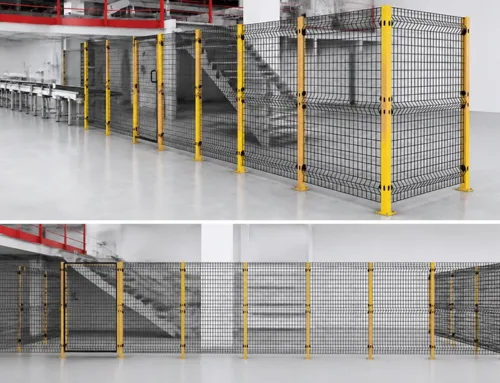
Yes. We provide a full library of 3D models for all our standard components—posts, panels, doors, and accessories. This allows your design team to integrate our Системы защитных ограждений для роботов seamlessly, verify clearances, and generate an accurate BOM directly from your design software.
5. We often have tight project deadlines. What is the typical lead time for a standard system?
We maintain a significant inventory of standard components (posts in 2000mm height, common panel widths, yellow/black colors) specifically to support the fast-paced needs of system integrators. For standard configurations, we can often ship within days to meet urgent project timelines.