RU
RU  EN
EN  DE
DE  PT
PT  JA
JA  ES
ES  IT
IT 

|
Your robot cell is installed, the timeline is tight, and the last thing you need is a stray forklift taking down your perimeter, failing the EHS audit, and putting your project in the red. Is your machine guarding an engineered asset designed for the realities of the factory floor, or is it just a liability waiting to happen? |
What Happens if a Forklift Hits the Safety Fence? It Depends Entirely on the Engineering.
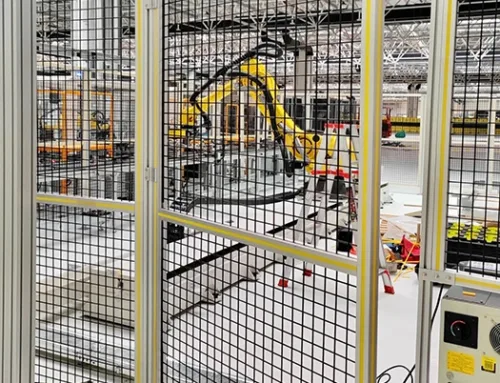
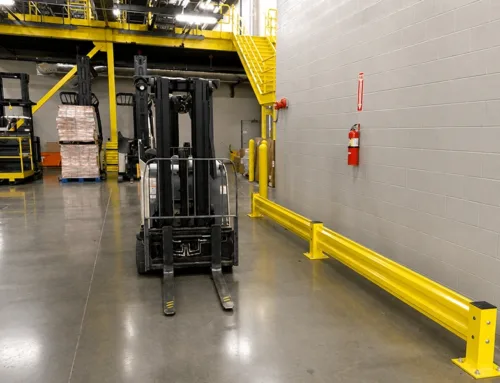
It’s a scenario that keeps automation project managers awake at night. A moment of inattention, a slippery floor, and a 5,000-pound forklift impacts the brand-new Защитные ограждения для роботов you just installed. What happens next separates a successful project from a catastrophic failure. The outcome isn’t a matter of luck; it’s a direct result of the physics and material science behind the barrier you chose.
For many, the answer is grim: welds snap, posts shear, and the fence collapses, potentially into the multi-million-dollar automation cell it was meant to protect. But for those who choose an engineered system, the answer is far less dramatic: a controlled absorption of energy, a replaceable component, and minimal downtime.
The Anatomy of a Catastrophic Failure: When “Good Enough” Fails
Traditional, locally fabricated guarding—often made from welded angle iron and basic wire mesh—is treated as a commodity. This approach overlooks the brutal reality of an industrial environment. When impacted by a forklift, this type of barrier fails in a predictable and dangerous sequence:
- Brittle Fracture: The welds, being the weakest points, don’t bend; they snap. This instantly compromises the structure, turning rigid sections into uncontrolled debris.
- Post Failure: The posts, lacking engineered reinforcement and robust anchoring, bend at the base and pull their anchors from the concrete, leading to a complete breach of the perimeter.
- The System Integrator’s Nightmare: The consequences extend far beyond a damaged fence. You now face emergency “hot work” permits for welders, significant production downtime for your client, project delays that trigger penalty clauses, and a serious loss of credibility during the final EHS audit.
Engineered to Absorb, Not Shatter: The Mdfence Difference
An impact is an energy transfer event. A properly engineered Охрана машин system is designed not just to be a barrier, but to manage that energy safely. This is achieved through a combination of superior materials, intelligent structural design, and certified performance.
It Starts with the Steel: Q235 and the Science of Ductility
Unlike brittle, low-grade steel, the Mdfence system is constructed from high-tensile Q235 carbon steel. This material possesses excellent ductility, meaning that under extreme force, it is engineered to bend and deform rather than fracture. This property of “plastic deformation” allows the fence to absorb the kinetic energy of an impact, much like a car’s crumple zone protects its occupants.
This inherent material strength is supported by robust 60x60mm posts, anchored to the floor with four M10 expansion bolts, creating a foundation designed to resist the immense leverage of an impact.
The Power of the Frame: Distributing the Load
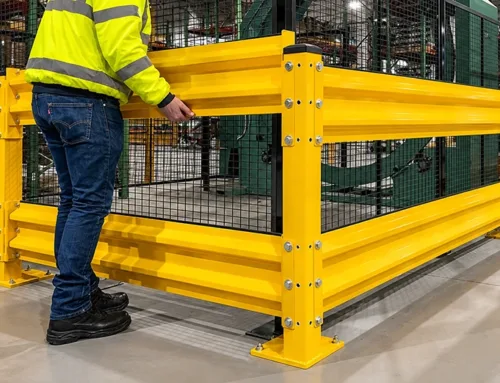
A common failure point in cheaper fencing is the mesh itself, which can pop out of a weak frame. Mdfence utilizes fully welded, 20x30mm tubular steel frames for every panel. This frame does more than just hold the mesh; it acts as a rigid diaphragm, distributing the point-of-impact force across the entire panel and transferring it efficiently into the energy-absorbing posts.
This robust construction is why our system is certified to withstand an impact of 1600 Joules—equivalent to a 220 lb (100 kg) object hitting it at 12.5 mph (20 km/h). It ensures the barrier holds, protecting the high-value assets and personnel inside the cell.

From Disaster Recovery to a 10-Minute Swap
So, what happens when a forklift hits an Mdfence system? The perimeter is maintained. The robot inside continues its cycle, unaware. The panel that took the hit may be visibly deformed, having sacrificed itself to absorb the impact energy, but it has not failed.
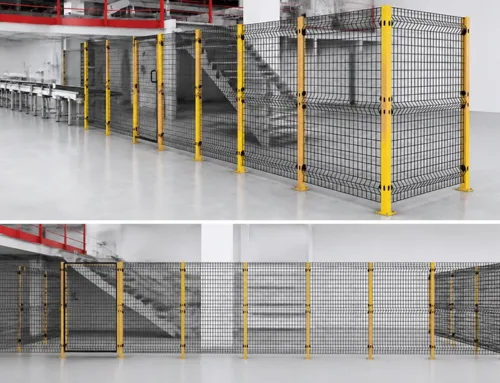
The recovery process is not a multi-day fire drill; it’s a simple maintenance task. Because Mdfence is a fully Modular Fencing System, there is no cutting or welding. Your client’s maintenance team simply needs a wrench and a replacement panel.
| Dimension | Traditional Welded Fence Repair | Mdfence Modular System Repair |
|---|---|---|
| Required Tools | Angle grinder, welder, C-clamps, paint, brushes | Hex wrench |
| Permits Required | Hot Work Permit | Нет |
| Estimated Downtime | 2-4 hours (minimum) | ~10 minutes |
| Возможность многократного использования активов | 0% – Damaged section is scrap metal | 95% – Only the impacted panel is replaced |
By undoing a few bolts on the connection clips, the damaged panel can be removed and a new one slotted into place in minutes. This is the difference between an unforeseen catastrophe and a planned, manageable maintenance event. For a system integrator, it’s the difference between a successful handover and a project that hemorrhages profit and reputation.

Your choice of safety fencing is more than a line item on a Bill of Materials; it’s a critical component of your risk management strategy. It directly impacts project timelines, client satisfaction, and the overall success of your integration. Don’t let a “good enough” barrier become your project’s single point of failure. Choose an engineered system designed to withstand the predictable chaos of the modern factory.
Frequently Asked Questions for Automation Professionals
1. What is the real total cost of ownership (TCO) of Mdfence compared to a locally welded solution?
While the initial material cost of a welded fence may seem lower, the TCO is significantly higher. You must factor in the extensive on-site labor for cutting, welding, grinding, and painting; the administrative cost of hot work permits; and the massive financial impact of extended downtime for repairs. Most importantly, a welded fence has zero residual value—it becomes scrap metal when your client reconfigures their line. Mdfence’s modularity makes it a reusable asset with a far lower TCO after the first line change.
2. How does Mdfence handle the integration of safety interlocks like Omron, Pizzato, or Schmersal?
We see the fence as part of the total safety circuit. We provide pre-engineered, laser-cut mounting plates and carriers specifically designed for industry-standard safety switches (e.g., Omron D4NL, Pizzato FS series). This eliminates risky on-site drilling and tapping, which can compromise the fence’s protective coating and lead to rust. It ensures perfect, repeatable alignment and dramatically speeds up your electrical integration and commissioning time.
3. Our end-client’s facility has uneven concrete floors. How does your system accommodate this?
This is a common issue we’ve engineered a solution for. The connection clips that attach the panels to the posts allow for a degree of vertical adjustment. This provides the flexibility needed to create a level and secure fence line even on floors with minor variations, ensuring there are no unsafe gaps at the bottom that could fail an EHS audit.
4. What is the typical lead time? Our integration projects have very aggressive timelines.
We understand the urgency of automation projects. We maintain a significant inventory of our standard components—RAL 1023 Safety Yellow posts and RAL 9005 Jet Black panels—specifically to support rapid deployment. For standard layouts, we can often ship far faster than the time it would take to source materials and fabricate a custom welded solution.
5. Can we get 3D CAD models to incorporate into our overall system design in SolidWorks or Inventor?
Absolutely. We provide 3D STP files for all standard components. We encourage our system integrator partners to use these models in the design phase. This allows you to verify clearances, plan safety interlock placements, and generate an accurate Bill of Materials, completely eliminating on-site surprises and ensuring what you designed is what you get.