RU
RU  EN
EN  DE
DE  PT
PT  JA
JA  ES
ES  IT
IT 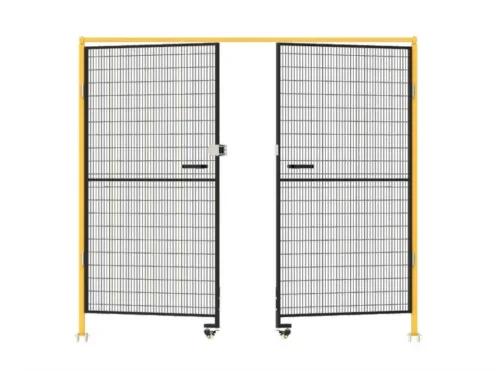
 |
Tired of hot work permits, on-site fabrication, and rust spots from drilled holes ruining your otherwise pristine robot cell installation? The sparks, the grinding dust, and the last-minute modifications for safety switches not only delay project delivery but also compromise the very integrity and compliance of your guarding system. There is a faster, cleaner, and more professional way to deploy Промышленная охрана периметра. |
The Hidden Costs of On-Site Drilling: Why Traditional Guarding Derails Automation Projects
For any automation system integrator, the final phase of a project—installing the защита машин—should be straightforward. Yet, it often devolves into a messy, time-consuming ordeal. The traditional “solution” of using generic fencing or locally welded barriers forces your technicians to become on-site fabricators. This introduces a cascade of problems:
- Compromised Corrosion Resistance: The moment a drill bit pierces the powder-coated surface of a steel post, the warranty against rust is void. In environments with cutting fluids or wash-down cycles, these penetration points become rust blooms within months, leading to a failed EHS audit and a dissatisfied end-client.
- Contamination Risks: Grinding and welding generate sparks and fine metal particulates. This “hot work” requires special permits and poses a significant risk to sensitive electronics, PLCs, and vision systems within the automation cell.
- Integration Delays: Manually drilling holes to mount safety interlock switches like an Omron D4NL or a Pizzato is imprecise. Misalignment can lead to nuisance trips or failure to engage, causing costly downtime and frantic troubleshooting during commissioning.
- Zero Flexibility: A welded fence is a permanent liability. When the production line is inevitably retooled or moved, the entire structure becomes scrap metal, requiring noisy, hazardous demolition and a complete repurchase.
The Cold Assembly Revolution: A No-Drill Approach to Structural Integrity
The Mdfence system is engineered to eliminate these project-killing variables. Our philosophy is simple: all precision work is done in the factory, so your on-site work is limited to clean, fast, mechanical assembly. We call this “cold assembly,” and it’s built on a foundation of robust, no-drill components.
Preserving Integrity with Bolt-On Connections
Instead of violating the structural and protective layers of the posts, our system utilizes high-strength steel fixing rings that clamp securely around the 60x60mm Q235 steel posts. These components are locked in place with M8 bolts. This method ensures two critical outcomes:
- The factory-applied electrostatic powder coating remains intact, guaranteeing long-term corrosion resistance that passes ISO 9227 salt spray tests.
- The full structural strength of the post is preserved, contributing to a system certified to withstand 1600 Joules of impact energy—enough to stop a 220-lb object moving at 12.5 mph.

Accelerate Deployment and Guarantee Compliance
For an automation integrator, time is money. A no-drill system translates directly into faster project completion and higher profitability. A typical Mdfence installation is up to 70% faster than a welded solution. Two technicians, equipped only with basic hand tools, can install over 150 feet of защитные ограждения для роботов in a single day.
Furthermore, the system is designed for the future. When a robot is upgraded or a conveyor line is rerouted, the modular panels and posts can be unbolted, reconfigured, and redeployed. This transforms your safety guarding from a disposable expense into a long-term, reusable asset with a 95% reusability rate.
Engineered Access Control: Doors Built for Industry
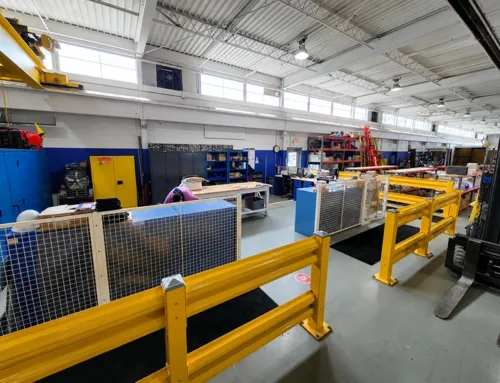
A guarding system is only as good as its access points. Our modular door systems are also a no-drill design, ensuring smooth, reliable operation without compromising the frame’s integrity. Whether your layout requires a simple single hinged door, a wide-opening sliding door for forklift access, or a space-saving folding door, each component is pre-engineered for a perfect fit. The addition of a top door frame beam ensures the posts remain parallel, preventing the door sag that plagues lesser systems and causes interlock misalignment.

Single Hinged Door |

Single Sliding Door |

Bi-Parting Folding Door |
Stop letting on-site fabrication dictate your project timelines and quality standards. Embrace a no-drill, cold assembly approach to industrial perimeter guarding and deliver automation cells that are as safe, robust, and professional as the robotics within them.
Часто задаваемые вопросы
1. How do I integrate my specific brand of safety interlock switches?
Our system includes pre-engineered lock carriers and mounting plates specifically designed for industry-standard switches, including models from Omron, Pizzato, Schmersal, and others. This ensures a perfect, bolt-on fit without any on-site drilling or fabrication.
2. What file formats do you provide for integration into our CAD layouts?
We provide complete 3D STP files for our entire component library. This allows your engineers to accurately model the guarding system within your preferred CAD environment (like SolidWorks, AutoCAD, or CATIA) to prevent clashes and generate a precise Bill of Materials (BOM).
3. What happens if a panel is damaged by a forklift?
Thanks to the modular, no-drill design, repairs are fast and simple. You only need to unbolt the four fixing rings holding the damaged panel, swap it with a new one, and tighten the bolts. A process that takes minutes, not hours, minimizing line downtime and requiring no specialized labor.
4. How does the system handle uneven concrete floors?
The welded base plates on our posts are designed to be robust. For minor variations, shims can be used. For more significant slopes, we offer adjustable leveling feet as an option to ensure the entire fencing system remains plumb and stable.
5. Is a “no-drill” system truly secure without being welded?
Absolutely. The term “no-drill” refers to the assembly of panels to posts. The entire system is securely anchored to the concrete floor using heavy-duty M10 expansion bolts. The mechanical strength of our bolted connections is engineered and tested to meet or exceed international safety standards like ISO 14120, providing a rigid and reliable barrier.