RU
RU  EN
EN  DE
DE  PT
PT  JA
JA  ES
ES  IT
IT WAREHOUSE LAYOUTS THAT KEEP CHANGING
Make forklift protection move with the warehouse
A corrugated guard rail gives warehouses a modular, bolt-on safety boundary that can be adjusted, removed, and rebuilt as aisles, equipment, and production zones change.
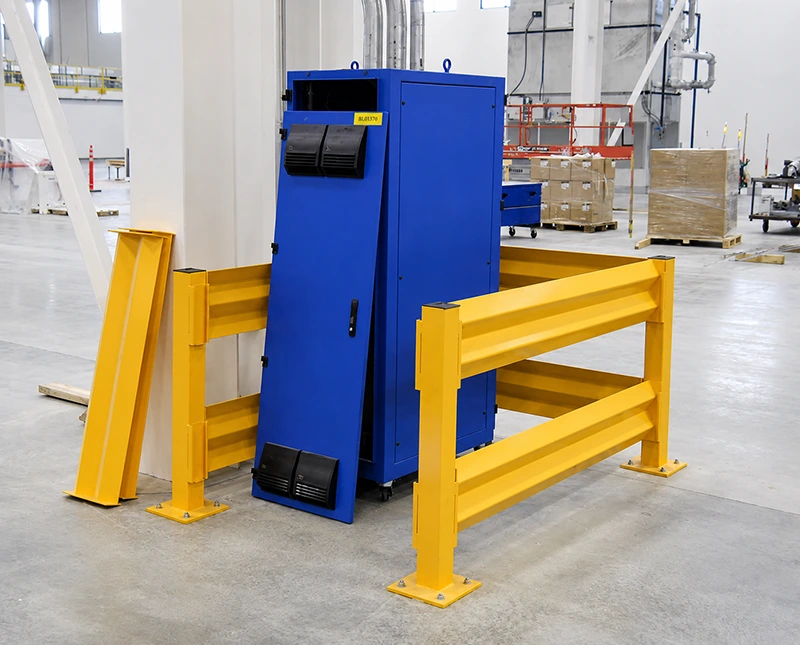
Why a fixed barrier falls behind the site plan
In a distribution center, storage lanes, conveyor routes, equipment positions, and pedestrian crossings may change with a contract, customer program, or production move. A welded steel pipe railing is difficult to relocate once it has been cut, welded, and painted on site. Concrete bollards occupy fixed points, while rope or strap barriers provide visibility but not a substantial physical boundary for forklift impact protection. The result is repeated demolition, new fabrication, or unprotected gaps whenever the warehouse layout changes.
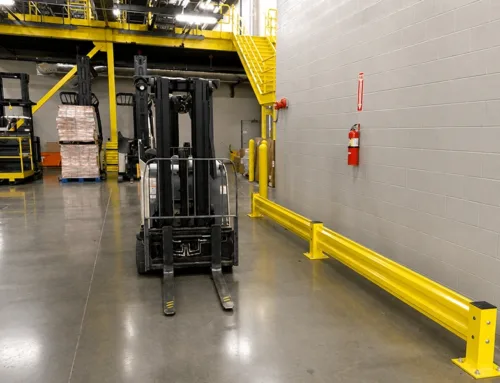
Hsafety is specified as warehouse guard rails and an industrial guard rail system for the outside of the risk area. It protects racks, walls, conveyors, cabinets, and other assets while supporting pedestrian-vehicle separation. It is not a machine safety fence: the fence controls access to an internal machine hazard, while this steel guard rail creates an external collision boundary around equipment and infrastructure.
| Требование к макету | Hsafety corrugated guard rail response |
|---|---|
| Frequent relocation or zone changes | Modular guardrail sections use bolted connections, allowing individual panels and posts to be dismantled and rebuilt in a new position. |
| Temporary vehicle or equipment access | A configurable lift-out guardrail panel can be lifted out when access is required, then refitted to restore the barrier without treating the whole run as a permanent obstruction. |
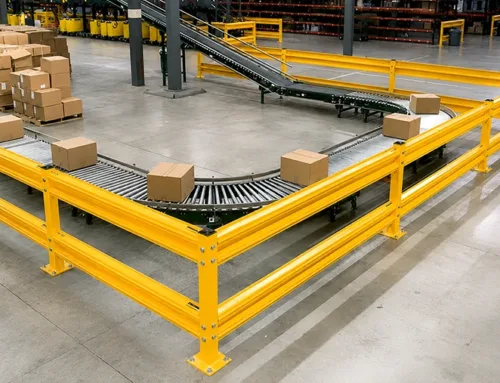
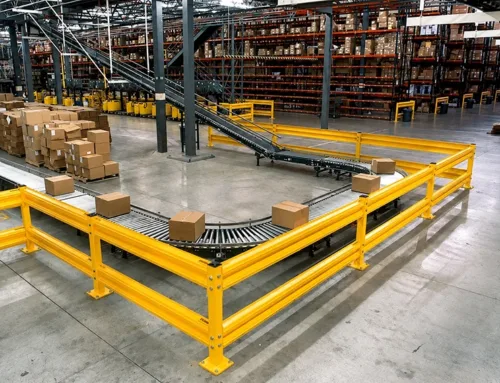
| Mixed straight and turning layouts | Custom length guardrail sections can complete straight runs, corners, and equipment boundaries instead of forcing standard panels into unsuitable gaps. |
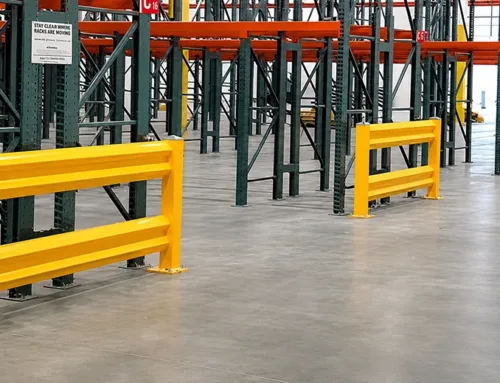
| Forklift and rack-end exposure | Double-rail layouts, square posts, base plates, and concrete floor anchoring establish a visible warehouse safety barrier for rack end protection and aisle protection. |
Structure and field evidence behind the flexible layout
Bolted modules support reconfiguration
The core bolted guard rail system uses Q235 carbon steel corrugated beams, square-tube posts, and floor-mounted base plates. The wave profile adds formed ribs to the corrugated steel beam; it is intended to distribute contact through a substantial steel barrier, while any post-impact inspection and replacement decision must follow the project engineer’s criteria. The system can be discussed in 2-rib W-beam guardrail or 3-rib thrie beam guardrail configurations, with single rail or double rail options selected for the risk area. No site welding, cutting, or repainting is needed for ordinary modular assembly.
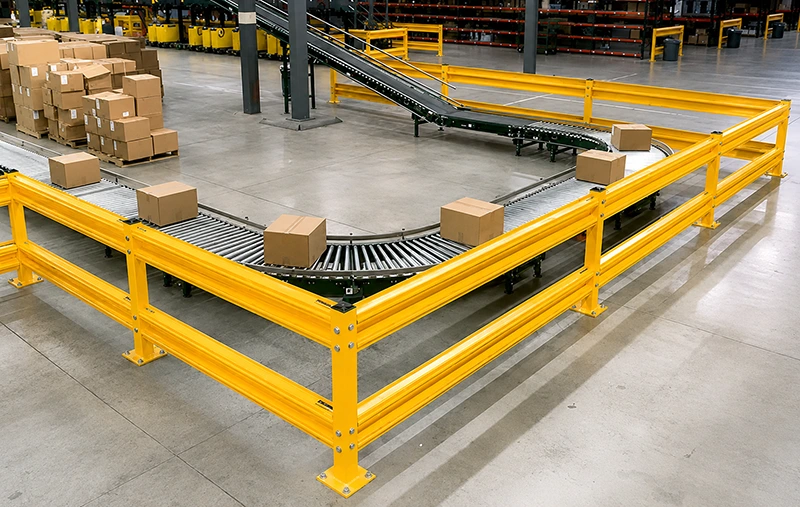
Custom lengths close the gaps around equipment
The photographed conveyor installation shows why a guardrail must follow the actual route rather than only a nominal aisle grid. Hsafety can be planned with common 1,500 mm modules and special-length panels. In one recorded four-zone layout, the required runs were 17,000 mm, 12,000 mm, 17,100 mm, and 11,900 mm. The design combined 64 standard 1,500 mm panels with eight special panels from 680 to 1,140 mm, producing a defined fit for each zone. These figures are project evidence, not a universal standard; final lengths should be confirmed against the approved drawing.
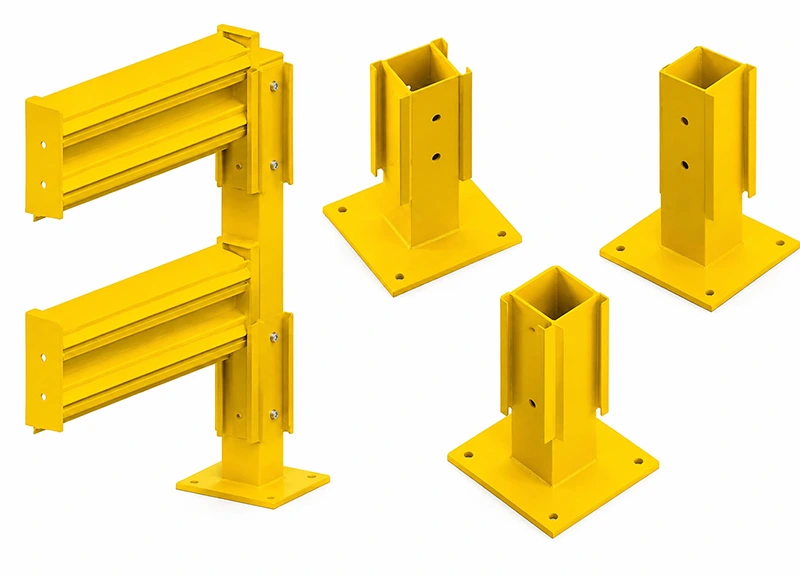
Anchored posts keep the protection defined
For the recorded solution, the 1,000 mm-high double-rail assembly used 80×80×6 mm square posts and 160×160×16 mm base plates, with the lower beam positioned about 100+6 mm above the floor. General installation information calls for expansion anchors into a concrete floor, with the slab condition and anchor selection checked before installation. Yellow powder coating improves visual detection in forklift areas; hot-dip galvanized finish, reflective tape, and other accessories can be considered when the environment or lighting requires them.
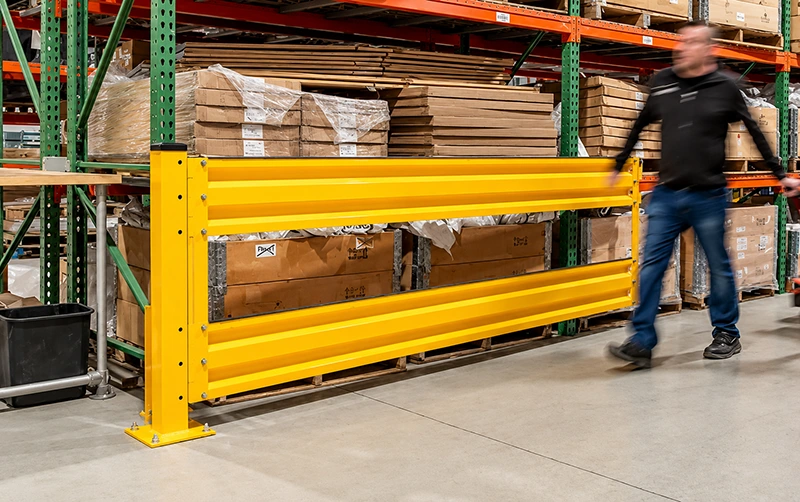
Where a reconfigurable warehouse safety barrier pays back
- Rack end protection: relocate sections when storage contracts change without discarding the complete run.
- Защита погрузочных доков: define vehicle edges and equipment boundaries while preserving planned access points.
- Conveyor and machine guarding support: protect fixed assets externally as lines are moved or expanded.
- Pedestrian-vehicle separation: create a visible industrial guard rail along aisles, crossings, and work zones.
The practical result is less dependence on repeated site fabrication. A removable guard rail can be taken out where a pallet, vehicle, or machine must pass, then returned to service. That flexibility helps the protection follow the operation, reduce accident downtime after forklift damage, and control repeat procurement when a warehouse or production line migrates.
Specify the next layout before fabrication
Share the protected assets, vehicle routes, straight and turning dimensions, required access points, concrete floor condition, and preferred finish. SGF can then review whether a single rail, double rail, 2-rib, or 3-rib configuration is appropriate, confirm custom panel lengths, and define whether lift-out sections should be included. Impact loads such as a 3-ton forklift at 10 km/h are project design conditions—not independent certification—so final engineering, anchoring, and inspection requirements must be confirmed for the site.
Build protection that can change with the contract
Hsafety combines corrugated guard rail panels, bolted posts, concrete floor anchoring, and optional lift-out access into a warehouse guardrail layout that can be dismantled and reconfigured. Send your current plan and the areas most likely to move.