EN
EN  DE
DE  RU
RU  PT
PT  JA
JA  ES
ES  IT
IT Safety guarding systems
Safety guarding systems that move with changing machine layouts
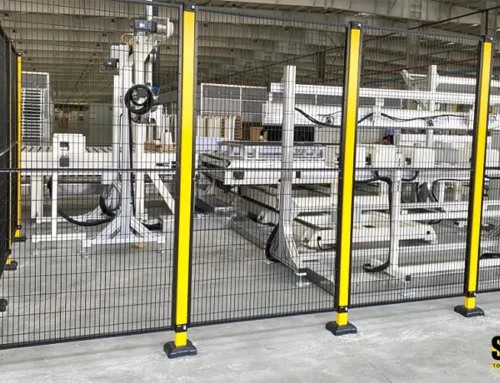
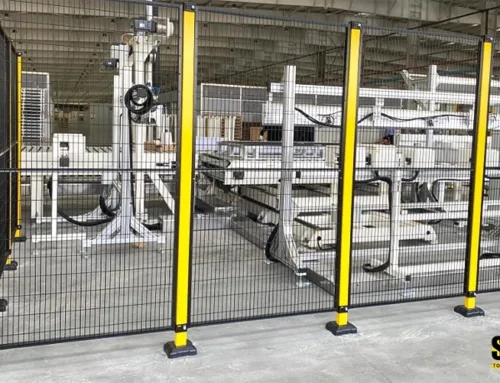
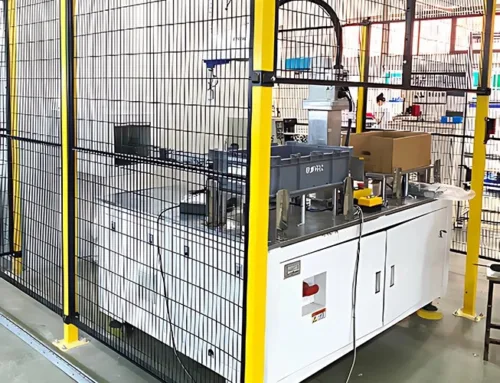
When a material-processing plant keeps adding machines, shifting storage zones, or reworking aisles, fixed welded fencing becomes a sunk cost. Mdfence uses cold-work modular assembly with clamp-ring connections, so the guard line is built without welding, installs 40%–70% faster than conventional methods, and can be dismantled and rebuilt elsewhere with more than 95% asset reuse.
What changes first: layout, risk, or cost?
For plants that process sheet, plate, parts, or mixed materials, the real pressure is not only safety compliance. It is the repeated cost of moving boundaries every time a new machine arrives or a storage area is reorganized. A welded fence solves one layout only. Mdfence is adapted for this exact scenario because the structure is modular, cold-work, and reversible.
| Layout challenge | Mdfence response |
|---|---|
| New machine introduction breaks the aisle plan | Modular panels and clamp-ring connections let the guard line be reconfigured without cutting or rewelding. |
| Heavy-material storage keeps moving | The same fence modules can be removed intact and rebuilt around the new storage footprint. |
| Hot-work permits slow the project | Cold-work assembly removes welding from the site, which reduces risk and simplifies installation in controlled warehouses. |
| Capital expense turns into waste after relocation | More than 95% asset reuse keeps the fencing as a movable asset instead of scrap after a layout change. |
Structure evidence behind the faster installation
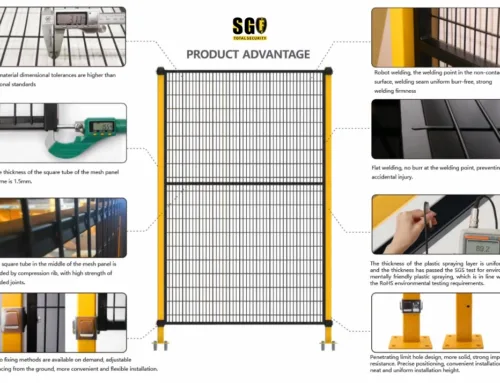
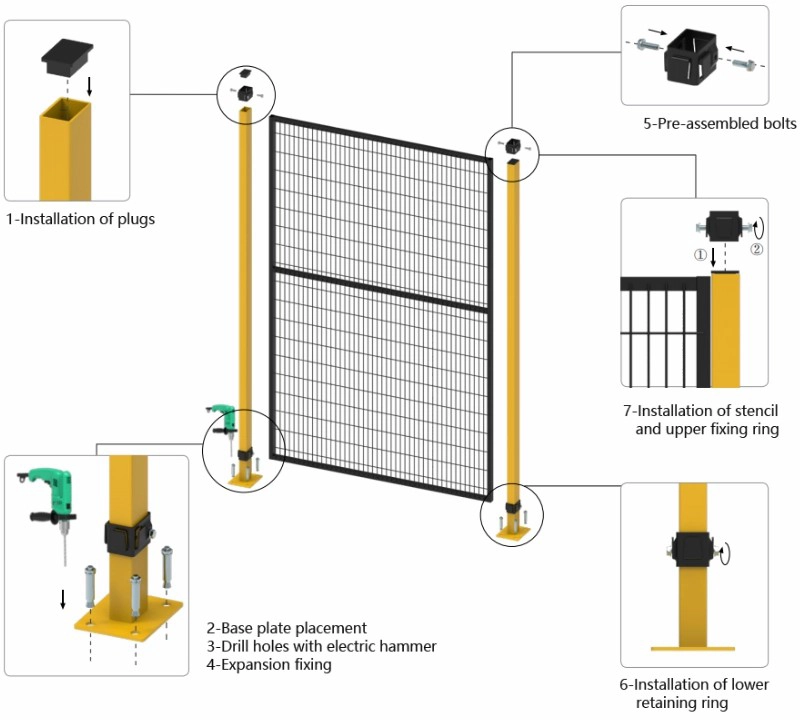
Proof of the build quality
The product proof board highlights the parts that matter in daily use: weld seam quality, coating consistency, base plate detail, and the geometry that keeps the fence stable after repeated assembly. That matters because relocatable guarding must still feel like industrial equipment, not temporary tape-and-post protection.
Cold-work assembly on site
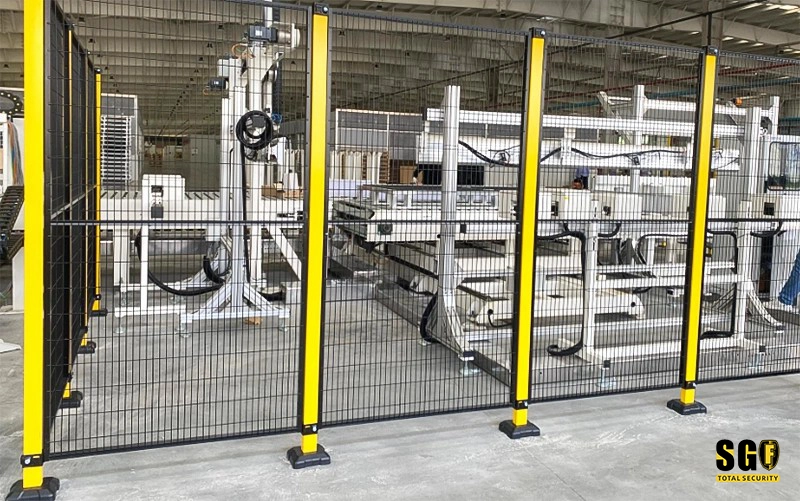
The installation diagram shows the practical sequence: base plate positioning, drilling, expansion bolts, and retaining-ring assembly. This is why the system fits warehouses and material centers where flame control is strict. The fence can be installed without welding equipment, weld permits, or the cleanup that usually slows a changeover project.
Modular structure for future re-layout
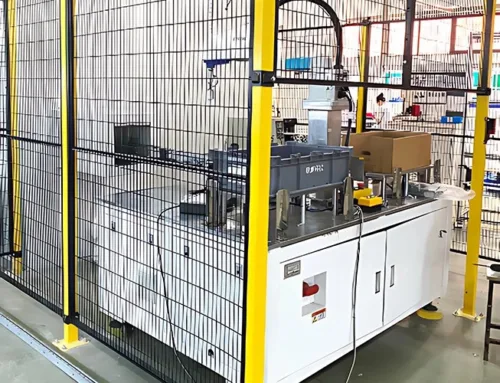
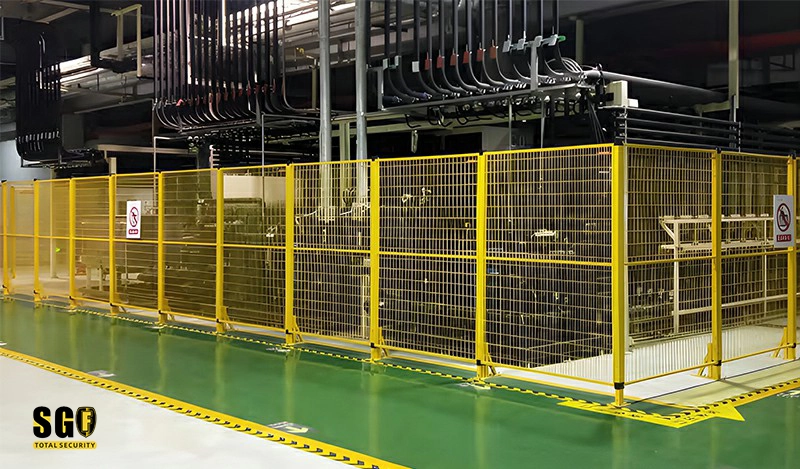
The technical front view makes the system logic obvious: posts, mesh panels, and fixing clamps are separate, repeatable parts. That separation is what makes the fence removable without damage. When the aisle changes again, the same modules can be reassembled into the new boundary instead of being scrapped and rebought.
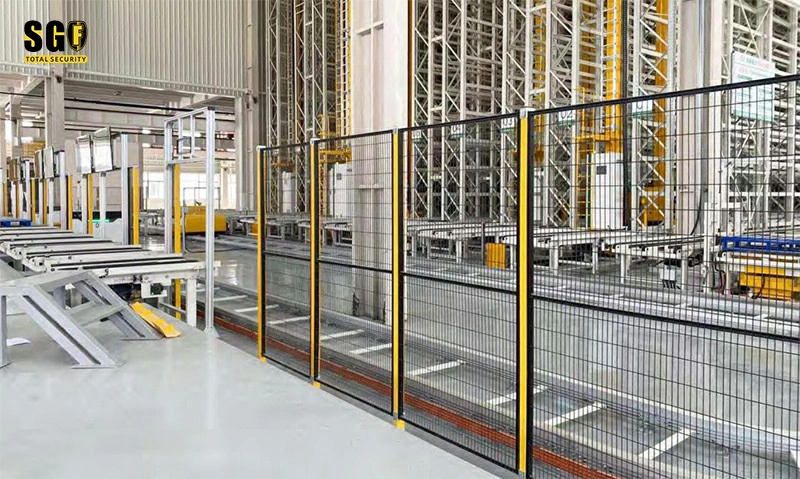
Where this approach works best
- Material processing centers that expand or shrink machine groups every quarter.
- Plants that must isolate new equipment without stopping the whole line for hot work.
- Warehouses and buffer zones where storage footprints change with inventory flow.
- Factories that want one guarding investment to survive multiple layout iterations.
In these settings, the value is not only safety enclosure. It is the ability to keep the same guarding investment alive through each layout revision, with the same modules reused, re-positioned, and put back into service fast.
Why buyers ask for modular guarding now
When the project team knows that the floor plan will change again, the buying decision changes too. Fixed welded barriers lock in a plan that may not survive the next machine arrival. Mdfence answers that risk with cold-work modular construction, no onsite welding, faster installation, and high reuse after relocation.
Build the first layout, and keep the next one too
If your plant is still treating guarding as a one-time fixed cost, the next layout change will expose that assumption. Mdfence is built for plants that need safety guarding systems to move with production, not resist it.