EN
EN  DE
DE  RU
RU  PT
PT  JA
JA  ES
ES  IT
IT 
Scenarios for low and high Profile Rack Guard

Here are some examples of application scenarios for low and high Profile Rack Guard:
A company has a small server room with limited space, and they need to protect their racks from accidental damage caused by equipment carts or people walking too close. Installing a low-profile rack guard will provide a barrier between the racks and the surrounding area, preventing any accidental bumps or collisions from causing damage.
A warehouse has a large number of racks with low clearances between them, making it difficult to install traditional rack guards. Installing a low-profile rack guard that is designed to fit in tight spaces will help protect the racks from forklifts or other equipment that may accidentally bump into them.
A retail store has racks that are close to the customer traffic flow. Installing a low-profile rack guard will protect the racks from shopping carts, strollers, or other items that may be pushed into them.
High Profile Rack Guard:
A manufacturing facility has a high volume of forklift traffic in the warehouse. Installing a high-profile rack guard will protect the racks from accidental collisions with forklifts and other heavy equipment.
A data center has tall racks with expensive equipment that needs to be protected from accidental damage caused by people or equipment. Installing a high-profile rack guard will provide an extra layer of protection for the racks and the equipment stored on them.
A distribution center has racks that are located in high-traffic areas, and there is a risk of accidental collisions with carts, forklifts, or other equipment. Installing a high-profile rack guard will provide a visible barrier that will help prevent accidents and protect the racks from damage.
Food & Beverage Line Reconfiguration: How Mefence Frameless Safety Fencing Turns Plant Zoning into a Reusable Asset
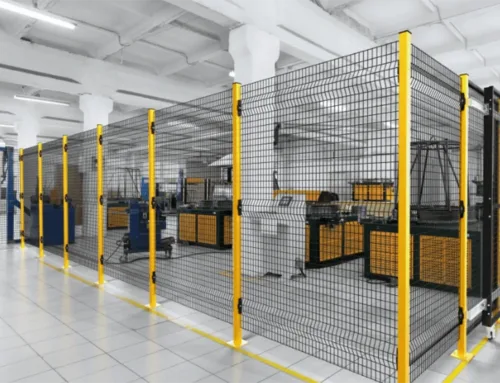
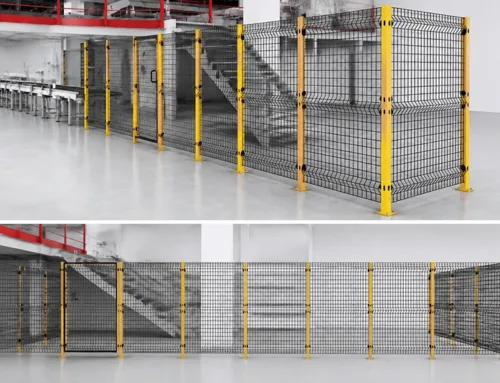
Short SKU lifecycles and frequent production-line changes make welded partitions expensive to abandon. Mefence frameless 3D industrial safety fencing uses clip-fixed modules, on-site cutting and reusable components for warehouse zoning, machine guarding and pedestrian-vehicle separation.
Food & Beverage Line Reconfiguration: How Mefence Turns Industrial Safety Fencing into a Reusable Asset
Shorter SKU life cycles force food and beverage plants to redraw production zones. Mefence frameless 3D industrial safety fencing can be dismantled, cut on site, moved, and reused as layouts change.
Food & Beverage Line Reconfiguration: Turn Mefence Safety Fencing into a Reusable Plant Asset
When seasonal SKUs and pilot runs repeatedly change a food and beverage production layout, Mefence Safety Fencing replaces welded-in zoning with a frameless, modular barrier that can be dismantled, cut on site, and reused.