EN
EN  DE
DE  RU
RU  PT
PT  JA
JA  ES
ES  IT
IT 
 |
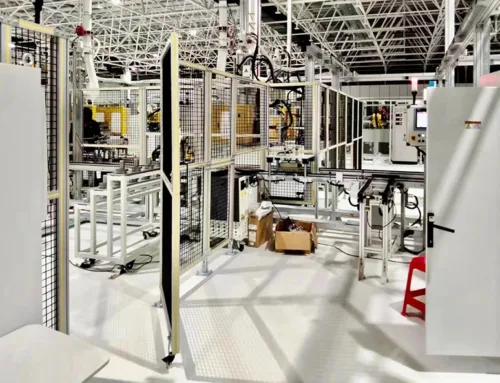
In the eyes of an Industrial Safety Standards Organization auditor, not all fences are created equal. A visually compliant perimeter is useless if it fails under the kinetic energy of a rejected workpiece or a colliding forklift. for system integrators delivering turnkey solutions to global automakers, using non-certified guarding is a liability time bomb. Discover how our TUV-certified, framed panel industrial safety fencing ensures your project complies with ISO 14120 while protecting your client’s most valuable assets. |
Why “Framed” Matters: The Physics of Impact Resistance
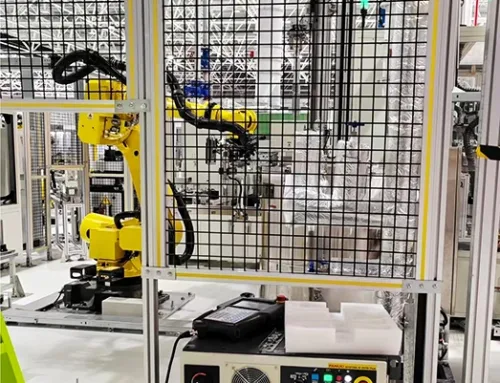
Many economy fencing systems use a “frameless” design where the wire mesh is simply bent at the edges. While cheaper, these panels lack structural rigidity. When impacted by a robotic arm or a heavy part ejected from a CNC machining center, they tend to deform plastically or burst, allowing debris to escape into the pedestrian aisle.
Our system is built differently. As shown in the structural diagram above, every mesh panel is welded into a robust 20x30mm steel tube frame. This frame acts as a skeleton, distributing impact forces across the entire module rather than focusing them on a single wire strand. This design is critical for compliance with ISO 14120, which mandates that guards must be capable of containing foreseen ejections from the machinery. By choosing a framed system, you provide a verified safety factor that protects personnel in the quality inspection cell next door.

Safety starts at the foundation: 60x60mm posts with reinforced anchoring plates.
The Backbone of Your Safety System: Q235 Carbon Steel Posts
A fence panel is only as strong as the post holding it. In a collision event, a weak post will fold, pulling the entire fence line down.
We utilize high-grade Q235 carbon steel for our posts, featuring a 60x60mm profile with wall thicknesses up to 2.0mm. This is significantly sturdier than the 40x40mm posts often found in light-duty guarding. Crucially, the base plate is engineered with a “lateral ear” design (as seen in the technical drawing), allowing for four M10 expansion bolts to anchor it firmly to the concrete. This stability is essential for robotics integration projects where the fence must also support heavy interlocks, light curtains, or cable trays without vibrating or shifting.
Surface Treatment That Survives the Factory Floor
Safety compliance also involves visibility and durability. A rusted fence suggests a neglected safety culture.
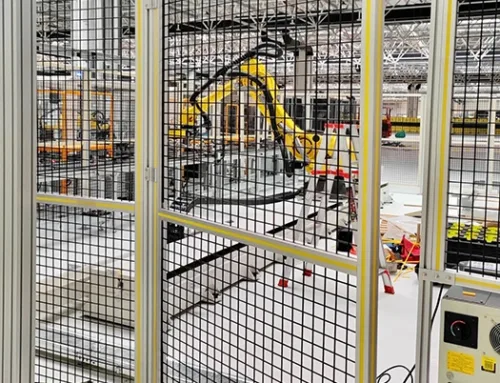
Our components undergo a multi-stage pre-treatment followed by a high-quality powder coating process (meeting GB/T9286-1998 adhesion standards). This ensures the “Safety Yellow” (RAL 1023) remains vibrant and visible, clearly demarcating hazardous zones around automated production lines. This corrosion resistance—verified by ISO 9227 salt spray testing—means your installation will pass visual inspections for years, maintaining the professional appearance expected by Automotive Industry Association members.
Frequently Asked Questions
1. Is your fencing system TUV certified?
Yes. Our industrial safety fencing system has undergone rigorous testing and certification by TUV, verifying its impact resistance and compliance with relevant machine safety standards.
2. What specific ISO standards does the system comply with?
Our design aligns with ISO 14120 (General requirements for the design and construction of guards) and ISO 13857 (Safety distances to prevent hazard zones being reached by upper and lower limbs).
3. Can the panels withstand a direct hit from a forklift?
While no fence is indestructible, our framed panel design combined with 60x60mm posts offers high impact resistance designed to contain machinery hazards. For high-traffic forklift areas, we recommend adding dedicated bollards for extra protection.
4. How is the mesh attached to the frame?
We use a “flat welding” technique where the mesh wire is fully welded to the inner face of the tube frame. This eliminates sharp edges (burrs) that could cut operators and ensures the mesh cannot be pushed out of the frame under pressure.
5. Do you provide compliance documentation for our safety file?
Yes. We can provide technical data sheets, material certifications, and TUV certificates upon request to help you compile the technical file required for your CE marking or safety audit.