EN
EN  DE
DE  RU
RU  PT
PT  JA
JA  ES
ES  IT
IT 

In the world of **custom machinery** and high-mix production, a static factory floor is a dead factory floor. You optimize your **robotics layouts** for flow and efficiency, but traditional welded guarding often becomes a rigid anchor that drags down your flexibility.
Don’t let your safety infrastructure dictate your process. Explore how a fully modular **industrial safety fencing** system allows you to reconfigure **automated production lines** overnight, reclaim valuable floor space with smart door solutions, and maintain compliance without sacrificing agility.
Stop Wasting Floor Space on “Dead Zones”
Real estate on the factory floor is expensive. When designing a **robot work cell**, every square meter counts. Generic fencing systems with weak structural integrity force you to push the barrier further away from the hazard to meet ISO 13857 safety distance calculations. This creates unusable “dead zones” around your **industrial robots**.
By utilizing high-strength **Q235 carbon steel** posts (60x60mm) and rigid framed panels, you can confidently place the guarding closer to the hazard (where standards permit). The superior **impact resistance** of a certified system ensures that even if a robotic arm malfunctions, the barrier holds firm. This tighter footprint allows you to fit more **assembly systems** into the same hall, directly increasing your revenue per square foot.

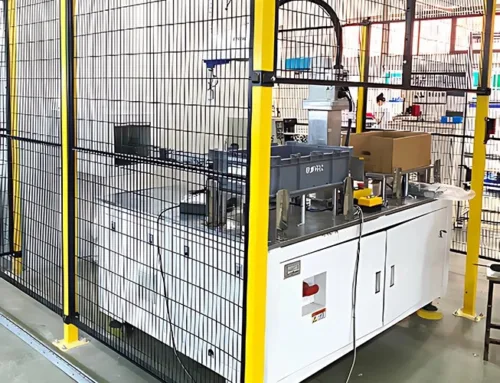
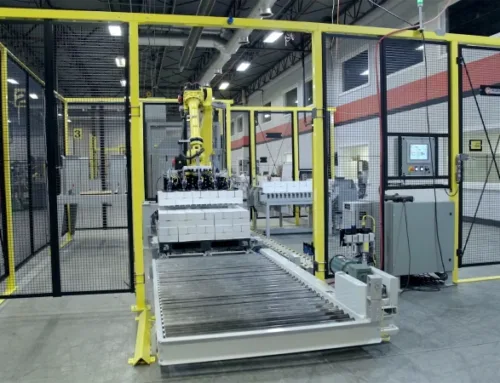
Customized layouts maximize floor space utilization in complex robotic cells.
The “Hot Work” Bottleneck in Maintenance
Accidents happen. A forklift in a **material handling area** backs into a post, or a heavy pallet crushes a mesh panel. With a traditional welded fence, fixing this is a logistical nightmare: you need to shut down the line, issue “hot work” permits for cutting and welding, and repaint the area—risking contamination of your **turnkey solutions**.
A modular, bolt-on system changes this dynamic entirely. Damaged components can be swapped out in minutes using simple hand tools. No welding, no sparks, no drama. Your maintenance team can restore full safety compliance during a lunch break, keeping your **OEE (Overall Equipment Effectiveness)** metrics green.
Access Control That Doesn’t Block Traffic
In a modern smart factory, traffic flow is critical. **AGV/AMR paths** and material carts need to move freely. Standard swing doors are often the enemy here—they require a large clearance radius that eats up aisle width.
Advanced door configurations, such as **folding doors** or trackless sliding doors, solve this friction point. A folding door can provide a massive 4-meter opening for bringing in large **CNC machinery** or raw materials, yet folds away neatly into a compact footprint when open. This ensures your **manufacturing technology** remains accessible for service without blocking the main logistics arteries of your plant.

Folding door systems offer wide access without obstructing narrow factory aisles.
Future-Proofing Your Investment
The production line you build today might not be the one you need tomorrow. Whether you are scaling up capacity or retooling for a new product model, your safety infrastructure needs to adapt. Mdfence systems are designed like an industrial erector set. Panels, posts, and doors can be disassembled, relocated, and reconfigured into entirely new layouts.
Instead of scrapping tons of steel every time you change a **robotics integration** layout, you reuse your assets. This not only aligns with lean manufacturing principles but also significantly reduces the capital expenditure for future upgrades.
Frequently Asked Questions
1. Can I mix and match different panel types in the same fencing line?
Yes. The modular design allows you to combine standard wire mesh panels for visibility with solid steel sheets (for welding sparks) or polycarbonate panels (for clear viewing) on the same post system, depending on the specific hazard at each station.
2. How do folding doors compare to sliding doors for space saving?
Folding doors are superior when you need a very wide opening (up to 4.8m) but have limited side clearance where a sliding door would normally retract. They “accordion” out of the way, leaving the full width clear for forklift access.
3. Is the system reusable if we move our factory?
Absolutely. Since the system uses bolted connections and expansion anchors rather than welding, the entire fence line can be dismantled, palletized, and reinstalled at a new location with zero loss of structural integrity.
4. What safety standards does the system comply with?
Our system is designed to meet rigorous international standards, including ISO 14120 (General requirements for guards) and ISO 13857 (Safety distances), making it suitable for global automotive and automation projects.
5. Do you offer “cut-to-size” panels for odd-shaped gaps?
We provide a wide range of standard widths to minimize the need for cutting. For non-standard gaps, we offer adjustable kit sections or can manufacture custom-width panels based on your CAD layout to ensure a perfect fit without on-site modification.