EN
EN  DE
DE  RU
RU  PT
PT  JA
JA  ES
ES  IT
IT 
In modern industrial automation, safety is not an option—it’s an engineered necessity. A robust safety fencing system is the first line of defense in protecting personnel, safeguarding high-value equipment, and ensuring regulatory compliance. Discover how a modular, high-impact system can be integrated into your facility to enhance safety and operational efficiency.
What is Industrial Safety Fencing?
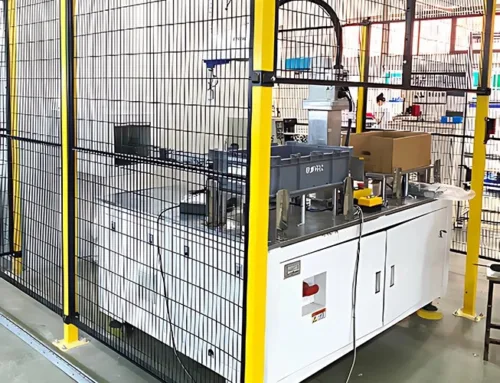
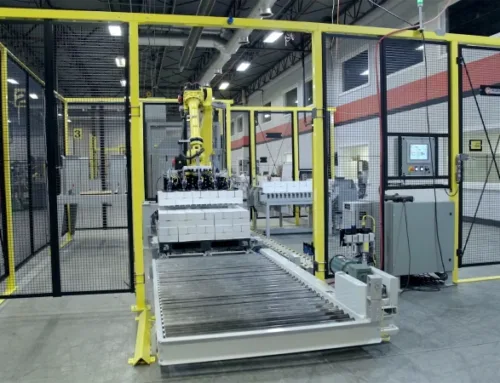
Industrial safety fencing is a modular physical barrier system engineered to restrict access to hazardous areas within an industrial environment. Its primary purpose is to create a secure perimeter around machinery, robot safety fencing, and automated work cells to prevent accidental contact between personnel and moving equipment. Unlike standard fencing, an industrial safety system is specifically designed to withstand the rigors of a factory setting, including physical impacts, and to integrate seamlessly with machine control systems.
A complete system typically consists of three core components:
- Posts: The vertical supports, usually made from heavy-gauge steel, that are securely anchored to the facility floor.
- Panels: The barrier sections, which can be wire mesh, polycarbonate, or solid steel, that attach between the posts.
- Access Points: A variety of door systems, such as hinged, sliding, or folding doors, equipped with locking mechanisms that can be integrated with safety circuits.
Why is a Robust Fencing System Required in Automated Environments?
For system integrators and plant managers, the requirement for safety fencing extends far beyond simple boundary demarcation. It is a critical investment in risk management, operational continuity, and project efficiency. The true value lies in how a well-designed system addresses the complex challenges of modern automation.
Protecting High-Value Assets and Ensuring Uptime
In facilities that operate high speed mechanical assembly machines or CNC machining centers, the cost of an accident is measured not only in potential injuries but also in equipment damage and lost production. An industrial robot or a multi-axis machining center represents a significant capital investment. A high-impact machine guarding fence acts as a physical shield, protecting these assets from accidental collisions with forklifts, pallet jacks, or other material handling equipment. This protection is fundamental to preventing costly downtime and ensuring the continuity of an automated production line.

Engineered for Structural Integrity and Impact Resistance
The effectiveness of a safety barrier is determined by its ability to withstand force. This is achieved through deliberate material selection and superior engineering design.
The Foundation: Q235 Carbon Steel and Framed Panel Design
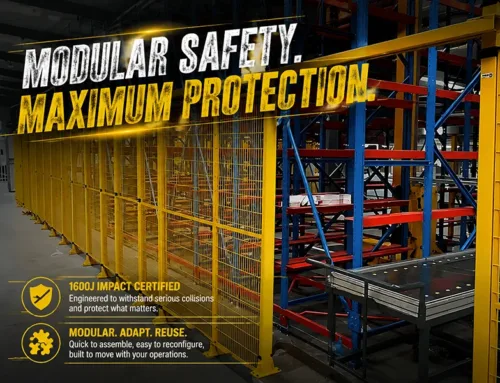
The structural backbone of a high-performance system is its material. Using high-strength Q235 carbon steel for components like the 60 x 60mm posts provides the necessary rigidity to absorb and dissipate energy from an impact. Furthermore, the use of framed panels—where a steel wire mesh is fully welded inside a rigid steel tube frame—creates a unitized structure that is significantly stronger than simple frameless mesh. This design prevents the panel from deforming or failing under load, maintaining the integrity of the safety perimeter during an incident.
Manufacturing Details that Matter: The Value of Flat Welding
Superior manufacturing processes, such as using flat, full-weld techniques to join the mesh to the frame, offer tangible benefits. This method eliminates sharp burrs and edges common with spot welding, preventing potential laceration injuries to personnel. It also creates a smooth, continuous surface that allows for a more durable and corrosion-resistant powder coating, extending the system’s lifespan even in harsh industrial environments.
Streamlining Integration for Complex Automation Projects
For system integrators developing turnkey solutions, time is money. The biggest challenges often arise during on-site installation and commissioning. A modular safety fencing system is required because it dramatically reduces the complexity and time associated with this final project phase.
Adapting to Real-World Layouts Without On-Site Fabrication
No two factory floors are identical. Custom robotics layouts often require non-standard configurations. A modular system with a wide range of panel widths and versatile connection hardware allows installers to precisely match the client’s CAD drawings without resorting to on-site cutting or welding. This not only speeds up installation but also preserves the integrity of the factory-applied anti-corrosion coating, ensuring long-term durability.

Integrating Fencing into the Machine Safety Circuit
Modern safety standards require that physical barriers work in concert with the machine’s control system. When a gate is opened, the machine must stop. The most significant challenge for electrical engineers is reliably mounting safety interlock switches (e.g., from brands like Omron or Pizzato) onto the fence posts and doors. A premier fencing system addresses this by providing pre-engineered safety interlock carriers. These specialized mounting plates are designed to perfectly fit specific switch models, eliminating the need for on-site drilling and fabrication. This “plug-and-play” approach ensures perfect alignment, enhances system reliability, and saves hours of skilled labor, directly accelerating project completion.
Achieving Global Compliance and Reducing Liability
For companies operating in or exporting to global markets, safety compliance is non-negotiable. Industrial safety fencing is required to meet a complex web of international and regional standards. A system that is certified to meet key regulations provides a critical advantage.
| Standard / Regulation | Region / Focus | Why It’s Required |
|---|---|---|
| ISO 14120 | International | Specifies the general requirements for the design and construction of machinery guards. Compliance is essential for CE marking in Europe. |
| OSHA 1910.212 | United States | Mandates that hazardous machine areas must be guarded. Non-compliance can lead to significant fines and legal liability. |
| ANSI/RIA R15.06 | United States | The primary safety standard for industrial robots and robot systems, detailing requirements for protective devices like fencing. |
By selecting a fencing system that is pre-certified by an authority like TUV and designed in accordance with these standards, a system integrator or manufacturer can de-risk their project. It ensures that the physical guarding will pass final safety inspections, facilitates market access, and transfers a portion of the compliance burden to the fencing supplier.
Frequently Asked Questions
1. What is the best material for industrial safety fencing?
High-strength carbon steel, such as Q235, is the industry standard for posts and frames due to its excellent balance of strength, durability, and impact resistance. For panels, steel wire mesh offers visibility and airflow, while polycarbonate is used when splash protection is needed.
2. How does modular safety fencing save time during installation?
Modular systems use standardized components (posts, panels, connectors) that are assembled on-site with bolts, requiring no welding or cutting. This allows for rapid deployment, easy adaptation to floor irregularities, and significantly reduces the labor hours required compared to custom-fabricated solutions.
3. Can industrial safety fencing be integrated with a machine’s emergency stop system?
Absolutely. This is a critical function. High-quality fencing systems provide pre-engineered mounting brackets for safety interlock switches on doors. When a door is opened, the switch sends a signal to the machine’s PLC or safety relay, triggering an immediate emergency stop.
4. What is the primary difference between framed and frameless fence panels?
Framed panels have a rigid steel tube frame welded around the perimeter of the mesh. This frame dramatically increases the panel’s rigidity and resistance to impact and deformation. Frameless panels, which are simply bent sheets of wire mesh, are less robust and more suitable for low-risk area demarcation rather than machine guarding.
5. What key safety standards should industrial safety fencing comply with?
The most important international standard is ISO 14120, which covers general requirements for guards. In the United States, key standards include OSHA 1910.212 (general machine guarding) and ANSI/RIA R15.06 (robot safety). Compliance with these standards ensures the system meets recognized safety benchmarks.