EN
EN  DE
DE  RU
RU  PT
PT  JA
JA  ES
ES  IT
IT 

|
As a system integrator delivering million-dollar turnkey automation solutions, the last thing you need is a failed EHS handover because the perimeter guarding is peeling, rusting, or degrading. In harsh automotive welding cells and CNC machining centers, cheap wet-painted steel simply doesn’t survive the constant barrage of synthetic coolants, industrial solvents, and hot weld spatter. You need a physical barrier engineered for extreme industrial environments—one that protects your robotic assets and ensures your automated production line looks as premium as it performs on day one, and day one thousand. |
The Hidden Enemy in Automotive Automation: Why Standard Paint Fails
In high-speed mechanical assembly machines and robotic work cells, the environment is unforgiving. Cutting fluids, synthetic CNC coolants, and hot weld spatter are a constant reality. Standard wet-painted or frameless wire mesh fences begin to blister and peel within months. Once the bare steel is exposed, oxidation sets in rapidly. When you are a system integrator trying to hand over a newly commissioned automotive welding station to a demanding OEM client, a rusting perimeter guard is an immediate red flag. It guarantees a failed EHS visual audit, delaying your final sign-off and impacting your cash flow.
The Q235 Steel & Electrostatic Powder Coating Advantage
To combat this, our industrial safety fence panels utilize high-tensile Q235 carbon steel combined with an advanced electrostatic powder coating process. Cured at high temperatures, this epoxy-polyester coating bonds at the molecular level to the steel substrate. It rigorously passes ISO 9227 neutral salt spray tests, meaning it effectively shrugs off aggressive CNC lubricants, resists burn-through from robotic welding spatter, and withstands harsh industrial washdowns.
Real-World ROI for System Integrators
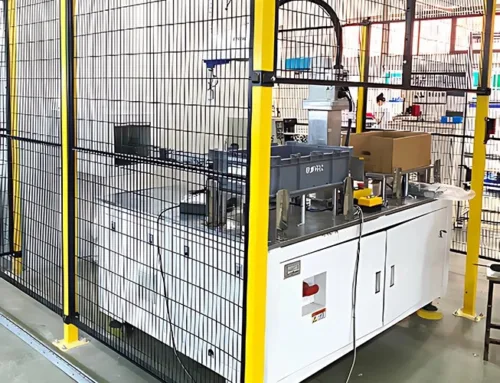
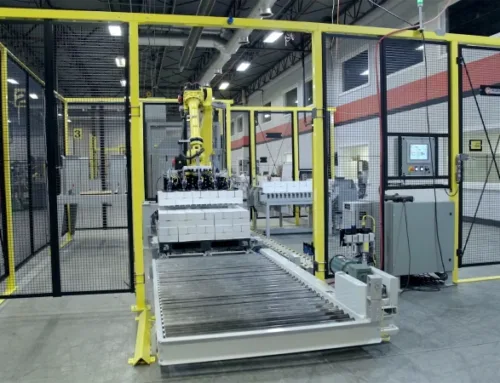
By specifying a powder-coated system, you deliver a pristine, OSHA-compliant robotic work cell with zero on-site touch-up painting required. The RAL 1023 Safety Yellow posts and RAL 9005 Black wire mesh maintain their high-visibility contrast for years. The black mesh specifically absorbs light to eliminate glare, providing operators with an unobstructed view of the cycle time and robotic movements, ensuring your client’s automated production line remains safe and highly visible.

Engineered for Impact: Protecting High-Value Robotics
Surface protection is only half the battle. In a busy logistics or material handling area, a forklift carrying a 2,000 lbs engine block might accidentally bump the perimeter, or a robotic arm might drop a heavy aluminum casting. Cheap, frameless wire mesh bends permanently upon impact, popping its weak spot welds and creating hazardous sharp edges that violate safety standards.
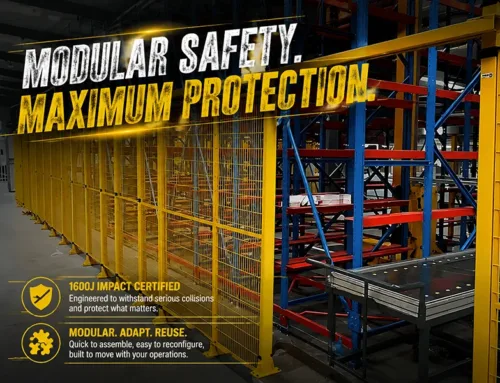
Our powder-coated finish protects a highly engineered structural beast. These machine guarding systems feature a fully welded 0.78″ x 1.18″ (20x30mm) tubular frame on every panel. The entire system is TUV-certified to withstand a massive 1600 Joules of impact energy—equivalent to stopping a 220 lbs object moving at 12.4 mph dead in its tracks.
The kinetic energy is absorbed by the framed panel and safely dissipated through the Q235 steel posts into the 4-point anchored heavy-duty base plates. There is no catastrophic failure, no flying shrapnel, and no structural collapse. Your automated line stays running, maximizing OEE (Overall Equipment Effectiveness) while protecting both personnel and your expensive capital equipment.
Seamless Integration for Turnkey Robotics Layouts
One of the biggest headaches during the final stages of a turnkey integration is access control. Trying to mount a Pizzato, Omron D4NL, or Schmersal safety interlock switch onto a generic fence means your mechanical assembly team has to drill and tap holes on-site. This hot work destroys the powder coating, introduces immediate rust points, and wastes valuable commissioning hours.

Our modular robot safety fencing is engineered specifically for system integrators. We utilize pre-fabricated mounting plates (Lock Carriers) designed for industry-standard safety switches. The electrostatic powder coating is applied after all holes are punched and tapped at our ISO 9001 factory.
Your electrical integration team simply bolts the safety interlocks directly to the pre-finished mounts on our sliding or hinged doors. When an operator opens the door, the mechanical separation immediately triggers the PLC’s Safety Torque Off (STO) circuit. This ensures full compliance with ISO 14120 and ANSI/RIA R15.06 standards without ever compromising the fence’s anti-corrosion integrity or delaying your project timeline.
Frequently Asked Questions (System Integration & Automotive Safety)
1. How does your powder-coated industrial safety fence hold up against CNC cutting fluids and synthetic coolants?
Our epoxy-polyester electrostatic powder coating is cured at high temperatures, creating a non-porous barrier that passes ISO 9227 neutral salt spray tests. It is highly resistant to degradation, blistering, or peeling when exposed to standard industrial CNC lubricants and solvents.
2. Can we mount safety light curtains directly to the powder-coated posts without drilling?
Yes. We offer specialized modular brackets and dedicated 80x80mm posts designed specifically to house light curtain emitters and receivers. This eliminates the need for on-site drilling, preserving the powder coat integrity and preventing rust.
3. What is the impact rating of your Q235 steel mesh panels for robotic work cells?
Our framed panel systems are TUV-certified to withstand an impact of 1600 Joules. This is achieved through the combination of high-tensile Q235 carbon steel, a fully welded 20x30mm tubular frame, and heavy-duty M10 floor anchors, ensuring containment of heavy parts or forklift bumps.
4. Does the black powder coating on the mesh panels improve operator visibility?
Absolutely. The RAL 9005 Black powder coating on the wire mesh absorbs ambient plant lighting rather than reflecting it. This eliminates glare, creating a “see-through” effect that allows operators and EHS managers to monitor automated machinery and robotic movements clearly.
5. How fast can your modular fencing be installed around an active automotive assembly line?
Because the system is 100% modular and utilizes a bolt-together clip system, it requires zero hot work (no welding) on site. A standard two-person crew can install up to 160 feet of fencing per day using basic hand tools, drastically reducing MTTR and installation downtime.