EN
EN  DE
DE  RU
RU  PT
PT  JA
JA  ES
ES  IT
IT 

|
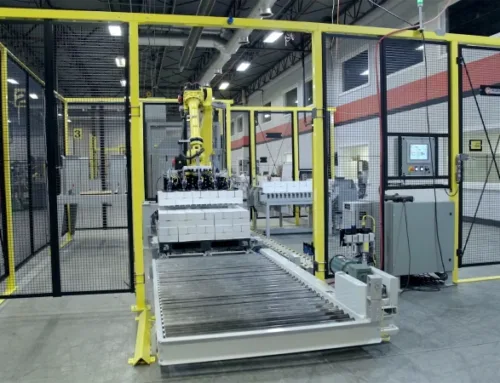
Deploying high-speed mechanical assembly machines and robotic work cells requires balancing aggressive cycle times with strict OSHA and ISO 14120 compliance. Relying on local fabricators for custom-welded barriers introduces unpredictable lead times, messy hot work on your clean plant floor, and a nightmare when integrating safety interlocks for PLC integration. You need a plug-and-play perimeter that acts as an active node in your Safe Torque Off (STO) circuit, engineered specifically for the dynamic layouts of modern automotive and automation facilities. |
The Hidden Bottleneck in High-Speed Assembly Lines
The Before Scenario: Automation system integrators often treat perimeter guarding as an afterthought. When commissioning a multi-station CNC machining center or a high-speed assembly line, relying on generic, frameless wire mesh leads to critical failures. Workers leaning on flimsy mesh cause elastic deformation, triggering false light curtain trips. Worse, when a high-speed spindle throws a part or an automated guided vehicle (AGV) bumps the barrier, brittle aluminum profiles or poorly welded joints snap, turning into dangerous shrapnel and causing catastrophic downtime.

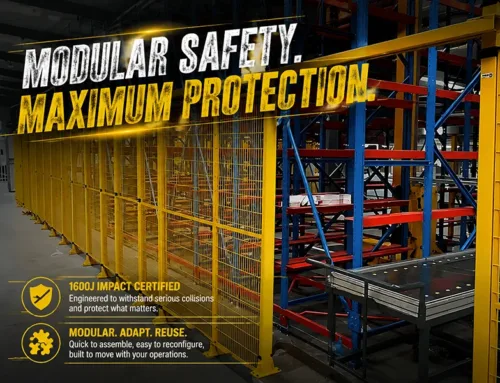
Why Mdfence Works: Our machine guard fencing is built on a foundation of structural integrity. Instead of frameless wire, we utilize a fully welded 20x30x1.5mm Q235 carbon steel framed panel architecture. The flattened weld points ensure maximum out-of-plane stiffness. Certified by TUV to withstand 1600 Joules of impact energy—equivalent to stopping a 220 lbs (100 kg) object moving at 12.4 mph (20 km/h)—the Q235 steel absorbs kinetic energy through plastic deformation rather than brittle fracture.
The After Result: You eliminate the risk of catastrophic perimeter breaches. The high rigidity prevents panel sagging, ensuring that your automated production line maintains maximum Overall Equipment Effectiveness (OEE) without nuisance stops caused by vibrating or warping panels.
Seamless PLC Integration: Mounting Safety Interlocks Without Hot Work
The Before Scenario: Integrating third-party safety switches (like Omron D4NL or Pizzato) onto standard fencing usually means your technicians are out on the floor with hand drills. Drilling into powder-coated posts creates metal shavings that damage sensitive electro-optical elements nearby, destroys the corrosion-resistant coating, and often results in misaligned switch keys. A misaligned door switch means the robotics layout cannot reset its safety circuit, delaying the cycle start.

Why Mdfence Works: We engineered our Robot Safety Fencing to be an active safety node. We provide pre-engineered installation carriers (such as the L-shaped mounting accessories shown above) designed specifically for industry-standard interlocks. The heavy-duty 60x60mm posts and framed doors ensure zero door sag over thousands of cycles, keeping the actuator key perfectly aligned with the switch body.
The After Result: Your controls engineers can plug-and-play the safety switches in minutes. No hot work, no drilling, no metal dust. Your STO circuit functions flawlessly from day one, ensuring seamless handover of the turnkey solution to your automotive clients.
Reclaiming Floor Space with ISO 13857 Compliant Mesh
The Before Scenario: Floor space in an advanced CNC center or automotive welding station is incredibly expensive. Using generic 2×2 inch (50x50mm) mesh allows fingers and arms to reach through. To comply with ISO 13857 reach-through standards, EHS managers are forced to install the barrier up to 33.5 inches (850mm) away from the hazard. This massive footprint eats into critical AGV paths and material handling areas.
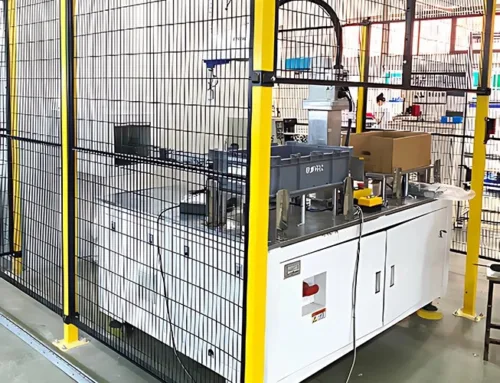
Why Mdfence Works: Our industrial safety fencing utilizes a tightly spaced 0.8×4 inch (20x100mm) “finger-safe” mesh design. This precise engineering restricts penetration to just the fingertips.
The After Result: You can legally and safely install the guarding just 4.7 inches (120mm) away from the moving machinery. For a typical 150-foot automated production line, this reclaims hundreds of square feet of usable plant floor, allowing you to widen forklift aisles or add an additional assembly station.
Unrestricted Access for Material Handling: Advanced Door Systems
The Before Scenario: High-speed assembly requires constant material feeding. Standard single hinged doors cannot accommodate the width of a loaded forklift or a large tooling changeover. When local fabricators attempt to build oversized doors, gravity takes over; the hinges stress, the door sags, and it drags on the concrete, eventually breaking the safety interlock alignment.

Why Mdfence Works: We offer a highly modular door system tailored for material handling. For wide access points with limited swing space, our double sliding doors utilize a heavy-duty top bearing rail system combined with a rigid door frame beam. This ensures the 60x60mm posts remain perfectly parallel, distributing the weight evenly.
The After Result: Forklifts and AGVs can seamlessly enter the robotics layout for tooling changes or pallet removal. The doors glide open effortlessly with one hand, and close with precision, instantly realigning the safety switches and minimizing Mean Time To Repair (MTTR) during routine maintenance.
The Integrator’s ROI: Cold Assembly vs. Hot Work
| Project Phase | Traditional Welded / Cheap Mesh | Mdfence Modular System |
|---|---|---|
| Design & Validation | Manual sketches; guesswork on ISO 13857 safety distances. | 3D STP files provided for direct CAD integration; guaranteed compliance. |
| Installation (Floor Impact) | Hot Work required. Sparks, fumes, fire permits needed. Line stops. | Cold Assembly. Bolted connections only. Zero sparks, zero downtime. |
| Layout Modifications | Requires angle grinders to cut. Asset is destroyed. Zero residual value. | Unbolt and reconfigure. 95% asset reuse rate for future line changes. |
Frequently Asked Questions for Automation Integrators
1. Can this fencing system integrate directly with our existing Omron and Pizzato safety switches?
Yes. We provide pre-engineered mounting plates (such as the KKCK-LCK-B-D4NL-SET) specifically designed for industry-standard safety interlocks. This eliminates the need for field drilling and ensures perfect alignment for your Safe Torque Off (STO) circuits.
2. How does the 20x100mm mesh impact the required safety distance from the robot envelope?
According to ISO 13857, our 20x100mm “finger-safe” mesh prevents upper and lower limb reach-through, allowing the fencing to be installed as close as 4.7 inches (120mm) to the hazard. This significantly reduces the overall footprint of the robotic cell compared to standard 50x50mm mesh.
3. Will the panels withstand a collision from a forklift or a high-speed ejected part?
The system is TUV certified to withstand up to 1600 Joules of impact energy. The Q235 carbon steel and fully welded 20x30mm framed architecture are designed to absorb kinetic energy via plastic deformation, preventing the barrier from shattering or collapsing.
4. We frequently reconfigure our automated assembly lines. Can this fencing be reused?
Absolutely. The modular, bolt-together design uses no on-site welding. Panels and posts can be unbolted and reassembled in new configurations, offering up to a 95% asset reuse rate when your factory layout changes.
5. How do you handle conveyor lines passing through the perimeter guarding?
We design custom tunnel guards tailored to your conveyor dimensions. These openings strictly adhere to ISO 13857 safety standards, ensuring that materials can flow freely into the high-speed assembly machine while preventing any personnel from reaching inside.