EN
EN  DE
DE  RU
RU  PT
PT  JA
JA  ES
ES  IT
IT 

|
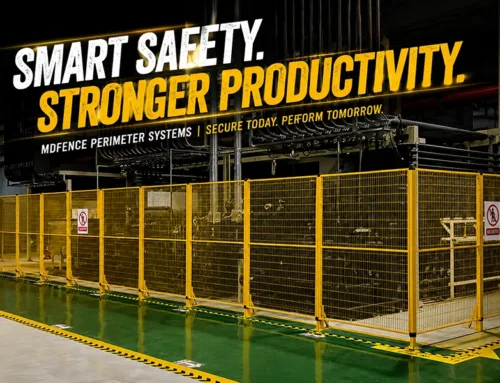
Your reputation is built on flawless robotic cell integration. But a failed EHS audit on safety guarding can derail project sign-off and kill your margins. Stop wrestling with on-site fabrication and compliance guesswork. Deliver a system that’s engineered to pass the first time. |
Compliance Guide for Robot Safety Fence Standards
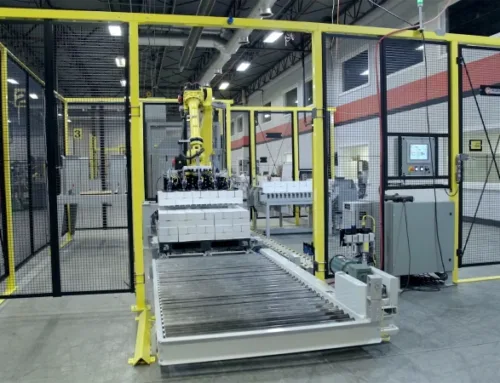
As an automation system integrator, navigating the web of safety standards like ISO 14120, ISO 13857, and ANSI/RIA R15.06 is more than a formality—it’s the foundation of a successful, sign-off-ready robot cell. A failure in Machine Guarding can lead to costly project delays, on-site rework, and a damaged reputation with your client. This guide moves beyond the theory and focuses on three practical pillars of compliance that directly impact your integration projects.
Pillar 1: Physical Integrity – More Than a Visual Deterrent (ISO 14120)
Your client’s EHS manager needs to know the barrier will perform during a worst-case scenario, like a robot dropping a payload or an AGV going off-course. Generic, unrated fencing or locally welded solutions create a massive liability because their performance is unknown. ISO 14120 specifies the general requirements for the design and construction of fixed guards, focusing on their ability to withstand operational stresses and foreseeable impacts.
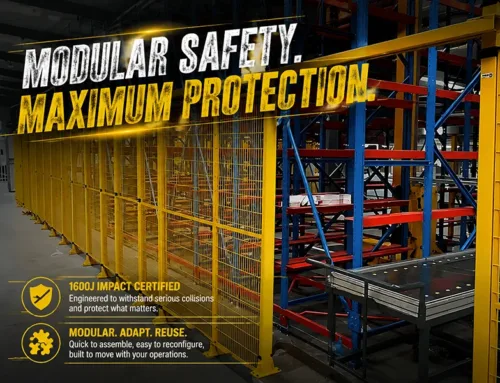
An engineered Robot Safety Fencing system is built from the ground up to meet these demands. The foundation is high-tensile Q235 carbon steel, used for both the robust 60x60mm posts and the fully welded 20x30mm tubular frame around each panel. This construction provides certified structural integrity, unlike frameless mesh that can easily deform or detach. For your risk assessment documentation, this translates into a verifiable impact resistance of 1600 Joules—enough to stop a 220 lbs (100 kg) object moving at 12.5 mph (20 km/h) without penetration.

The Integrator’s Advantage: You can confidently submit a solution with a spec sheet that proves compliance. No more debates over weld quality or material strength during the final audit. You deliver a physically robust system that protects both people and your client’s high-value automation assets.
Pillar 2: Safe Distancing – Turning Compliance into Floor Space (ISO 13857)
Every square foot of factory floor is prime real estate. When you’re forced to use a guard with large 50x50mm mesh openings, ISO 13857 dictates a significant safety distance—often up to 850mm (33.5 inches)—to prevent an operator from reaching through to the hazard. This forces you to design a larger, less efficient work cell, consuming valuable space your client could use for material staging or walkways.
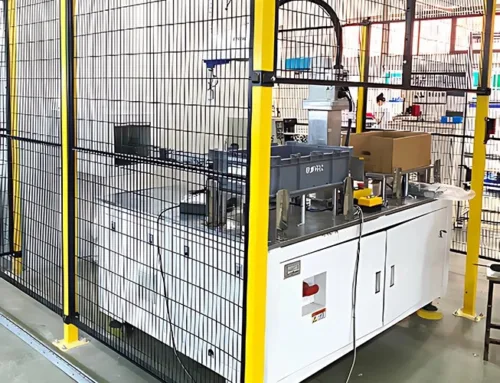
This is a problem solved by physics, not just policy. A mesh opening of 20x100mm is specifically designed to be “finger-safe.” According to the ISO 13857 standard, this small aperture physically prevents reach-through, allowing the safety distance to be legally and safely reduced to just 120mm (4.7 inches). For a 50-foot production line, this small change can reclaim over 350 square feet of usable floor space.
The Integrator’s Advantage: You can now offer your client a more compact and efficient cell layout as a value-added feature of your design. You’re not just selling a robot; you’re providing a spatially optimized solution that directly impacts their operational efficiency.
Pillar 3: Control Integration – From Passive Barrier to Active Safety Component (ANSI/RIA R15.06)
The final, and often most frustrating, hurdle is integrating the physical barrier with the machine’s control system. The project specs call for an Omron D4NL or Pizzato safety interlock, but the generic fence provides no clean way to mount it. This leaves your technicians drilling and tapping on-site, compromising the powder-coat finish and creating a flimsy bracket that can lead to switch misalignment and costly nuisance trips for your client down the line.
A modern Industrial Safety Fencing system anticipates this need. It’s designed to be an active part of the safety circuit. With pre-engineered components like a dedicated `Safety Interlock Carrier`, you get a standardized, rigid mounting plate designed for the exact bolt pattern of industry-leading switches. The installation is clean, repeatable, and robust, ensuring the access gate performs as a reliable input to the safety PLC.

The Integrator’s Advantage: You eliminate a major installation bottleneck and a common point of failure. Your team saves hours of frustrating on-site fabrication, and the final product is more reliable and professional. This seamless integration ensures the entire safety system—mechanical and electrical—functions as one, satisfying the stringent requirements of ANSI/RIA R15.06 and delivering a truly turnkey solution.
Frequently Asked Questions
1. Can your fence panels be modified on-site for conveyor cutouts?
Yes. The robust 20x30mm tubular frame allows for sections of the mesh to be cut out for conveyors or cable trays without compromising the panel’s overall structural integrity. For standard applications, we also offer pre-fabricated tunnel guard components for a cleaner, faster solution.
2. Do you provide 3D CAD models for our system design phase?
Absolutely. We provide comprehensive 3D STP files for all standard components. This allows your engineering team to simply drop the guarding system into your master assembly, check for clearances, and generate an accurate bill of materials, dramatically speeding up your design process.
3. How does the Mdfence system accommodate uneven concrete floors?
The system is designed with real-world factory conditions in mind. The anchor points on our post base plates provide a degree of tolerance, and the modular connection clips that attach the panels to the posts allow for minor vertical adjustments to ensure a level and secure installation even on slightly uneven surfaces.
4. What is the typical lead time for a standard robot cell configuration?
We maintain a significant inventory of our standard components—including posts, panels, and door kits—in our most common sizes and colors. This allows us to fulfill orders for typical robot cell layouts rapidly, helping you meet aggressive project timelines.
5. Is the yellow and black color scheme compliant with US standards?
Yes. The RAL 1023 (Safety Yellow) for posts and RAL 9005 (Black) for panels aligns with the principles of ANSI Z535.1 for safety color coding. The yellow clearly identifies a physical hazard boundary, while the black mesh reduces glare and improves visibility into the work cell, a feature highly valued by operators and maintenance staff.