EN
EN  DE
DE  RU
RU  PT
PT  JA
JA  ES
ES  IT
IT  |
Your conveyor is the artery of your operation, but every unprotected pinch point or hard-to-access motor is a ticking clock—counting down to the next costly line stoppage or OSHA-recordable incident. Traditional welded cages make quick jam-clearing impossible and turn routine maintenance into a multi-hour shutdown with grinders and welders. It’s time to stop choosing between throughput and safety. |
The Conveyor Conundrum: Why Traditional Guarding Kills Your Throughput
In any facility driven by automated conveyors, uptime is everything. Yet, the very measures intended to ensure safety often become the biggest operational bottlenecks. You’ve seen it before: a box gets skewed and jams the line. An operator, under pressure to hit their numbers, reaches past a flimsy barrier or through an oversized gap, triggering a full line E-stop or, worse, risking a serious injury at a roller or belt pinch point.
The alternative, a heavy-duty, welded-in-place guard, creates a different set of problems. When a drive motor needs replacing or a belt needs servicing, the maintenance team has to bring out the angle grinders and hot work permits. A 30-minute mechanical job spirals into a four-hour ordeal of cutting, grinding, welding, and repainting. That’s a half-shift of lost production, directly hitting your OEE (Overall Equipment Effectiveness) and creating a maintenance backlog that echoes for days.
Engineered for Flow: A Modular Approach to Conveyor Safety
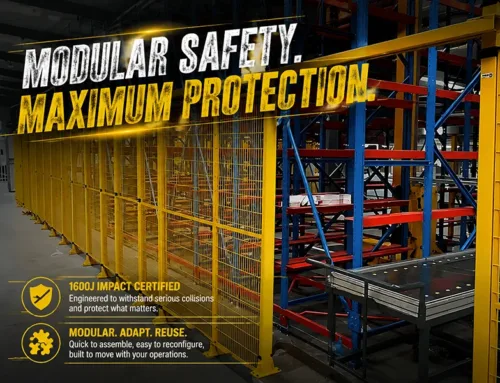
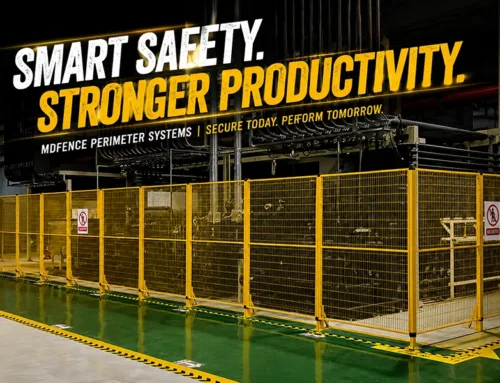
A modern conveyor system demands a safety solution as dynamic and efficient as the line itself. Mdfence industrial safety fencing is not just a barrier; it’s an integrated system designed to eliminate the conflict between access and protection.
1. Tunnel Guards: Uninterrupted Flow, Uncompromised Safety
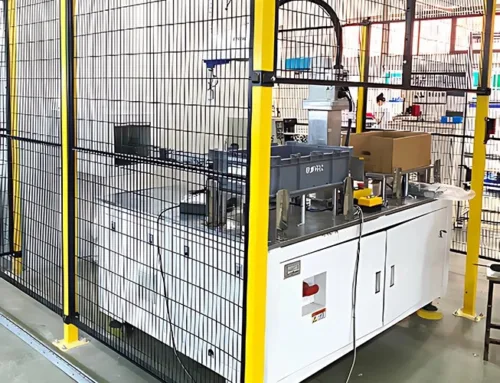
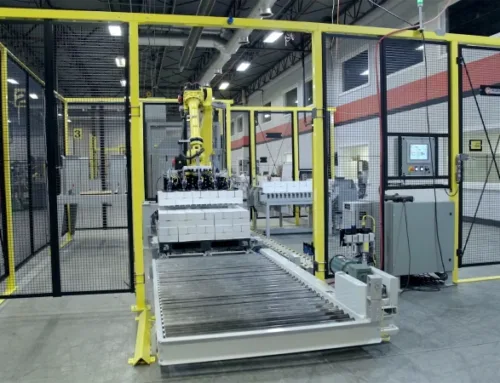
The core challenge is letting product through while keeping people out. Instead of leaving large, non-compliant gaps, our system utilizes custom-fabricated Tunnel Guards. These openings are engineered to the precise cross-section of your product, adhering strictly to ISO 13857 standards. This standard dictates the safe distance based on opening size, ensuring that while your totes, boxes, or components pass through unimpeded, an operator’s hand or arm cannot reach the hazardous moving parts within. These tunnels are built from our standard, robust带框网板 (Framed Panel), ensuring the structural integrity of the entire barrier is maintained.

2. Rapid-Access Interlocked Doors: Turn Minutes into Seconds
For inevitable jam-clearing, strategic access is key. We replace immovable panels with lightweight, yet durable, hinged or sliding doors at key points along your conveyor. More importantly, these aren’t just simple gates. They are designed as an active part of your control system. Our pre-engineered mounting plates allow for the seamless integration of safety interlock switches from leading brands like Omron or Pizzato. When an operator opens the door, the switch instantly signals your PLC to initiate a Safe Torque Off (STO) for that specific conveyor zone. The jam is cleared safely, the door is closed, and the line is back up and running in under a minute—not the 15 minutes it takes to recover from a full E-stop.

3. Built for the Real World: Fast Repairs, No Hot Work
Line-side environments are tough. A stray pallet jack or maintenance cart can easily damage a section of guarding. With a welded system, that means more cutting and welding. Our modular machine guarding system is built from high-strength Q235 carbon steel components that bolt together. If a panel or post is damaged, your maintenance team can unbolt the four fasteners, swap in a new component, and have the line fully protected again in less than 10 minutes. No hot work permits, no fumes, and minimal impact on production.

From Bottleneck to Uninterrupted Operation
Imagine your next preventative maintenance cycle. Instead of scheduling a full production shutdown, your team simply unbolts the necessary panels around the conveyor drive system during a planned changeover. The work is completed, and the guards are reinstalled before the next shift even starts. This is the reality of a modular system.
The entire installation is a “cold assembly” process. There is no on-site welding, which means your lines can continue to run in adjacent zones during installation. Two technicians with basic hand tools can erect over 150 feet of conveyor guarding in a single day, ensuring your new automation lines get up and running faster and your existing lines are retrofitted with minimal disruption.

By replacing rigid, obstructive barriers with a flexible, intelligent robot safety fencing system, you transform your conveyor guarding from a liability into an asset that boosts safety, accessibility, and, ultimately, your plant’s overall productivity.
Frequently Asked Questions
1. How do you create openings for our conveyors to pass through the fence?
We create custom “Tunnel Guards.” Based on the dimensions of the products on your conveyor, we design and fabricate openings in our standard mesh panels that are large enough for the product to pass through but small enough to prevent human access, strictly following ISO 13857 safety distance guidelines.
2. Can your safety barriers integrate with our conveyor’s E-stop or control system?
Absolutely. This is one of our core strengths. Our door systems are designed with pre-engineered mounting plates for industry-standard safety interlock switches (e.g., Omron, Pizzato, Schmersal). When a door is opened, the switch sends a signal to your PLC to safely stop the necessary section of the conveyor, integrating seamlessly into your safety circuit.
3. We need to frequently reconfigure our conveyor lines. Is your system suitable for that?
Yes, our system is ideal for dynamic environments. Because it’s a fully modular, bolt-together system, it can be easily disassembled, reconfigured, and reassembled as your production layout changes. This makes it a long-term asset, not a one-time construction expense like welded guarding.
4. How do your barriers hold up to impacts from carts or pallet jacks common in conveyor areas?
Our systems are constructed from industrial-grade Q235 carbon steel, with robust 60x60mm (approx. 2.36″ x 2.36″) posts and fully welded framed panels. They are engineered for high impact resistance to withstand the typical collisions found in a busy logistics or manufacturing environment, protecting both your personnel and your conveyor equipment.
5. What is the installation process like, and does it require production to stop?
Installation is a “cold assembly” process requiring only standard hand tools, primarily wrenches and a drill for floor anchors. There is no welding, grinding, or painting on-site. This means installation is fast, clean, and can often be completed in sections or during off-shifts without requiring a full shutdown of adjacent production lines.