EN
EN  DE
DE  RU
RU  PT
PT  JA
JA  ES
ES  IT
IT 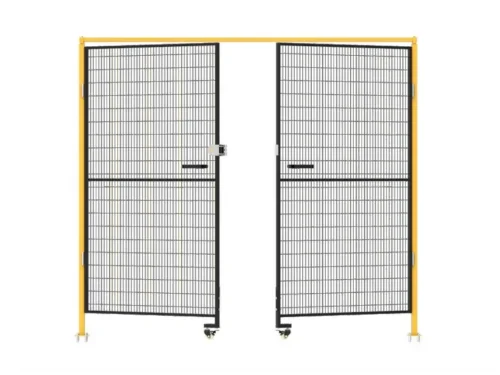
 |
Your new conveyor line is installed, but the guarding is threatening to derail your project timeline. Hot work permits, production halts for welding, and non-compliant cutouts are not an option when every minute of downtime costs thousands. There is a smarter, faster way to secure your automation and protect your cycle time. |
Industrial automation safety barriers for conveyors.
Conveyors are the lifeblood of modern automated facilities, moving components seamlessly between robotic work cells, assembly stations, and end-of-line packaging. But these essential arteries present a unique and persistent safety challenge. Every point where a product passes through a barrier is a potential breach—an opening that, if improperly guarded, can lead to serious injury and fail a critical EHS audit. The traditional approach of welding custom cages on-site is slow, disruptive, and fundamentally inflexible for today’s dynamic production environments.
The Old Way: How Welded Guards Sabotage Your OEE
For any experienced Automation Engineer or Plant Manager, the scenario is painfully familiar. You’ve invested millions in a high-speed production line, but the final safety sign-off is held up by the guarding. The on-site fabrication process itself introduces massive inefficiencies and risks:
- Costly Production Halts: Welding requires hot work permits, fire watches, and the shutdown of nearby operations due to fumes and spark hazards. This isn’t just an inconvenience; it’s a direct hit to your output targets.
- Compliance Roulette: A hand-cut opening for a conveyor belt, measured by eye, is a gamble. If an auditor finds the gap violates ISO 13857 reach distance standards, it means immediate rework, more downtime, and potential fines.
- Zero Asset Value: When it’s time to re-tool the line or perform major maintenance, welded barriers are not an asset; they’re an obstacle. They are taken out with an angle grinder and sent to the scrap heap, representing a 100% loss on your initial investment.
A Modular Approach: Engineering for Flow and Safety
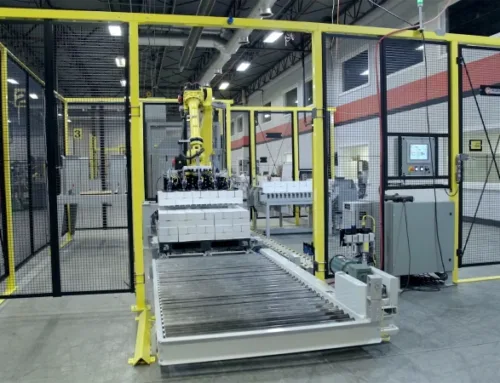
Instead of treating conveyor guarding as a fabrication problem, we approach it as an engineering challenge. The Mdfence system is designed to integrate with your automated line, not just surround it. This is achieved through a combination of intelligent design and robust materials.
Eradicate On-Site Hot Work with Cold Assembly
The entire Mdfence system is a bolt-together solution. Panels, posts, and doors are pre-fabricated and assembled on-site using high-strength steel connectors and standard hand tools. This “cold assembly” process is up to 70% faster than traditional welding. It means our installation teams can work alongside your technicians, during off-shifts or even weekends, without disrupting a single minute of your core production. What used to take a week of noisy, hazardous work can now be completed in a day.

Precision-Engineered Tunnel Guards for Guaranteed Compliance
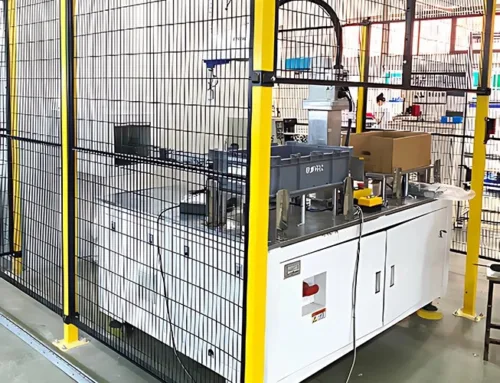
Guesswork has no place in safety. For conveyor pass-throughs, we utilize custom-fabricated Tunnel Guards. These are specifically engineered enclosures that surround the conveyor where it passes through the fence line. The opening size is precisely calculated based on the distance to the nearest hazard (like rollers or pinch points), ensuring full compliance with ISO 13857. This is complemented by our standard 20x100mm mesh pattern, which prevents fingers from reaching through, allowing the entire barrier to be placed closer to the equipment and saving valuable floor space.

Seamless Access Control for Maintenance and Operations
Effective guarding doesn’t impede necessary access; it controls it. In the tight confines of a conveyor line, a hinged door is often impractical. Our Robot Safety Fencing system includes track-mounted sliding doors that provide wide access for maintenance without requiring a large swing radius. More importantly, these doors are designed as an integral part of your safety circuit. We provide pre-engineered mounting plates for industry-standard interlock switches (like Omron, Pizzato, or Schmersal), allowing the door’s status to be fed directly to your safety PLC. Opening the door can trigger a Safe Torque Off (STO) command, immediately and safely halting the upstream machinery.

The Result: A Safer Line, A Faster Launch, A Smarter Investment
By shifting from on-site fabrication to a pre-engineered, modular system, the benefits extend far beyond the initial installation. You gain a safer, more efficient, and adaptable production environment.
- Accelerated Project Timelines: Eliminate the delays associated with welding and rework. Get your line running and generating revenue faster.
- Protected OEE: Drastically reduce unplanned downtime. Faster maintenance access (lower MTTR) and the elimination of nuisance trips from poorly guarded openings contribute directly to higher Overall Equipment Effectiveness.
- A Future-Proof Asset: When your production needs change, your guarding changes with them. The entire system can be unbolted, reconfigured, and redeployed with up to 95% asset reuse. The barrier you buy today is an investment that adapts for tomorrow.
Don’t let outdated guarding methods put your automation investment at risk. It’s time to build safety that’s as smart and flexible as the systems it protects.
Frequently Asked Questions
1. How do you handle guarding for conveyors of varying widths and heights?
Our Tunnel Guards are custom-fabricated based on your specific conveyor dimensions and the required safety distance calculations from the nearest hazard, per ISO 13857. We work directly with your CAD layouts to ensure a perfect, compliant fit for everything from small belt conveyors to large pallet transfer systems.
2. Can your system integrate with our existing safety PLC and light curtains?
Absolutely. Our door systems are designed with pre-drilled mounting plates for a wide range of popular safety interlock switches. Furthermore, we offer dedicated 80x80mm posts designed to seamlessly integrate light curtain transmitters and receivers directly into the fence line, creating a cohesive and robust safety solution.
3. What is the impact rating? Can it stop a falling tote or a runaway maintenance cart?
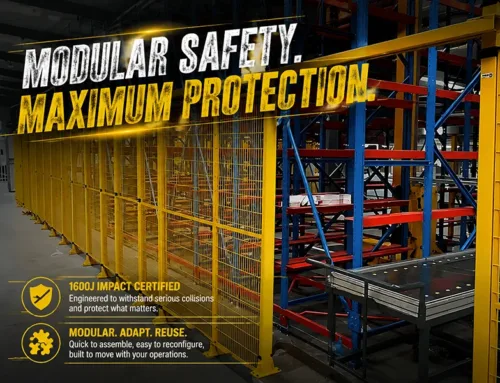
The Mdfence system is constructed from high-tensile Q235 carbon steel and is certified to withstand a 1600 Joule impact. This is equivalent to stopping a 100 kg (220 lbs) object moving at 20 km/h (12.4 mph), providing robust protection for both personnel and high-value automated equipment.
4. We have floor-level chain conveyors. How do you prevent step-overs?
We can configure the system using custom-height panels or multi-panel stacks to create a barrier that runs just inches from the plant floor. This effectively eliminates the risk of personnel stepping over low-level conveyors to access a hazardous area, ensuring a continuous and secure perimeter.
5. How quickly can we get a layout and quote for our 50-meter-long assembly line?
Our process is built for speed. Once we receive your facility’s CAD file (e.g., .dwg or .stp), our solutions engineers can typically produce a detailed layout, 3D model, and a complete Bill of Materials (BOM) for your project within 24-48 hours.