EN
EN  DE
DE  RU
RU  PT
PT  JA
JA  ES
ES  IT
IT 

|
Your AGV fleet is growing, but so are the near-misses. Every time a pedestrian strays into an automated corridor or a forklift clips a conveyor, your uptime and safety record are at risk. Floor tape is a suggestion, not a solution. It’s time for a physical barrier that’s as intelligent and flexible as your automation. |
Industrial Perimeter Guarding for high-traffic AGV zones.
In today’s distribution centers and manufacturing plants, Automated Guided Vehicles (AGVs) and Autonomous Mobile Robots (AMRs) are the new workhorses. They navigate complex routes, transport heavy loads, and are the backbone of operational efficiency. But the chaotic interface where these tireless machines meet human workers and manually operated equipment like forklifts has become a major source of risk and a critical bottleneck to achieving maximum throughput.
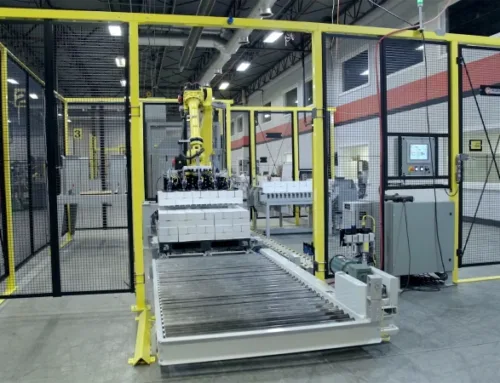
Floor tape gets ignored, and lightweight temporary barriers are easily displaced, creating hazards. To truly secure these dynamic environments, you need an engineered solution: a robust, modular Industrial Perimeter Guarding system designed to manage the realities of high-traffic automated zones.
The High Cost of “Good Enough” in AGV Corridors
Relying on inadequate or purely visual guides in a busy automated facility introduces daily risks that directly impact your bottom line:
- Costly AGV Traffic Jams: A misplaced pallet, a stray cart, or a knocked-over cone can halt an entire AGV fleet. This doesn’t just stop one vehicle; it creates a cascading gridlock, disrupting pick-and-pack cycles and jeopardizing shipping deadlines.
- The Forklift Factor: A manned forklift deviating from its path is one of the greatest threats in an automated facility. Even a minor impact can damage a high-value AGV, misalign a critical conveyor section, or, worse, strike a robotic charging station, causing extensive downtime and expensive repairs.
- Pedestrian Blind Spots: In a noisy, fast-paced warehouse, an employee focused on a task can easily step into the path of a silent, fast-moving AMR. These near-misses are a plant manager’s nightmare and a clear signal of an auditable safety failure.
Engineering a Collision-Proof Corridor: The Mdfence Logic
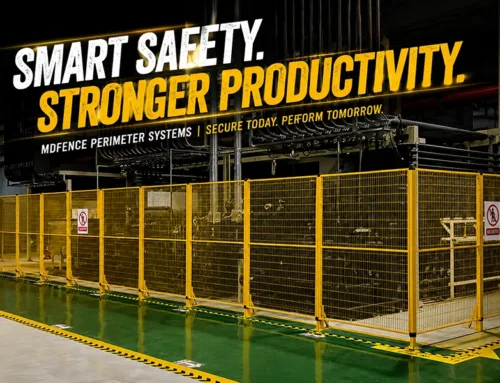
A true safety solution moves beyond mere suggestion and creates a predictable, physically-enforced environment. It’s built on a foundation of industrial-grade engineering principles that directly counter the chaos of a mixed-traffic warehouse.
From Visual Guideline to Physical Hard Stop
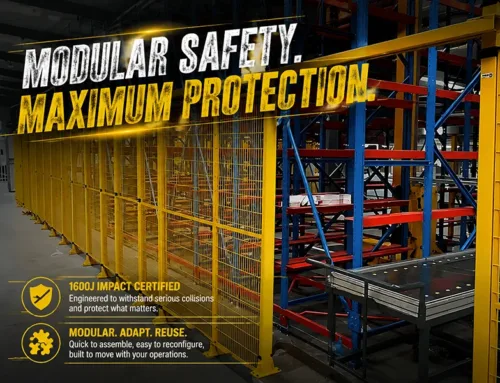
The primary function of guarding in an AGV zone is to prevent incursions. Our system is not just a visual deterrent; it’s a physical hard stop. The entire structure, from the 60x60mm posts to the fully-welded panel frames, is constructed from high-tensile Q235 carbon steel. It’s certified to withstand an impact of 1600 Joules—equivalent to stopping a 220 lbs (100kg) load moving at 12.5 mph (20 km/h). This means it can absorb a direct hit from a rogue pallet jack or a misdirected AGV, protecting both your people and your assets.

Layouts That Evolve with Your Fleet
Your operation isn’t static, so why should your safety infrastructure be? The core advantage of a modular Robot Safety Fencing system is its inherent flexibility. Our bolt-together design eliminates the need for any on-site welding, cutting, or grinding.
When you need to add a new conveyor line, reconfigure AGV charging bays, or create a temporary quality inspection cell, the system can be easily disassembled and reconfigured by your own maintenance team. This means no hot work permits, no waiting for external contractors, and a 100% reusable asset that adapts to your business needs, protecting your initial investment.

Smart Access for Authorized Personnel
Controlling the flow of people is just as important as controlling the flow of vehicles. We offer a full range of access solutions, including hinged, bi-parting, and space-saving sliding doors, ideal for wide forklift access points. More importantly, these gates are designed to be part of your active safety circuit. Our pre-engineered mounting plates for industry-standard safety interlock switches (like Omron, Pizzato, or Schmersal) turn a simple gate into an intelligent access point. Opening the door can automatically signal your Warehouse Control System (WCS) to pause AGVs in that zone, creating a fail-safe environment for maintenance or manual intervention.

The Result: Predictable Uptime and Auditable Safety
Implementing an engineered Machine Guarding system in your AGV zones transforms an unpredictable environment into a controlled, high-efficiency workspace. The benefits are immediate and measurable:
- Drastically Reduced Incidents: Clear, unbreachable physical segregation of pedestrian walkways, forklift lanes, and AGV highways eliminates the primary cause of collisions.
- Maximized Throughput: With their paths secured, your AGVs can operate at their optimal programmed speeds without the need for constant, cautious deceleration in mixed-traffic areas.
- OSHA-Ready Compliance: A professionally installed, impact-rated guarding system is a clear demonstration of your commitment to safety. It provides the auditable, documented proof that you have taken robust measures to mitigate risks in your automated facility.
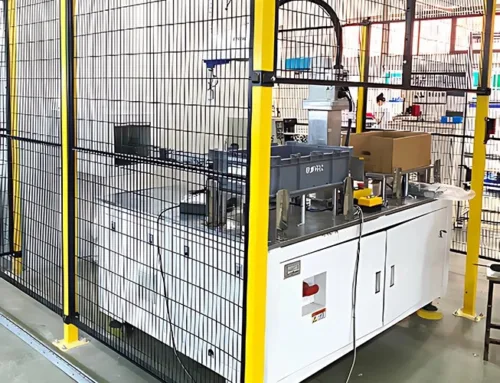
- Enhanced 5S and Organization: The high-visibility safety yellow posts and non-glare black mesh create a clean, organized visual environment. Details like our two-piece post base covers conceal anchor bolts, preventing trip hazards and making floor cleaning simpler.

Frequently Asked Questions
1. Can your fencing withstand a direct hit from a forklift?
Our heavy-duty system is engineered from Q235 carbon steel and certified to withstand significant impact forces (1600 Joules). While a direct, high-speed collision with a loaded forklift may cause damage, the system is designed to absorb the energy and prevent the vehicle from breaching the perimeter, protecting high-value assets or personnel on the other side. For extreme-risk areas, we can recommend reinforced configurations.
2. We frequently change our warehouse layout. How difficult is it to reconfigure this guarding?
This is one of our system’s core strengths. The fully modular, bolt-together design requires no welding or cutting. A two-person maintenance team with standard hand tools can typically disassemble, move, and re-install a section of fencing in a single shift, making it ideal for dynamic and evolving operational layouts.
3. Can we integrate our existing safety light curtains and emergency stops with your system?
Absolutely. Our system is designed to be the physical foundation of a comprehensive safety solution. We offer specialized posts and mounting brackets designed to seamlessly integrate third-party safety devices like light curtains, laser scanners, and E-stop buttons, creating a unified safety cell.
4. How does the black mesh affect visibility for our camera monitoring systems?
The RAL 9005 deep black powder coating on our mesh panels is specifically chosen for its optical properties. Unlike reflective galvanized or brightly colored mesh, the black finish absorbs light and minimizes glare, providing excellent through-visibility for both the human eye and security cameras. It effectively makes the fence “disappear” when viewed directly, allowing for clear monitoring of the automated zone.
5. What is the typical installation time for a 200-foot AGV corridor?
With a prepared concrete surface, an experienced two-person crew can typically install 150-250 feet of standard fencing per day. The pre-fabricated, bolt-together nature of the system eliminates the variables and delays associated with on-site welding and fabrication, ensuring a rapid and predictable deployment schedule.