EN
EN  DE
DE  RU
RU  PT
PT  JA
JA  ES
ES  IT
IT 

|
Your multi-robot cell design is approved, but the go-live date is tight. Now you’re facing the challenge of specifying, fabricating, and integrating a safety system that won’t get rejected by the end-user’s EHS team. What if your physical guarding was as precise and predictable as your PLC code? |
As a system integrator, you live in two worlds. The first is the clean, digital world of CAD, where every component in your multi-robot work cell fits perfectly. The second is the messy physical world of the factory floor, where “good enough” solutions can derail your entire project. This is especially true for machine guarding. A locally welded cage or a flimsy off-the-shelf fence isn’t just a line item; it’s a major project risk that can lead to failed acceptance tests, costly rework, and missed deadlines.
The Hidden Costs of “Good Enough” Guarding in Automation
When the pressure is on, it’s tempting to treat safety fencing as a commodity. However, for complex robotic cells, this approach often backfires, creating problems that cost far more than the initial savings.
The Local Welder Gamble
Hiring a local fabrication shop introduces massive variability. You’re dealing with inconsistent weld quality, the need for on-site hot work permits, and the inevitable delays. The final product rarely matches the professional aesthetic of your multi-million dollar automation system, and more importantly, it comes with zero compliance documentation to satisfy a stringent EHS audit.
The Flimsy Mesh Trap
Low-cost, frameless mesh panels (often called “Anping” mesh) present a different set of problems. Their lack of structural rigidity is a critical flaw in automated environments. Doors built with this material inevitably sag over time. This slight misalignment is enough to cause nuisance trips in your safety interlock switches, leading to frustrating and difficult-to-diagnose line stoppages that destroy OEE. Furthermore, their large 50x50mm mesh openings force you to place the barrier far from the robot to meet ISO 13857 safety distance requirements, wasting valuable floor space you meticulously planned for in your layout.
From Raw Steel to a Plug-and-Play Safety Asset
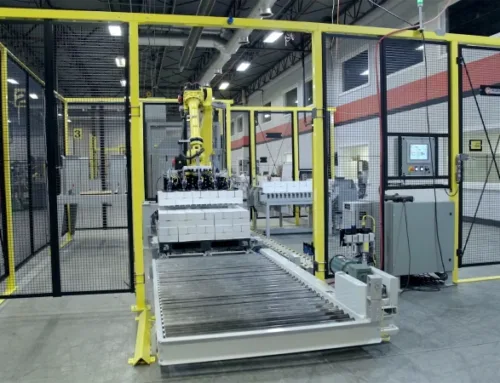
A truly effective robot safety fencing system isn’t a barrier; it’s an integrated component of your automation design. It should be specified with the same precision as your PLCs and end-effectors. This is the engineering philosophy behind the Mdfence system.
Foundation of Strength: Q235 Steel and Framed Panel Architecture
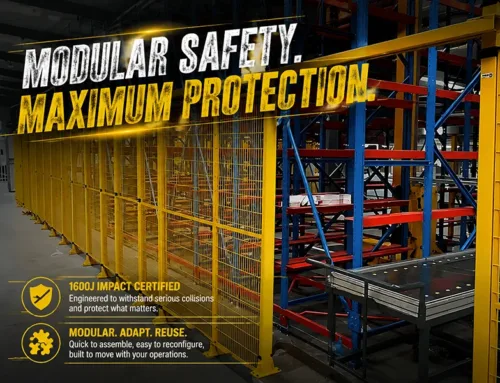
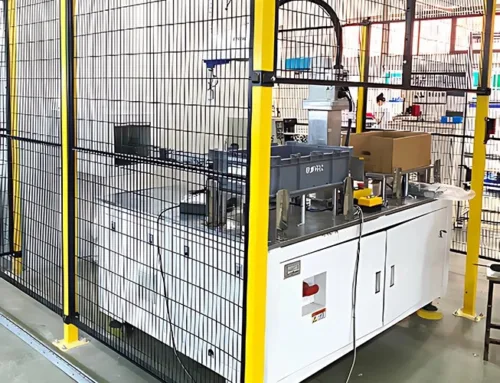
The system’s backbone is high-tensile Q235 carbon steel. Unlike brittle materials, Q235 steel is designed to deform under extreme impact (like a forklift collision), absorbing energy rather than shattering and creating secondary projectiles. The core of the system’s rigidity comes from its Framed Panel design. Every mesh panel is fully welded inside a 20x30mm tubular steel frame. This architecture provides immense out-of-plane stiffness, preventing the sag and flex that plague frameless systems and ensuring your access doors remain perfectly aligned for years of service.

Designed for PLe/SIL3: Seamless Safety Interlock Integration
Integrating safety interlocks is where most fencing systems fail. Drilling holes into a powder-coated post on-site is messy, compromises corrosion resistance, and rarely results in perfect alignment. Mdfence solves this critical integration challenge with a range of pre-engineered lock carriers and mounting plates specifically designed for industry-standard switches like the Omron D4NL or Pizzato series. This “plug-and-play” approach ensures that the mechanical component of your safety circuit is as reliable as the electrical one, eliminating a common point of failure and saving your team hours of on-site fabrication and rework.

Cold Assembly That Respects Your Timeline
Every component of the Mdfence system is designed for rapid, bolt-together assembly. There is no on-site welding, grinding, or painting. This “cold assembly” process is up to 70% faster than traditional fabrication and can be performed without disrupting other commissioning activities on the plant floor. Your team can erect 50 meters of fencing in a single day with just a few basic hand tools, keeping your project on its aggressive timeline.

From Project Risk to Client Confidence
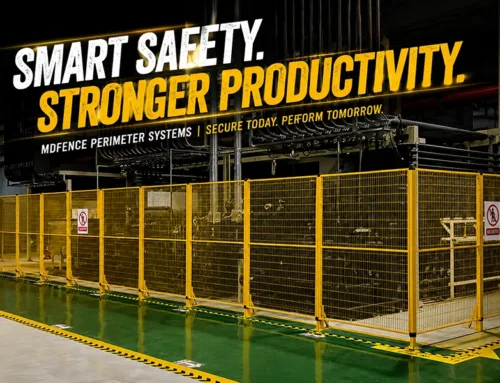
By choosing an engineered industrial safety fencing system, you transform a potential bottleneck into a feature that enhances your project’s value. The system arrives as a complete kit, with a BOM that matches your CAD model down to the last bolt. The final installation is clean, professional, and backed by ISO 14120 compliance documentation, ensuring you pass the end-user’s EHS audit on the first walkthrough.
Most importantly, this modular system becomes a long-term asset. When your client needs to retool the line for a new model year, the fencing can be easily reconfigured and reused, not scrapped. This demonstrates foresight and delivers value that extends far beyond the initial project scope, solidifying your reputation as a premier system integrator.

Frequently Asked Questions
1. Can your system accommodate conveyors or other material handling pass-throughs?
Absolutely. We provide pre-engineered Tunnel Guards and custom-sized openings that are fully compliant with ISO 13857 safety standards. This ensures materials can pass through the barrier without creating a hazardous access point for personnel.
2. Do you provide CAD/STP files for integration into our master layout?
Yes. We offer a complete library of 3D CAD models for all standard components. This allows your design team to integrate our fencing system directly into your master assembly, verify clearances, and generate an accurate Bill of Materials, eliminating design guesswork and on-site surprises.
3. How does the 20x100mm mesh size benefit my cell design?
The 20mm narrow opening is a “finger-safe” design according to ISO 13857. This allows the physical barrier to be installed as close as 120mm to the hazard zone. Compared to larger 50x50mm mesh which can require a setback of 850mm, our system can save you several square meters of valuable floor space around each robot.
4. What is the typical lead time for a custom robot cell project?
While custom components require a specific lead time, all our standard components (posts, panels, fasteners, door hardware) are stocked for rapid deployment. This allows us to meet the urgent deadlines common in automation projects, often shipping standard configurations within days.
5. Is the system compatible with safety light curtains?
Yes. We offer dedicated 80x80mm posts with integrated channels designed specifically for mounting safety light curtains (muting sensors). This provides a clean, robust, and seamless integration of electronic and physical guarding into a single cohesive system.