EN
EN  DE
DE  RU
RU  PT
PT  JA
JA  ES
ES  IT
IT 
 |
Your latest automation project is approved. The KUKA robot is on order, the PLC logic is mapped out, but the machine guarding is still a vague box on the CAD drawing. Now comes the choice: resort to the slow, inflexible process of on-site welding, or specify a generic fence that creates compliance headaches and wastes precious floor space. This final 10% of the project shouldn’t be the most frustrating part. |
Durable Safety Fence Industrial Solutions
In the world of automation integration, the success of a project is measured in uptime, cycle time, and flawless safety compliance. Yet, too often, the physical barrier that surrounds a multi-million dollar robotic cell—the Machine Guarding Systems—is treated as a low-tech commodity. This approach inevitably leads to on-site fabrication delays, failed EHS audits, and inflexible layouts that can’t adapt to future needs. A truly durable solution isn’t just about strong steel; it’s about robust engineering that accelerates your project and protects your investment for years to come.
The Hidden Costs of “Good Enough” Guarding in Automated Cells
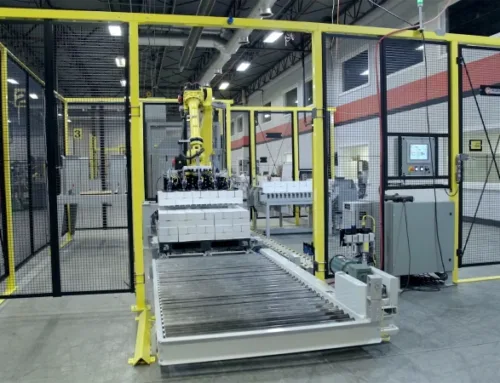
For any Systems Integrator or Plant Engineer, the “Before” scenario is painfully familiar. You’ve designed a state-of-the-art robot work cell, but the guarding becomes a bottleneck.
- The Welding Trap: Opting for a local welder means dealing with hot work permits, fire safety hazards, and production downtime. The quality is inconsistent, and the final result is a permanent structure. When the line needs to be retooled in 18 months, that “cheap” welded fence becomes scrap metal, and the entire cost is written off.
- The Compliance Gamble: Using standard, large-aperture wire mesh (e.g., 50x50mm) to save on material costs creates a massive compliance problem. According to ISO 13857, to prevent a hand or arm from reaching a hazard, this type of fence must be installed far from the machine—often 850mm or more. In a dense manufacturing environment, this wasted space is a luxury no one can afford.
This traditional approach forces a compromise between safety, efficiency, and budget, leaving your high-tech automation protected by a low-tech, inflexible, and often non-compliant barrier.
Engineered for Impact and Efficiency: The Mdfence Structural Advantage
A durable Robot Safety Fencing solution starts at the molecular level and extends to its modular architecture. It’s a system designed to solve the core contradictions of the factory floor.
1. Strength Where It Counts: The Framed Panel Core
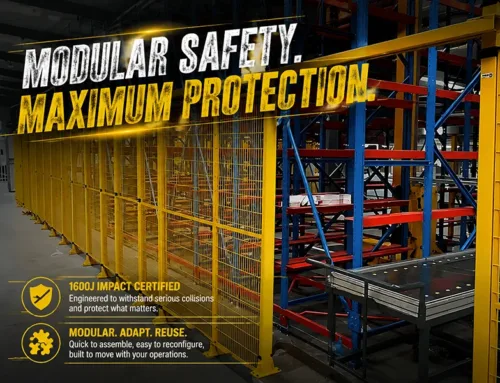
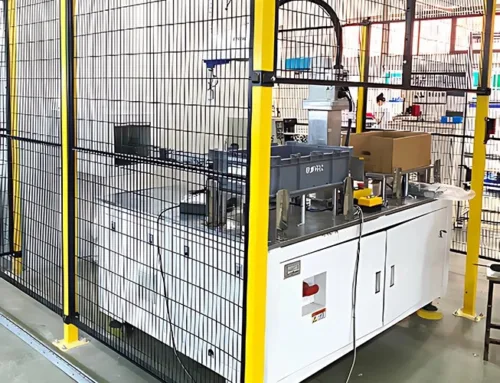
Unlike flimsy, frameless mesh that deforms under the slightest impact, our system is built around a fully welded 20x30mm tubular steel frame. This isn’t just for aesthetics; this architecture provides immense out-of-plane stiffness. The entire structure is built from high-tensile Q235 carbon steel, engineered to withstand a certified 1600 Joule impact. That’s the equivalent of stopping a 100 kg (220 lbs) object moving at 20 km/h (12.4 mph). It’s the difference between a minor incident and a catastrophic failure that destroys an expensive end-of-arm tool or the robot itself.

2. Intelligence in the Details: The Space-Saving Mesh
Our standard 20x100mm mesh aperture is a deliberate engineering choice. This “finger-safe” design, compliant with ISO 13857, allows the guarding to be installed as close as 120mm (4.7 inches) from the hazard. For a 50-meter production line, this can reclaim over 35 square meters of valuable floor space compared to traditional mesh—enough for another pallet station or a wider, safer forklift aisle.
3. Speed of Assembly: The No-Weld Connection
The entire system is assembled with high-strength steel brackets and bolts. This “cold assembly” process is 40% faster than welding, requires no hot work permits, and produces no hazardous fumes. Two technicians can install over 50 meters in a single day using basic hand tools. More importantly, it means the system is 100% reconfigurable. When your layout changes, your safety fence adapts with it, preserving your initial investment.

From Passive Barrier to Active Safety Component
For a modern automation cell, a fence that merely acts as a physical wall is insufficient. It must integrate seamlessly into the machine’s safety control system. This is often where integrators face the biggest challenges—drilling, tapping, and fabricating custom brackets to mount safety interlock switches like an Omron D4NL or a Pizzato FS series.
Our system eliminates this pain point. We provide pre-engineered, model-specific mounting plates, or what we call a Safety Interlock Carrier. This transforms the fence door from a simple access point into a reliable node in your safety circuit. When a door is opened, the switch is actuated with perfect alignment, triggering the Safety Torque Off (STO) command to the PLC. This pre-validated solution saves hours of on-site fabrication and de-risks your safety system commissioning, ensuring you pass the most stringent EHS audits the first time.
As demonstrated in complex projects for integrators like GBM Automation, we deliver a complete, customized solution based directly on your CAD files, ensuring every panel, post, and interlock fits perfectly from day one.

Your Automation Deserves an Engineered Safety Solution
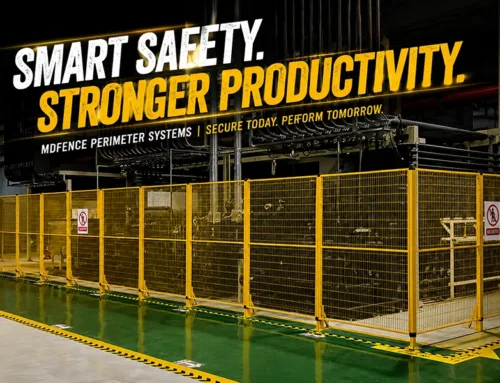
Your investment in robotics and automation is a commitment to precision, efficiency, and safety. Your guarding system should reflect that same standard. A durable Safety Fence Industrial solution is not an expense; it’s an enabling asset that accelerates deployment, maximizes floor space, and adapts to the dynamic nature of modern manufacturing. Stop letting the fence be the weak link in your automation chain.
Frequently Asked Questions
1. How does your system integrate with our existing safety PLCs and interlocks from brands like Schmersal, Omron, or Pilz?
Our system is designed for seamless integration. We offer a range of pre-engineered mounting plates and “Safety Interlock Carriers” specifically designed for popular models like the Omron D4NL, Pizzato, and others. These kits ensure perfect alignment and turn our fence doors into reliable inputs for your safety PLC, making it an active component in your PLe/SIL3 safety circuits without any on-site drilling or custom fabrication.
2. We are concerned about impacts from forklifts or ejected parts. What level of impact can your robot safety fence withstand?
Our standard system, built with Q235 carbon steel and framed panels, is TUV-certified to withstand an impact energy of 1600 Joules. To put that in perspective, it’s equivalent to absorbing the impact of a 100 kg (220 lbs) object, like a heavy tooling fixture, moving at 20 km/h (12.4 mph) without a breach. This provides robust protection for both personnel and high-value automation assets.
3. Our factory floor is extremely crowded. How does your guarding help with space constraints around robot cells?
This is one of the key problems we solve. Our standard 20x100mm mesh is specifically designed to meet ISO 13857 “finger-safe” standards. This allows you to legally and safely place the fence as close as 120mm (4.7 inches) to the machinery’s hazard zone. Compared to larger mesh that requires setbacks of 850mm or more, our system can save you significant square footage around every single robot cell.
4. Our production lines are reconfigured every couple of years. Is this system reusable or is it a sunk cost like welded fencing?
Our system is designed for flexibility and long-term value. It is a 100% modular, bolt-together solution. There is no welding, so it can be disassembled, reconfigured, and re-installed with basic tools. This gives you an asset reusability rate of over 95%, meaning your initial investment is protected and can be adapted as your production needs evolve.
5. Our automated line has multiple conveyor pass-throughs and areas where we need light curtains. Can your system accommodate this?
Absolutely. We regularly design solutions for complex layouts. We provide custom-sized tunnel guards for conveyor openings that allow product to pass through while preventing human access, all in compliance with ISO 13857. We also offer dedicated, reinforced 80x80mm posts designed specifically for mounting light curtains, creating a seamless and robust integration between the physical barrier and the electronic safety devices.