EN
EN  DE
DE  RU
RU  PT
PT  JA
JA  ES
ES  IT
IT 
In the world of industrial safety, there exists a category of “common knowledge” that feels right but is, in practice, dangerously flawed. These are the assumptions and misconceptions we see implemented in facilities every day—often with the best of intentions—that create a false sense of security while leaving assets and personnel exposed to significant risk.
Today, we are going to act as myth busters. We will tackle three of the most common and perilous misconceptions about facility protection. Our goal is to replace well-intentioned guesswork with sound engineering principles, helping you build a safety system that is genuinely effective.
Myth #1: “A Guardrail is a Guardrail. I Can Just Use a Highway Barrier.”
The Perceived Logic: Highway guardrails are designed to stop cars moving at high speeds. Surely, one would be more than strong enough to stop a slow-moving forklift inside a warehouse. They often look similar, and sometimes surplus highway material can be acquired cheaply.
The Engineering Fact: This is a classic case of misapplying a tool because it looks familiar. A highway W-beam guardrail and an industrial heavy duty guardrail are fundamentally different systems, engineered to solve vastly different problems.
Different Impact Dynamics: Highway barriers are designed to handle glancing blows from vehicles traveling at high speeds (e.g., 60 mph). Their primary function is to absorb and redirect a vehicle’s momentum, preventing it from crossing a median or leaving the roadway. An indoor industrial impact is entirely different: it’s typically a low-speed, high-mass, direct or near-direct perpendicular impact. The goal is not to redirect, but to absorb and stop the vehicle completely within a very short distance.
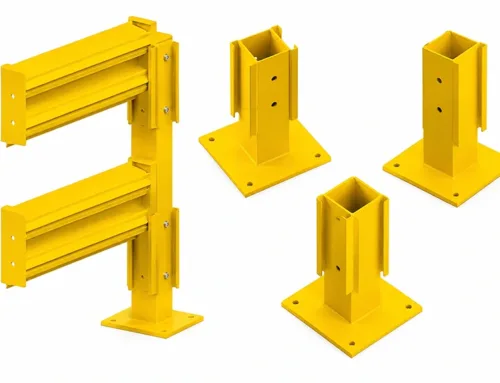
Different Installation Engineering: Highway guardrails are installed on wooden or steel posts driven deep into soil, which is expected to yield and deform as part of the energy absorption process. Attempting to bolt this same system to a rigid concrete floor fundamentally changes its performance. An industrial guardrail system, with its wide, 10×10-inch base plates and specific concrete anchor bolt specifications, is engineered from the ground up to transfer impact forces safely into a solid concrete substrate without failing.
Using a highway barrier indoors is not just a sub-optimal choice; it’s an unpredictable one. You are using a product outside of its tested and intended purpose, meaning you have no verifiable data on how it will perform when you need it most.
Myth #2: “A Poured Concrete Curb or Bollard Offers the Same Protection.”
The Perceived Logic: Concrete is incredibly strong. A solid concrete curb or a series of concrete-filled steel pipes (bollards) seems like an immovable object that would easily stop a forklift.
The Engineering Fact: While concrete has immense compressive strength (it’s hard to crush), it has very poor tensile strength (it cracks when pulled or bent). A direct impact from a forklift places immense tensile and shear stress on a curb or bollard at its base.
The Risk of Brittle Failure: Unlike an engineered steel guardrail, which is designed to flex and deform to absorb energy, concrete does not bend. It withstands the force until its tensile limit is exceeded, at which point it experiences a sudden, brittle failure. This can result in the curb shattering, sending dangerous projectiles into the work area, or a bollard shearing off at its base and becoming a hazard itself.
The Problem of Force Transfer: A steel guardrail system acts like a spring, absorbing the impact over a fraction of a second and distributing the load across multiple posts and anchors. A rigid concrete structure transfers that entire impact force almost instantaneously to the floor slab it’s attached to. This can cause significant damage to your concrete floor, leading to costly and disruptive repairs that go far beyond the cost of a replacement rail section.
A concrete barrier might seem strong, but a purpose-built steel barrier system is far more resilient—and resilience, not just brute strength, is the key to effective impact absorption.
Myth #3: “As Long as It’s Made of Steel and Painted Yellow, It’s a Safety Barrier.”
The Perceived Logic: The barrier’s main job is to be a visual deterrent. As long as it’s yellow and made of metal, it will make operators more cautious and should be sufficient.
The Engineering Fact: This is perhaps the most dangerous myth of all because it promotes a false sense of security. A non-engineered, locally fabricated steel railing may serve as a visual guide, but it offers no quantifiable level of protection.
The difference between a decorative railing and a true safety barrier lies in verifiable performance data. A professional heavy duty guardrail system has been designed and tested to meet a specific impact rating, such as the capacity to stop a 10,000-pound vehicle at 4 mph. This rating is a promise. It is your assurance that the product’s material thickness, beam profile, post dimensions, and anchor specifications have all been calculated to work together as a system to stop a predictable threat.
Choosing an unrated barrier is a gamble. You are installing a safety device with an unknown capacity to perform its one critical function. A true safety solution replaces guesswork with certainty.
Your facility’s safety deserves more than assumptions. It deserves an engineered approach based on sound physics and verifiable data.