EN
EN  DE
DE  RU
RU  PT
PT  JA
JA  ES
ES  IT
IT 

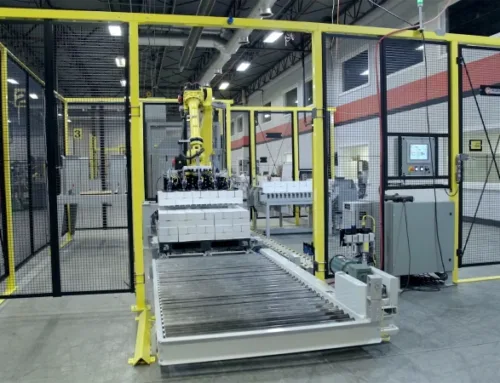
Every minute a KUKA or FANUC robot sits idle because of a misaligned safety switch or a forklift bump, your plant’s OEE plummets. In high-speed automotive assembly, relying on flimsy wire mesh or custom-welded barriers means longer MTTR and failed EHS audits. You need a guarding system that actively integrates with your PLC while absorbing catastrophic impacts without shutting down the line.
The Hidden OEE Killers in Automotive Workcells
In an automated production line, the physical barrier is often treated as an afterthought until it causes a shutdown. Picture a typical automotive welding station: a 5,000 lbs forklift slightly taps a standard frameless wire fence while delivering stamped parts. The cheap mesh deforms, pushing into the safety zone, or worse, the door hinges sag.
When the door sags, the actuator key misaligns with the safety interlock switch. The Safe Torque Off (STO) circuit breaks. The robot halts mid-cycle. To fix it, your maintenance team has to issue a hot work permit, bring in a welder, cut the bent frame, weld a new piece, and repaint it. That is 4 hours of lost cycle time. This is the exact scenario where inadequate Machine Guarding Systems destroy your Overall Equipment Effectiveness (OEE).

The Physics of Uptime: Why Modular Framing Works
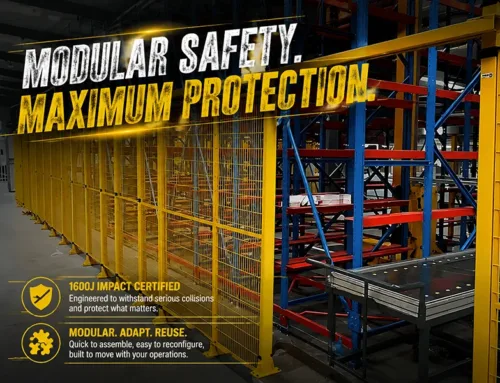
To protect cycle times, you must eliminate the “Hot Work” MTTR. Mdfence engineered a system based on the structural mechanics of Q235 cold-rolled carbon steel. Instead of relying on the tensile strength of bent wire, our Industrial Safety Fencing utilizes a fully welded 0.78″ x 1.18″ (20x30mm) tubular frame for every panel.
The Logic: When a heavy work-in-progress (WIP) part is ejected from a CNC machining center, or an AGV veers off path, the kinetic energy hits the mesh. The flattened weld points transfer this load to the tubular frame, which disperses it to the 2.36″ x 2.36″ (60x60mm) posts, and finally down to the 4-bolt anchorage system. It is TUV-certified to withstand a 1600 Joules impact—equivalent to stopping a 220 lbs mass moving at 12 mph. It absorbs the energy through plastic deformation rather than brittle fracture.
The Actual Benefit: If a forklift destroys a panel, your technician uses an Allen wrench to unbolt the clips, swaps in a new panel from inventory, and tightens it. The cell is back online in 10 minutes. No welding, no sparks, no grinding. MTTR is slashed by over 90%.
Seamless PLC Integration & Reclaiming Floor Space
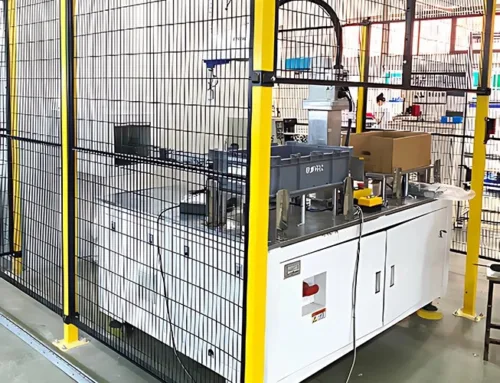
System integrators know the pain of field-modifying barriers to accept Omron D4NL or Pizzato switches. Drilling into powder-coated steel on the factory floor invites rust and misalignments.

The Logic: Our Robot Safety Fencing acts as the physical carrier for your safety logic. We provide pre-engineered lock carriers (e.g., KKCK-LCK-B-D4NL-SET). Furthermore, standard hinged doors feature a heavy-duty door frame beam (shown above) that ties the two posts together. This guarantees the posts remain perfectly parallel.
The Actual Benefit: The door never sags. The actuator key hits the switch dead-center every single time a worker enters the cell for LOTO (Lockout/Tagout). Nuisance trips are eliminated. Additionally, our 0.78″ x 3.93″ (20x100mm) finger-safe mesh exceeds ISO 13857 standards, allowing you to install the perimeter just 4.7 inches (120mm) away from the hazard, rather than the 33.4 inches (850mm) required for standard 2″x2″ mesh. You reclaim massive amounts of premium floor space for wider AGV paths.

Traditional Welding vs. Modular Integration Matrix
| Operational Phase | Standard Welded/Frameless Fencing | Mdfence Modular System |
|---|---|---|
| Layout & Engineering | Guesswork on safety distances; manual cut-to-fit on site. | Provide 3D STP files; verify ISO 13857 compliance directly in CAD before deployment. |
| Installation & Commissioning | Hot work permits required. Sparks damage adjacent optical sensors and light curtains. | Cold assembly. 100% bolt-on design speeds up integration by 40%. |
| Maintenance & OEE | Door sag causes switch misalignment; high MTTR for repairs. | Rigid tubular frames prevent sagging; damaged panels replaced in 10 mins. |
Frequently Asked Questions (FAQs)
1. How does your 20x100mm mesh specifically improve cycle times in a robotic assembly cell?
By meeting the strict finger-safe requirements of ISO 13857, the 20x100mm mesh allows the barrier to be placed as close as 4.7 inches (120mm) to the robot’s maximum reach. This shrinks the footprint of the cell, meaning operators and material handling systems travel shorter distances to load/unload parts, directly shaving seconds off your cycle time.
2. Can this system integrate directly with our existing Siemens or Rockwell PLC safety circuits?
Yes. The physical barrier is designed with pre-engineered lock carriers that accommodate industry-standard safety interlock switches (like Omron, Schmersal, or Pizzato). The rigid frame ensures the actuator key never misaligns, providing a stable, mechanical foundation for your electronic Safe Torque Off (STO) circuits.
3. What happens to the guarding if an AGV or forklift collides with it during material handling?
Our system is TUV certified to withstand a 1600 Joules impact. The Q235 carbon steel and framed panel architecture absorb the kinetic energy through plastic deformation (bending) rather than snapping. It prevents the vehicle from breaching the robot cell, and the damaged panel can be unbolted and replaced in minutes without hot work.
4. We frequently reconfigure our automotive manufacturing lines. Is this fencing reusable?
Absolutely. Because it is a 100% modular, bolt-together system, it offers a 95% asset reuse rate. When your line layout changes, you simply unbolt the clips, move the posts, and reassemble the panels in the new configuration. No cutting or grinding is required.
5. Does the fencing system comply with OSHA and ISO 14120 standards for machine safety?
Yes, the system is designed strictly in accordance with ISO 14120 general requirements for the design and construction of fixed guards, as well as ANSI/RIA R15.06 for industrial robot safety. This ensures you pass stringent EHS audits and maintain compliance across global manufacturing facilities.