EN
EN  DE
DE  RU
RU  PT
PT  JA
JA  ES
ES  IT
IT FORKLIFT SAFETY BARRIER | FCBarrier
Self-Rebounding Barrier for Forklift Zones: Stop Steel Guardrail Repair Cycles
In warehouse aisles, loading bays, and factory traffic lanes, a Self-Rebounding Barrier absorbs impact instead of sending rigid force back into the forklift. FCBarrier helps replace repeated steel barrier cutting, welding, and repainting with low-maintenance polymer protection for racking, columns, equipment, and people.
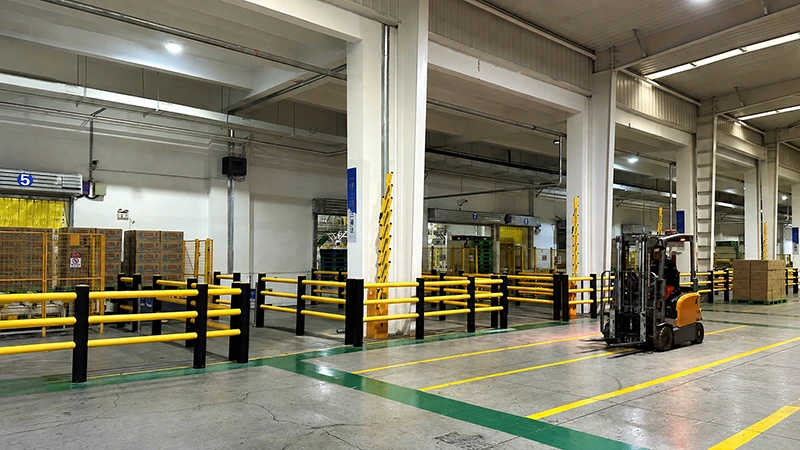
What Changes After the First Forklift Impact?
Warehouse managers and EHS teams are not only managing the first collision. They are managing the repair chain that follows: a steel barrier deforms, anchors and nearby concrete take the force, the rail must be cut and welded, and the surface needs new paint. Rigid rebound can also transfer secondary damage to the forklift. FCBarrier is specified for the repeat-collision zones where that cycle creates cost and accident downtime.
| Protection decision | FCBarrier evidence and operating result |
|---|---|
| Steel barrier vs flexible barrier | ARMORFLEX polymer is designed to absorb up to 80% of collision energy and self-rebound after impact, rather than relying on a permanently rigid rail. |
| Impact capacity | Published product-family ratings range from 3,850 J for SR100 to 28,950 J for DR190, TR190+, and CTR190+. The top rating is stated as equivalent to an 8-ton forklift at 9.6 km/h. |
| Protection coverage | SR, DR, TR, and CTR series support single-rail, double-rail, traffic and column-protection layouts for racking protection, pedestrian segregation, machinery protection, and loading dock protection. |
| Maintenance after contact | Self-coloured polymer avoids routine repainting; modular sections support quick repair or replacement of the affected part instead of rebuilding an entire barrier line. |
Why FCBarrier Fits Existing Warehouse and Factory Layouts
Absorb impact where forklifts actually operate
A warehouse safety barrier must separate people, vehicles, and assets without turning every contact into structural repair. FCBarrier provides impact-resistant forklift safety barrier coverage for narrow aisles, rack ends, loading bays, and factory walkways. Its self-rebounding behavior is the reason to consider a polymer barrier vs steel barrier when repeated contact is an operating reality.
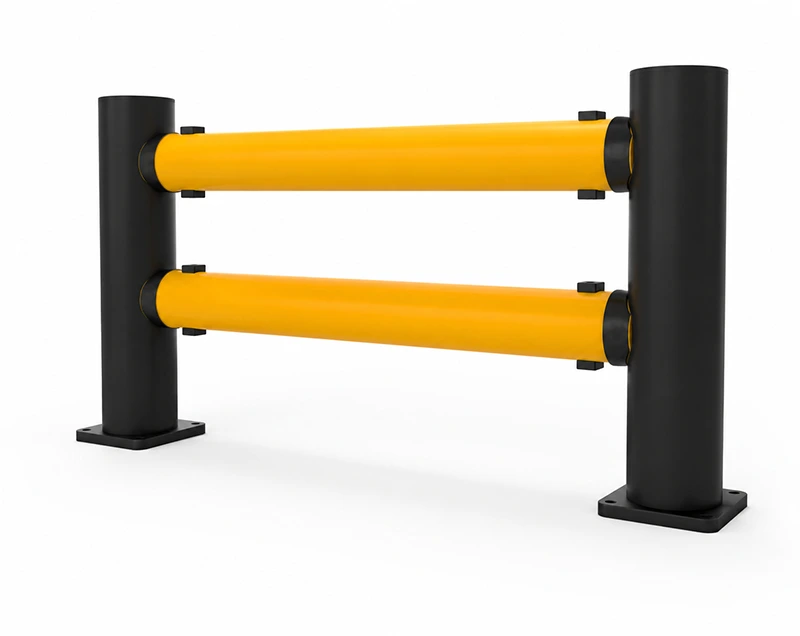
Use the rail and post configuration for the load
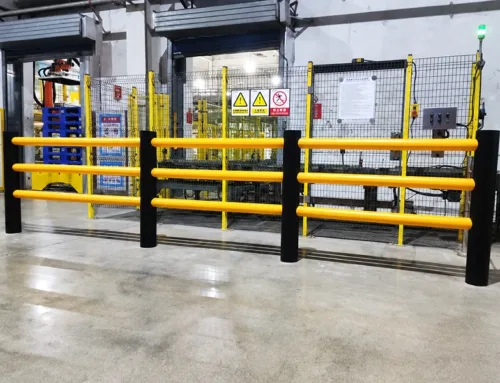
The product family includes Single Rail, Double Rail, Traffic Rail, and Column Protector layouts. A DR190 or TR190+ configuration can be evaluated where the stated 28,950 J rating is required; SR and lower-rated configurations can be matched to lighter protection duties. The image shows the dual-rail, post, connector, and bolted base-plate arrangement that planners need to review before setting a floor-anchored barrier line.
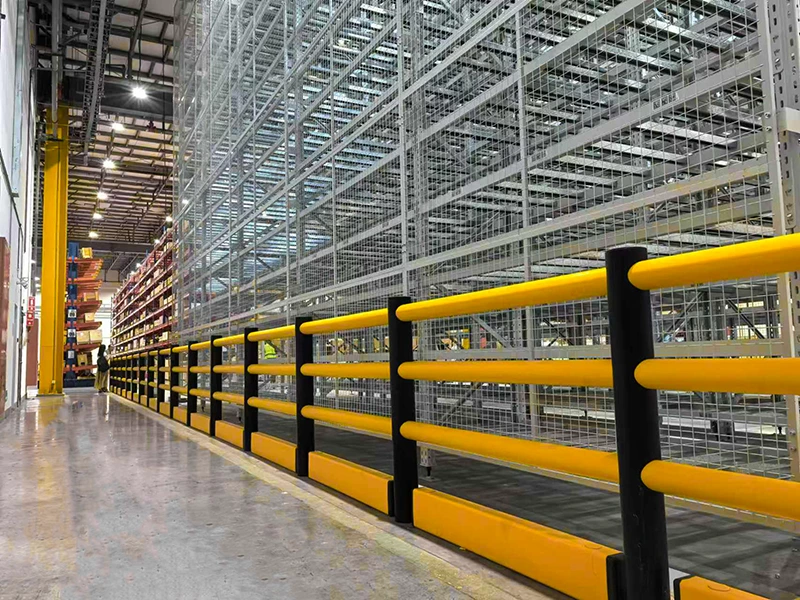
Retrofit protection without rebuilding the traffic plan
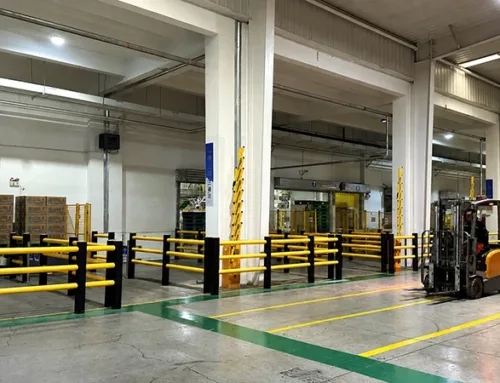
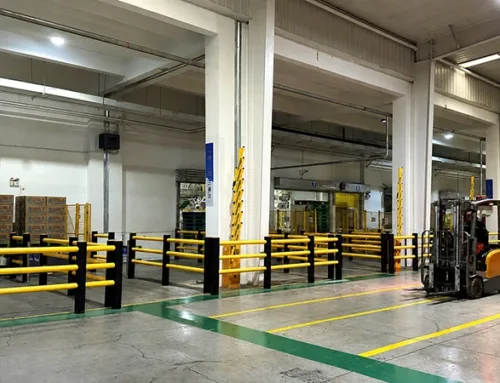
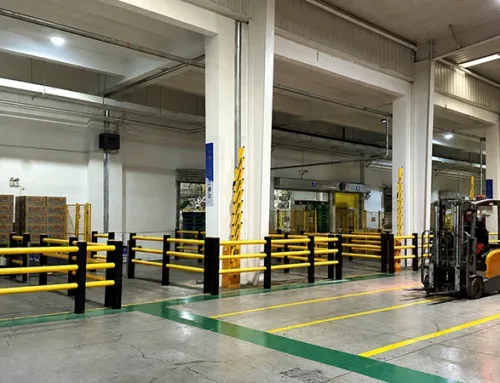
Existing sites can add a modular barrier along racking, columns, equipment boundaries, pedestrian routes, or loading dock edges. The installation demonstration uses a three-rail, two-post basic unit, an electric hammer drill, hand drill, torque wrench, rubber mallet, and expansion bolts into a concrete floor, with a professional two-person workflow. The continuous warehouse installation shown here supports the retrofit and quick-install discussion; the visual itself is not used as proof of rebound performance.
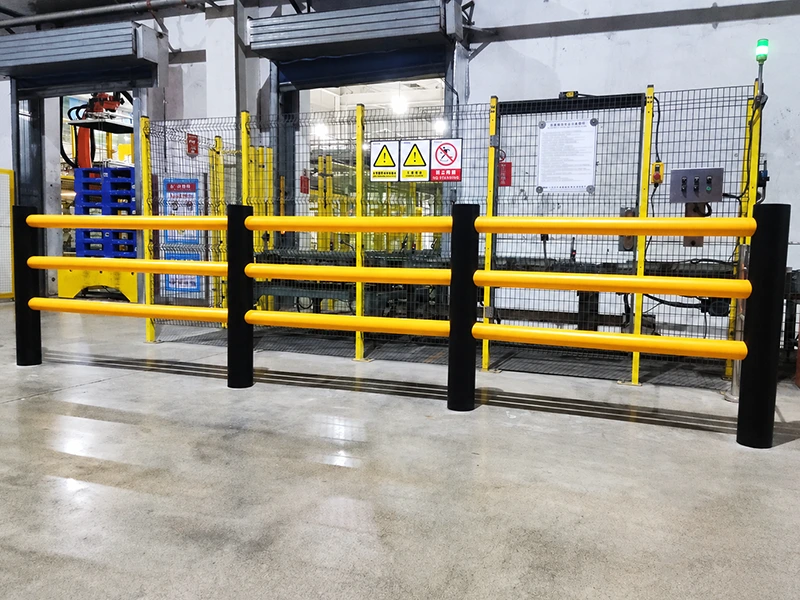
Where a Self-Rebounding Barrier Delivers the Most Value
- Warehouse safety barrier and racking protection: protect rack ends and aisle edges from forklift damage.
- Loading dock protection: define loading zones where repeated vehicle contact can damage anchors, floors, and building edges.
- Column protector and machinery protection: shield columns, machines, conveyors, and access routes in manufacturing plants.
- Pedestrian barrier and workplace safety: create a visible separation between pedestrian walkways and forklift routes.
- Logistics centre and distribution centre safety: add floor-anchored, modular protection during a retrofit instead of changing the whole layout.
- Food, beverage, and pharmaceutical plant safety: consider the corrosion-free, UV-resistant polymer positioning where low maintenance and easy cleaning matter.
The right selection still depends on vehicle mass, speed, impact direction, slab condition, traffic frequency, and the asset being protected. Confirm the required series and anchor design with the project team rather than treating a general image or rating as a site-specific engineering approval.
Specify the Barrier Around the Real Impact Risk
Start with the collision history and map the warehouse or plant: forklift routes, rack ends, columns, pedestrian crossings, loading dock edges, and machinery access. Then compare the required energy level with the SR, DR, TR, or CTR series. FCBarrier provides a practical route toward lower maintenance, reduced repair cost, less accident downtime, and protection for vehicles, floors, structures, and people. Public third-party PAS 13 certification and detailed slab pull-out values are not confirmed in the current source set, so request the applicable technical evidence for your project.
Replace the Next Steel Repair with a Self-Rebounding Barrier Review
Share your forklift route, impact history, protected assets, and preferred rail layout. SGF can help you assess a Flexible Safety Barrier, Flexible Crash Barrier, or Column Protector configuration for the zone that keeps getting hit.