EN
EN  DE
DE  RU
RU  PT
PT  JA
JA  ES
ES  IT
IT 
ROBOT CELL GUARDING · MACHINE PERIMETER GUARDING
20x100mm Robot Safety Fencing for Compact Automation Cells
For large automation equipment, a machine guarding fence is not only a safety boundary. Its mesh opening determines how far the fence must stand from the hazard. A 20x100mm narrow-opening configuration can help an automation integrator place the physical guarding solution closer to the robot envelope than a conventional 50x50mm mesh layout—subject to the applicable ISO 13857 risk calculation—while preserving forklift and pedestrian routes and valuable production floor space.

Why the Mesh Opening Changes the Layout
An automation cell can occupy most of a bay before the guarding is even added. In the GBIM project scenario, a conventional 50x50mm wire mesh panel would require the fence to be set back more than 850mm from the danger zone under the applicable standard calculation. That setback consumes forklift and pedestrian clearance, reduces usable production area, and can force the integrator to offer a larger, more expensive cell footprint.
| Layout decision | Engineering consequence |
|---|---|
| Conventional 50x50mm mesh example | A larger safety distance may push the perimeter away from the hazard and narrow the remaining factory routes. |
| 20x100mm narrow-opening mesh | Can support a closer perimeter concept; the project team must verify the final distance against ISO 13857, hazard height, access direction, and risk assessment. |
| Result for an automation integrator | A compact robot safety fence can create more room for forklift and pedestrian safety, equipment access, and future line changes. |
Product Fit: A Framed, Configurable Safety Boundary
1. Narrow-opening panels for space-constrained machine guarding
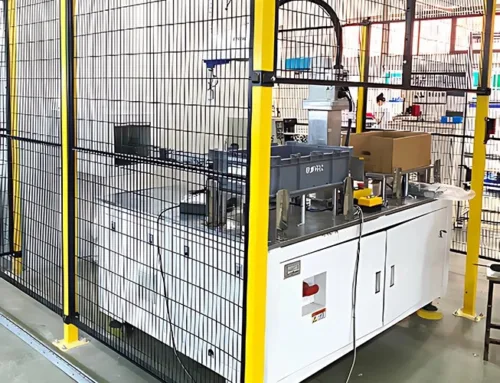
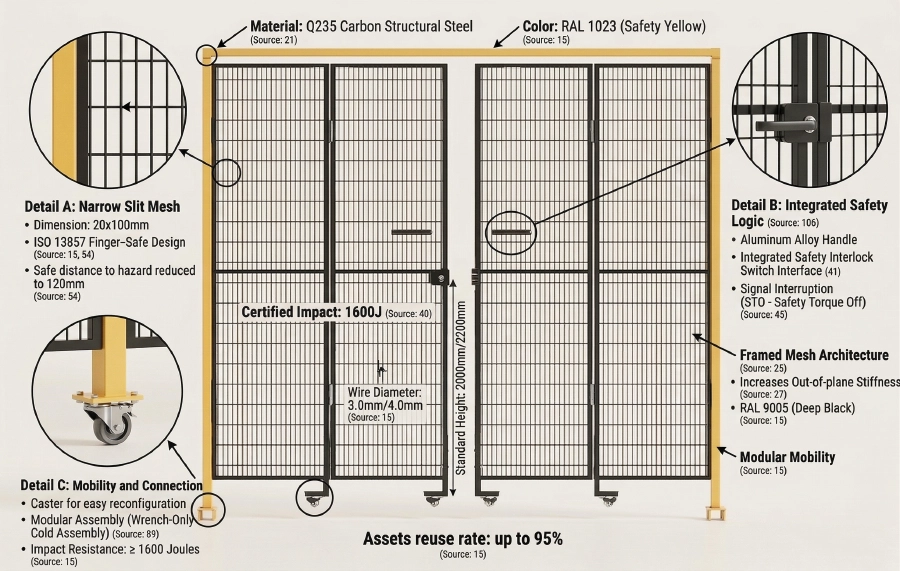
The relevant configuration uses 20x100mm mesh openings with 3.0mm or 4.0mm wire, rather than treating a generic mesh panel as a complete guarding design. The panel is carried in a welded tubular frame, typically 20x30x1.5mm, with Q235 carbon steel posts and project-confirmed heights such as 2000mm or 2200mm. This framed mesh panel gives the integrator a defined physical edge, repeatable panel connections, and a practical basis for checking the robot envelope, conveyor openings, and maintenance access. The 120mm close-fit figure is a project design target—not a universal clearance promise—and must be confirmed against the applicable standard and hazard assessment.
2. Full-weld construction and anchored posts provide visible evidence
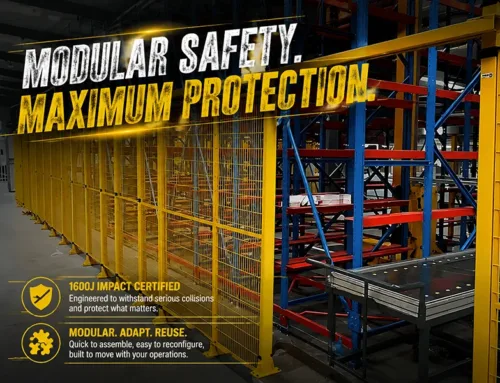
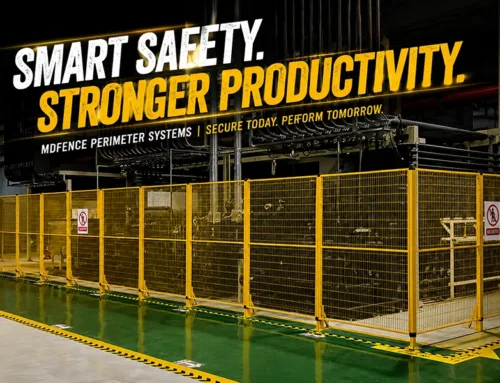
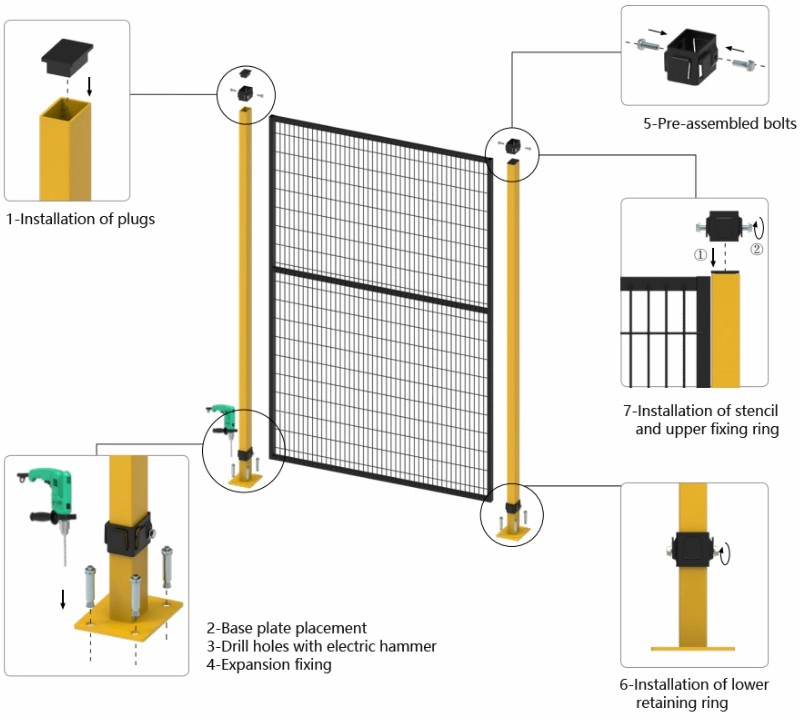
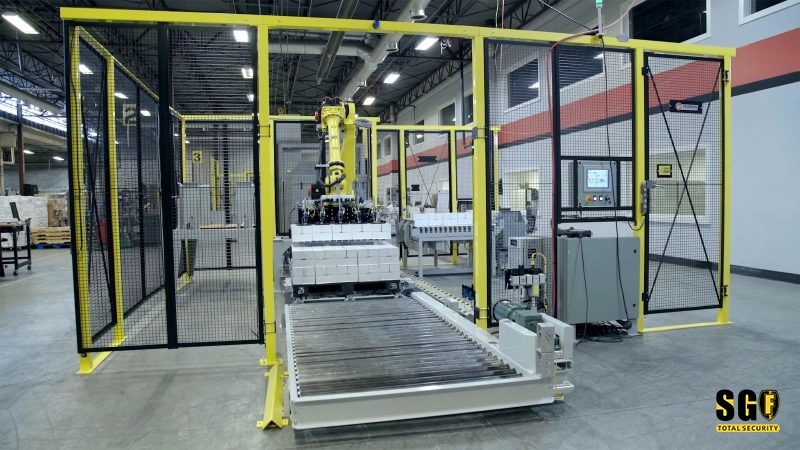
The structure is more than a roll of wire. The indexed engineering evidence shows the narrow mesh, Q235 steel frame, safety-yellow posts, interlock handle, and base arrangement together. Flat full welds and burr-free weld safety design support a smooth panel edge, while powder-coated steel fence components provide the specified RAL1023 yellow / RAL9005 black visual zoning when that finish is selected. Standard project materials cite an impact design value of ≥1600J and TUV testing or certification evidence; the rating must be matched to the contracted configuration rather than copied to every custom size. The result is a machine safety fence with a documented load path through panel, post, base plate, and concrete anchor.
3. Gates and safety interlock interfaces keep the cell usable
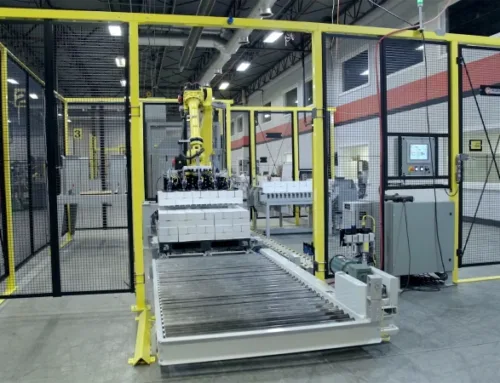
A compact perimeter still needs controlled entry, material flow, and maintenance access. Hinged safety doors, sliding safety gates, and other project-selected door types can be combined with a safety lock mounting carrier for devices such as Omron D4NL or Pizzato FS series switches. The fence supplies the mechanical carrier and alignment basis; the safety switch, PLC, and stop circuit remain part of the project electrical design. In a robot cell with a control cabinet and roller conveyor, this separation of responsibilities makes the entry logic easier to review and the equipment isolation procedure easier to maintain.
What the Compact Footprint Delivers
- More usable factory area: reducing unnecessary perimeter setback can preserve forklift and pedestrian safety routes around a large automated cell.
- A stronger customer offer: an integrator can deliver equipment isolation in limited space instead of passing a larger building-footprint penalty to the end user.
- Better automation system isolation: framed panels, anchored safety fence posts, controlled gates, and safety interlock devices establish a clearer robot cell boundary.
- Change-ready maintenance: bolted modular panels can be removed, extended, or reconfigured without assuming that every future modification requires destructive site welding.
- Traceable compliance work: the final layout can be reviewed against ISO 14120, ISO 13857, OSHA machine guarding requirements, and applicable local rules with the correct hazard data.
For automated material handling, conveyor line safety guarding, CNC machine guards, and robot safety fencing, the commercial result is straightforward: a smaller cell can release several square metres of high-value factory space per machine. The actual saving depends on the hazard geometry, aisle requirement, access points, floor condition, and final approved drawing.
Start with the Hazard and Floor-Plan Data
To size an industrial safety fencing layout, provide the robot or machine envelope, hazard heights, required openings, conveyor transfer points, maintenance route, forklift turning clearance, floor construction, preferred gate type, and safety switch specification. SGF can then map the 20x100mm mesh option, post spacing, anchoring, door carrier, and interlock interface into a project BOM. The 120mm close-fit concept should be released only after the responsible safety engineer confirms the applicable calculation and acceptance criteria.
Build a Smaller Automation Cell Without Losing the Safety Boundary
When ordinary 50x50mm mesh forces an 850mm setback, the lost floor area becomes an engineering and sales issue—not just a fencing detail. A properly calculated 20x100mm machine guarding fence can help an integrator protect the robot cell, retain traffic routes, and offer end users a more compact automation system. Send the cell layout and hazard data for a configuration review.