EN
EN  DE
DE  RU
RU  PT
PT  JA
JA  ES
ES  IT
IT For EMS and multi-variant plants running new product introduction every few weeks, a welded square-tube fence becomes a sunk cost the moment the line re-balances. Mefence frameless 3D industrial safety fencing installs in three clip-fixed steps, cuts to size on site, and travels with the line — turning a one-time welded partition into a reusable plant asset that survives the next NPI, and the one after that.
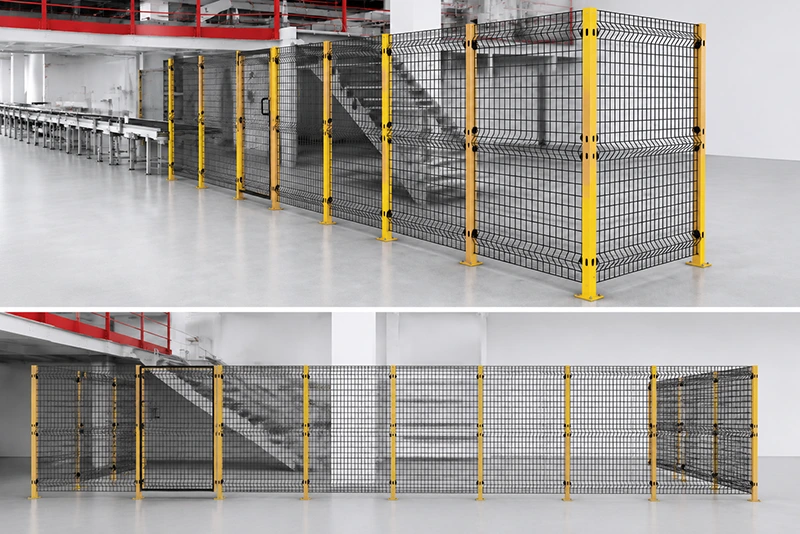
The Real Cost of Frequent NPI Is Not the Machine, It Is the Fence Around It
A typical EMS line in Suzhou, Penang or Guadalajara carries 6 to 12 new product introductions a year. The SMT placement, the test fixture and the conveyor all move; the safety fence is supposed to move with them. With a traditional welded square-tube fence, every line changeover triggers a small demolition project: cut the tube, grind the weld, drill new anchor holes, repaint the floor, and bring the welder back in for hot work beside a live production line. On most EMS floors, that work eats two shifts of downtime, one external welding crew invoice, and a fresh round of fit-for-purpose paperwork.
Painted lines, barrier tape and cones are the usual workaround, but they fail the moment a new SKU rolls out: tape tears under trolley wheels, cones migrate overnight, and AGV or AMR routes get crossed by operators in a hurry. The result is exactly what an EHS manager does not want — ghost stops on every AMR, near-misses at every changeover, and a safety perimeter that exists only on the layout drawing.
Why a Frameless 3D Mesh Fence Fits the EMS Re-Route Cycle
Mefence industrial safety fence is a frameless 3D welded wire mesh panel pressed with multiple horizontal T-shaped ridges. There is no perimeter frame tube to cut through, no welded joints to grind out, and no factory-finished size that the line has to respect. The panel is shipped in standard widths of 200 to 1400 mm and heights of 200 to 3000 mm, and it accepts on-site trimming with a standard angle grinder or bolt cutter — so an irregular workstation, a column line or an existing cable tray is no longer a problem the installer has to solve with a torch.
The connection is just as deliberate. Yellow powder-coated Q235 steel posts (40 × 60 mm or 60 × 60 mm) carry slotted mounting holes; the mesh panel is clamped to the post with a plastic clip and self-tapping screw. There is no square-tube welding in production and no site welding during install. The same panel can be un-clipped, moved 4 m down the line, re-clipped to an existing post, and back in service before the next shift change.
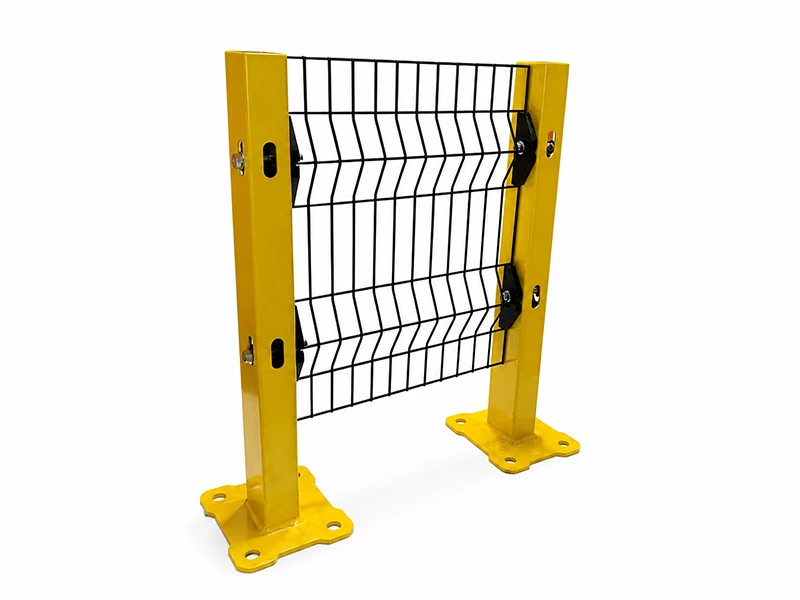
What the Spec Sheet Actually Says About Reuse
The numbers matter when a procurement team is justifying the spend against a one-off welded partition. The table below is straight from the Mefence data plate — no impact-rating claim, no EU certification overpromise — only the facts an EMS plant engineer needs to size the perimeter, anchor it to a concrete floor and re-issue the layout next quarter.
| Item | Spec / Range | Why It Matters for EMS Line Changeover |
|---|---|---|
| Material | Q235 carbon steel, electrostatic powder coating | Reusable across multiple NPI cycles without repainting |
| Wire diameter | 3 mm / 4 mm | 3 mm for typical zoning; 4 mm for higher-traffic AGV corridors |
| Mesh opening | 20 × 100 mm or 50 × 50 mm | Keeps camera, LiDAR and supervisor visibility clear |
| Panel width | 200 – 1400 mm | Cuts to fit irregular workstation footprints on site |
| Panel height | 200 – 3000 mm | Covers mezzanines and elevated platforms in the same SKU family |
| Post size | 40 × 60 mm / 60 × 60 mm | Slotted mounting holes allow alignment compensation |
| Post-to-floor | Base plate + expansion bolt | Bolts down to existing concrete; lifts out without slab damage |
| Connection | Plastic clip + self-tapping screw | No site welding, no hot-work permit, single-tool install |
| Standard colour | Yellow + black (custom colours on request, incl. orange) | High-visibility zoning for fast-moving EMS lines |
| Ground clearance | 140 mm | AGV / AMR routes and cable trays pass underneath |
| Functional ridge | T-shaped pressed bend across panel | Carries cable bundles and accepts wood-slat inserts for shielding |
| Installation time | One person, three-step clip fixing; ~50% reduction vs. conventional framed fence | Re-route during a weekend changeover window |
| Compliance reference | OSHA 29 CFR 1910.212, ANSI B11.19, ISO 14120, ISO 14119, ISO 13857, ISO 13855 | Used for area demarcation and traffic control, not certified impact containment |
Three Engineering Choices That Keep the Fence Reusable
1. Clip-fixed assembly, no site welding
The plastic clip + self-tapping screw joint is the single biggest reason the fence survives an NPI cycle. A maintenance technician with a cordless drill can dismantle a 10 m run, re-drill the base plates in the new layout, and have the same panels back in service before production resumes. There is no welder invoice, no fire-watch, no paint-curing downtime beside the line.
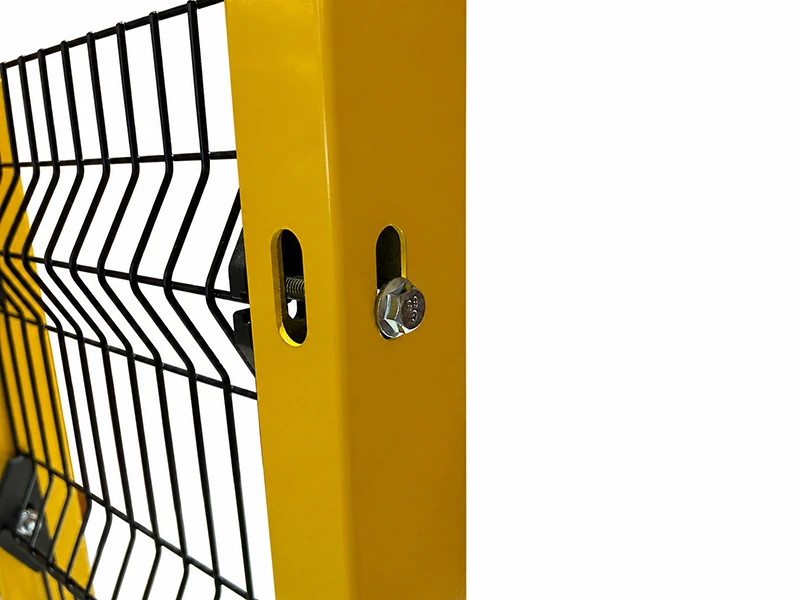
2. Frameless mesh that cuts to irregular shapes on site
Because the panel has no perimeter tube, an installer can notch around an existing cable tray, step around a column, or close an odd-shaped angle at a conveyor tail without sending the panel back to the shop. The 20 × 100 mm mesh keeps the cut edge readable; the T-shaped ridge gives the panel enough rigidity to stand without a frame tube.
3. Base-plate post + slotted hole for floor realignment
The post base plate is bolted down with expansion bolts; the slotted mounting holes in the post let the post sit at the right angle even when the original anchor holes no longer match the new layout. When the layout rotates 90° next quarter, the same post is re-anchored into the new slab marks — the panel hardware stays unchanged.
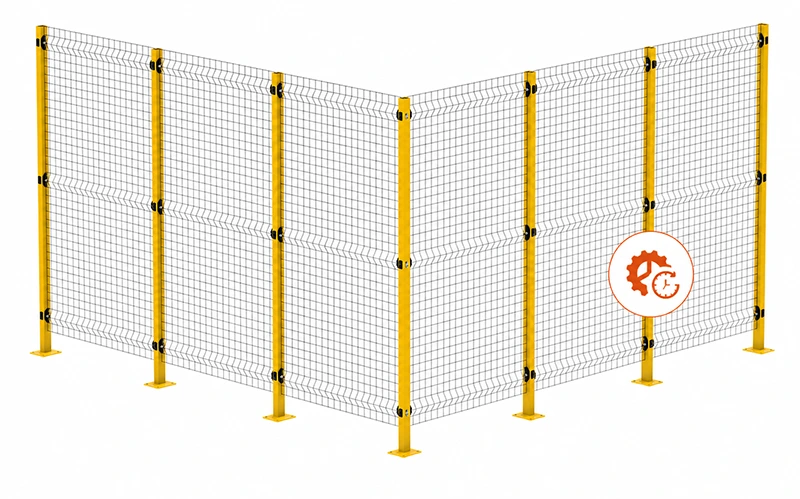
Where EMS and Multi-Variant Plants Actually Use It
- NPI pilot cells. A 6 m × 4 m pilot line goes in over a weekend with three clip-fixed posts and a pair of mesh panels; the same hardware moves to the next pilot when the SKU graduates or retires.
- Re-configurable SMT islands. Yellow-black panels close the gap between pick-and-place, AOI and rework benches; re-routing happens with a drill, not a welder.
- AGV / AMR lanes beside operator aisles. The 140 mm ground clearance lets AMR routes pass under the fence; the open 20 × 100 mm mesh keeps LiDAR and overhead cameras reading through.
- Cable and pneumatic routing along the line. The pressed T-shaped ridge carries cable bundles and accepts wood-slat inserts where visual shielding is required between cells.
- Tool crib and instrument storage. Mesh panels define locked enclosures next to the line, with the same post-and-clip system used on the perimeter.
- Plant consolidation after SKU retirement. When a SKU is delisted or a satellite plant is consolidated, the same Mefence modules redeploy to the receiving site instead of being cut up and scrapped.
Mefence is positioned as non-high-impact area demarcation, traffic control and visual shielding. For direct strike zones at high-energy robot or conveyor cells, the spec line routes the buyer to SGF’s heavier Machine Fence family — a frameless 3D mesh is the wrong product for an impact containment claim.
What to Send the EMS Engineering Team Before They Re-Quote the Fence
A useful spec package for an EMS line changeover project includes: the new floor plan with the proposed re-route, the line height requirement (typically 2000–2400 mm for SMT islands), the AGV/AMR corridor widths, and a short note on whether the existing post anchor holes can be re-used or need to be patched. With those four inputs, the Mefence team can return a clip-fixed BOM sized for the next NPI cycle — not a one-off welded cage that will be cut out again when the line rotates 90° next quarter.