EN
EN  DE
DE  RU
RU  PT
PT  JA
JA  ES
ES  IT
IT Premium-OEM JIT/JIS + AGV · Passive Boundary
Why a Maintenance-Free Corrugated Steel Warehouse Guard Rail Is the “No-Fatality, No-Stop” Baseline Beneath Every ATS Schedule
On a premium-OEM shop floor, a single hand-pallet jack that misses the roller conveyor end, or a counter-balanced truck that turns in on the AGV pick lane, can halt a 60-second takt, freeze the inbound kit at the JIS drop, and put the next brand-defining lot into the ESG incident log. A bolted, 1,000 mm Q235 wave-beam warehouse guard rail sits below the ATS digital dispatch as a maintenance-free, one-time-capex passive boundary — absorbing the strike that the schedule, the operator training and the forklift telematics cannot keep out, so the JIT/JIS material channel and the AGV path keep moving on every premium-OEM plant.
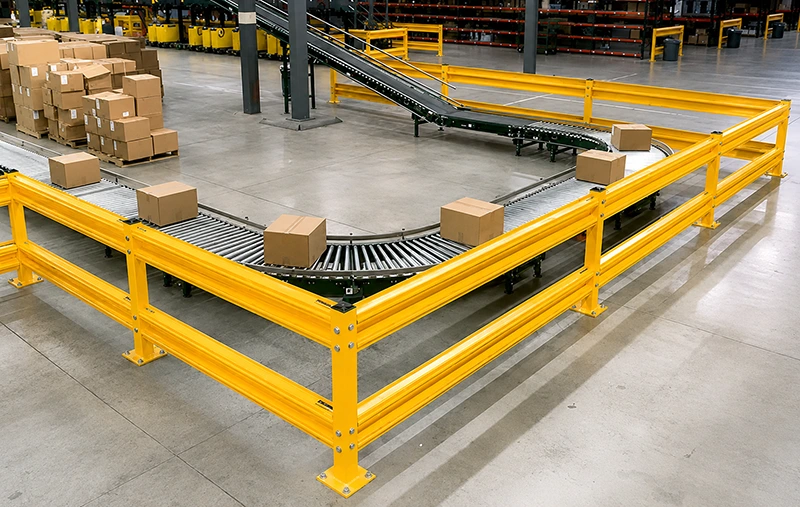
What “Maintenance-Free, One-Time Capex” Looks Like on Paper
A corrugated steel warehouse guard rail is not a consumable asset. Hot-dip galvanized Q235 plate, post and base weld do not age the way polymer rebounds lose their third-party certification, and they do not demand an annual spring-back test in front of an EHS auditor. The numbers below come from the same bolted modular build we used for a four-zone, 58,000 mm premium-OEM material-channel rollout across body and powertrain halls.
| Build item | Value |
|---|---|
| Total rail height | 1,000 mm |
| Standard panel length | 1,500 mm |
| Standard post spacing | 1,500 mm |
| Wave-beam width | 300 mm |
| Wave amplitude (corrugation) | 40 mm |
| Wave-beam thickness | 3 mm or 4 mm Q235 |
| Post section | 80 × 80 × 6 mm square tube |
| Base plate | 160 × 160 × 16 mm, 4 × M16 anchor bolts to concrete floor |
| Impact envelope (project reference) | 16,680 N (3 t forklift @ 10 km/h, head-on) |
| Panel finish | Hot-dip galvanized to ISO 1461, or RAL 1023 powder coat over hot-dip galvanized substrate |
| Custom project fills | 680 / 780 / 1,040 / 1,140 mm wave-beam fillers — no on-site welding required |
Three Failure Modes the ATS Schedule Cannot Catch
1. Forklift overrun at the JIS material-channel end-cap
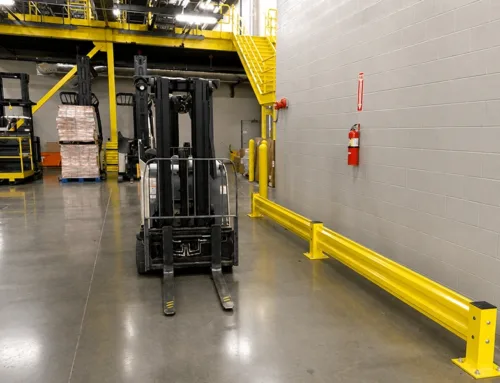
A hand-pallet jack that misjudges the roller conveyor end-cap, or a counter-balanced truck that misses the curve at the JIS drop lane, can crush the conveyor drum and stop the inbound kit before it ever reaches the line. A 1,000 mm double-rail Q235 corrugated beam, anchored on 80 × 80 × 6 mm posts at 1,500 mm spacing, takes the strike at the panel face and keeps the conveyor inside its service interval. The barrier ties directly to the warehouse roller-conveyor cell boundary and the inbound material path on every premium-OEM JIT/JIS floor — turning the slot beside the conveyor into a defined physical aisle instead of a painted suggestion.
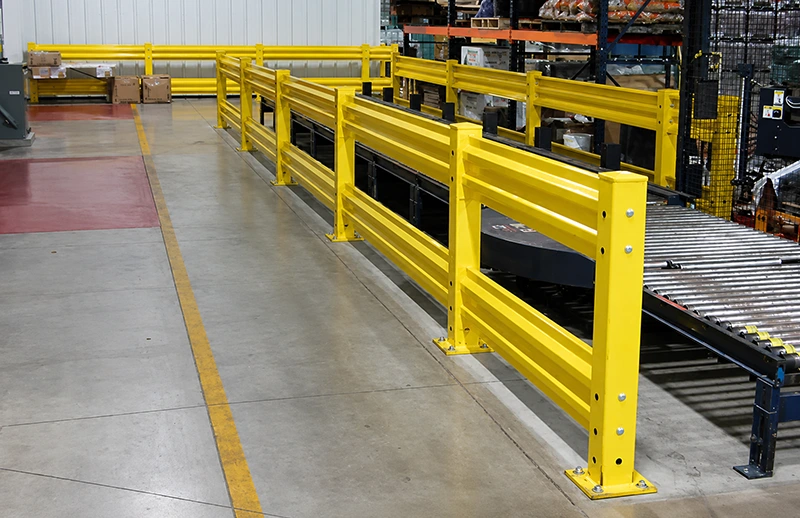
2. Wayward truck into the AGV pick lane at the rack face
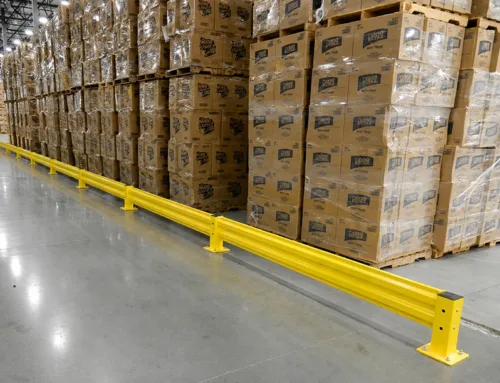
At the AGV pick point, an entire pallet-rack row sits inside the same traffic envelope as a hand-pallet jack and a turn-in counter-balanced truck. A 1,000 mm double-rail guard, bolted through a 160 × 160 × 16 mm base plate at every post with four M16 anchor bolts into the concrete floor, anchors the rack-end upright and blocks the truck before it can pull the rack onto the AGV’s recovery path. The protection is fixed, section-by-section replaceable after a strike, and immune to the painted-line wear that lets the same incident recur every quarter on a busy premium-OEM floor.
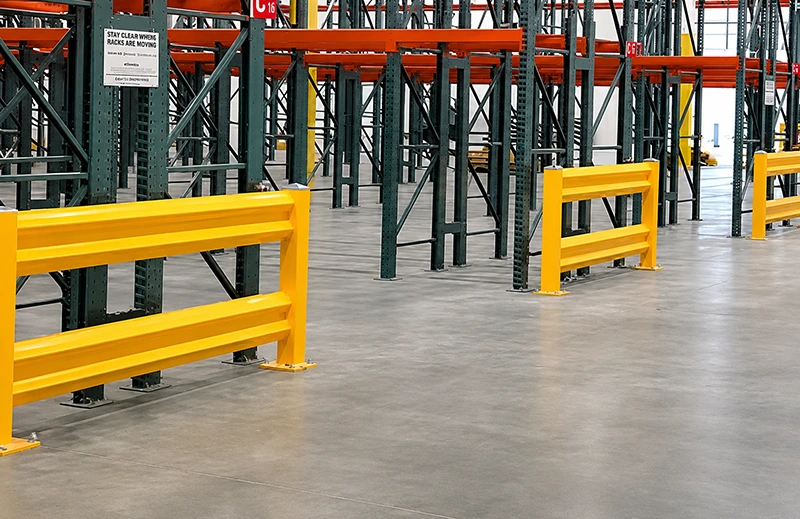
3. Maintenance-free anatomy — no polymer spring, no annual re-test
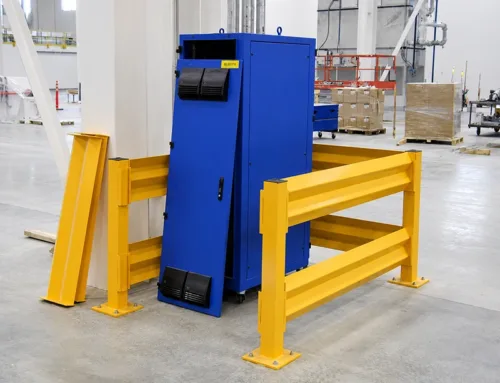
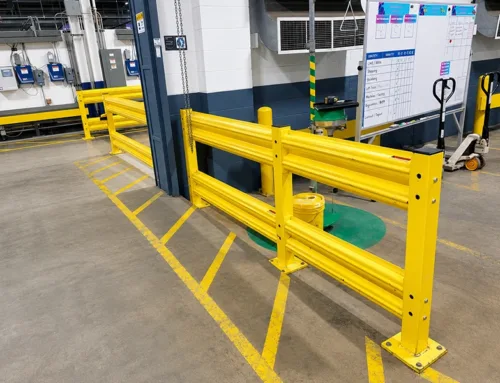
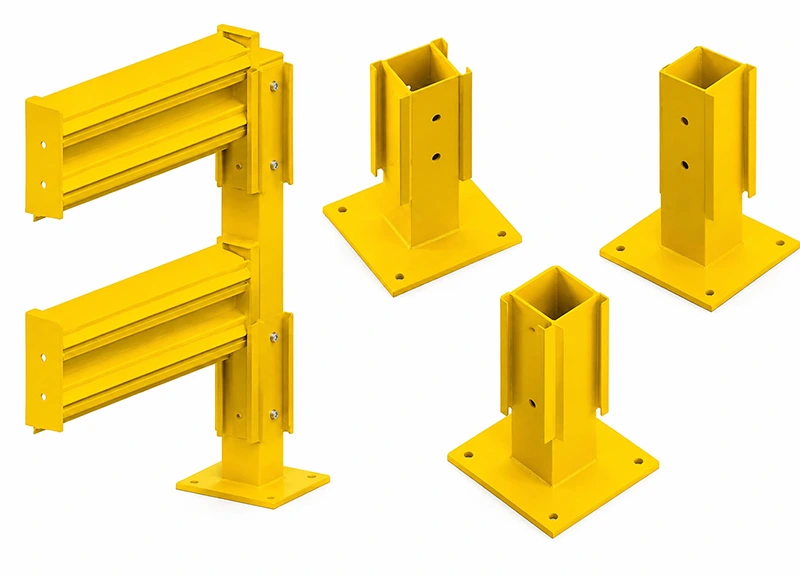
Two parallel wave-beams, 300 mm wide with a 40 mm corrugation amplitude, are slipped into the side-mount slots of an 80 × 80 × 6 mm square post with exposed M16 bolts at every post-to-beam interface. The design has no internal polymer spring to rebound-test, no manufacturer-side inspection interval and no third-party re-certification cycle. Hot-dip galvanizing under ISO 1461 puts the corrosion life onto the steel substrate itself, so a wash-down with hot water, a paint-line solvent mist or a coastal-dock salt film does not age the barrier the way a painted guard rail ages over the same ten-year window.
Where This Rail Lands on a Premium-OEM Floor
- Material-channel and roller-conveyor boundary along the inbound JIS line
- AGV pick-lane and drop-off-dock perimeter at the rack face
- Double-rail barrier at the assembly-cell perimeter where the cell sits between a JIT delivery aisle and an AGV charging bay
- Rack-end protection at the mezzanine-supported pick module
- Floor-mounted aisle divider between the body shop and the powertrain staging area on a multi-powertrain OEM campus
- Cold-storage dock perimeter, where hot-dip galvanizing outlasts painted steel in the same five-year window
In every case the rail is part of the static map. The ATS handles the trajectory; the guard rail handles the strike that escapes the schedule — so the JIT/JIS sequence, the AGV battery cycle and the body-shop takt keep running on every premium-OEM plant.
Spec Pack and One-Spec Multi-Plant Rollout
Send us the JIS material-channel layout, the AGV pick-lane width and the forklift class in use at each site. We return one bolted-modular bill of materials per plant, with the same 1,000 mm rail height, the same 80 × 80 × 6 mm post, the same 160 × 160 × 16 mm base plate and the same custom-cut wave-beam fillers — so every plant buys the same maintenance-free corrugated steel warehouse guard rail the Chinese manufacturing cost edge already supports, without the polymer re-validation cycle that quietly eats into a multi-plant EHS budget.
Send Your Layout to Engineering
Premium-OEM plants running a 60-second takt need the rail that backs the ATS, not the rail that competes with it. Share your line drawings and the forklift class on every site, and engineering will return a per-site bill of materials, an impact-load envelope for the forklift in service, and the maintenance-free write-up your EHS team can file against the next ISO 12100 review.