EN
EN  DE
DE  RU
RU  PT
PT  JA
JA  ES
ES  IT
IT JIT / JIS Sequencing · Premium-OEM Plant Logistics
A Pallet Jack at the JIS Drop Lane Can Stop a Premium-OEM Paint Shop: How a Q235 Warehouse Guard Rail Anchors the Static Inflow Boundary Beneath Automotive Sequencing Schedules
For a premium-tier body shop running just-in-sequence delivery from the parts supermarket, the most exposed asset is not the press or the robot — it is the physical boundary between the inbound flow and the line-side rack. A bolted, double-rail Q235 corrugated steel warehouse guard rail installed at the JIS drop lane absorbs the misplaced hand-pallet jack, the pallet-truck over-steer and the AGV recovery drift that the existing ATS digital dispatch cannot catch. It is the 1,000 mm static physical layer that keeps a 60-second takt alive for the next carrier without breaking the sequencing schedule, complements the digital layer the plant already trusts, and amortises the same Chinese-supplier unit cost across every premium-OEM plant on the multi-site rollout.
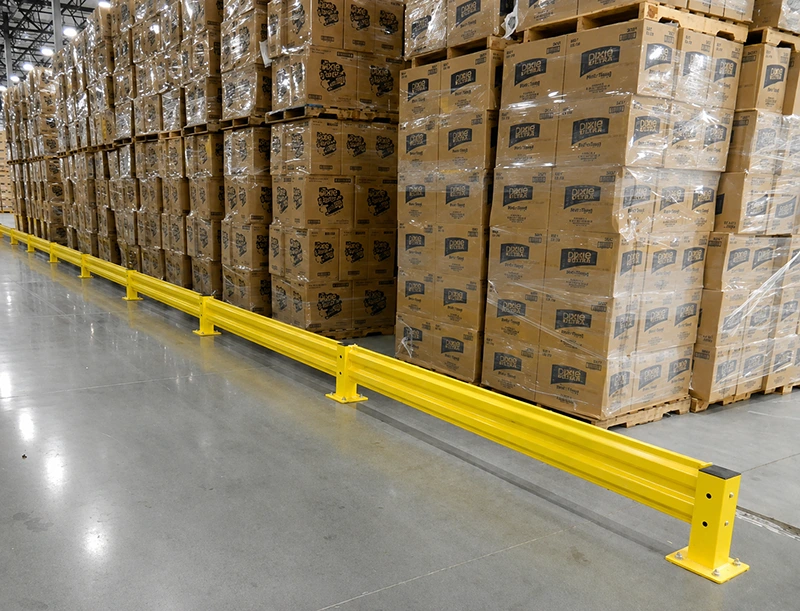
Q235 Warehouse Guard Rail — JIS Drop-Lane Configuration
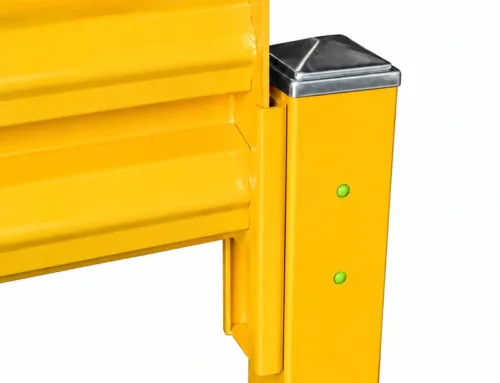
The numbers below reflect the 1,000 mm-high double-rail configuration engineered for the inbound and JIS sequencing lane at a premium-OEM plant. The base plate, square-tube post and concrete anchor are sized so a misplaced forklift, AGV recovery run or hand pallet jack is absorbed inside the barrier envelope — the paint-shop takt keeps moving, the rack upright stays inside spec, and the supplier drop window does not slip.
| Parameter | Specification |
|---|---|
| Material | Q235 carbon steel; powder-coated yellow as standard; hot-dip galvanised on request |
| Panel profile | 2-rib corrugated (W-beam) double rail; 3-rib thrie beam available for higher load zones |
| Panel thickness | 3 mm or 4 mm (4 mm recommended for the JIS drop-lane envelope) |
| Standard panel length | 1,500 mm |
| Special filler panels | 680 mm, 780 mm, 1,040 mm, 1,140 mm cut to the drop-lane dimension |
| Panel width | 310 mm |
| Wave height / pitch | 85 mm wave height; 194 mm wave pitch |
| Post size | 80 × 80 × 6 mm square tube |
| Base plate | 160 × 160 × 16 mm, four anchor holes |
| Anchor | M12 / M16 expansion bolts into ≥150 mm concrete slab |
| Total height | 1,000 mm (lower panel offset 100–106 mm above floor) |
| Finish / options | Yellow RAL / Pantone powder coat; hot-dip galvanising; reflective tape; end caps; column protector; lift-out segment |
Why a Bolted Q235 Warehouse Guard Rail Fits a JIS Drop Boundary
1. A Static Inflow Boundary That Holds When the ATS Map Re-Draws
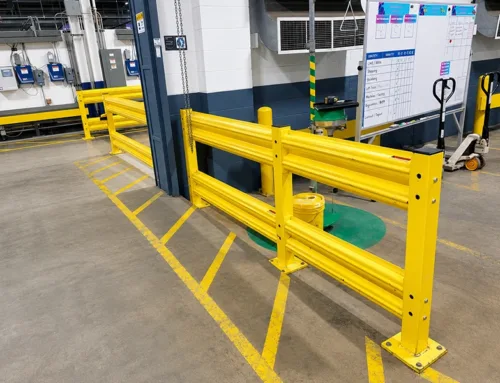
Between the inbound pallet-staging aisle and the line-side supermarket, the same 3 m envelope routinely mixes AGV inbound runs, hand pallet jacks, milk-run tug trains and human pickers. A digital schedule alone keeps roughly 95% of the flow on plan, and the rest is where a JIT/JIS takt dies. A bolted Q235 corrugated steel warehouse guard rail along the rack-back edge supplies the static physical boundary that catches the 5% — the misjudged lift-truck reversal at the supermarket endcap, the AGV recovery drift across the painted line, the hand pallet jack that follows the audit-trail tag one bay too far. The line is built from 1,500 mm standard panels and 680–1,140 mm custom fillers, so any asymmetric layout along the supermarket edge is closed without leaving a gap wider than the 1,500 mm post pitch.

2. Double-Rail Q235 Profile Absorbs the Strike Without Breaking the Takt
A single misplaced pallet truck at typical dock speed delivers enough localised load to bend a painted tube railing; the double-rail 2-rib corrugated panel is built to deform locally at the contact rib and stay structurally serviceable across the rack face. Post spacing at 1,500 mm with an 80 × 80 × 6 mm square tube and a 160 × 160 × 16 mm base plate lets the impact energy stay inside the panel rib and travel into the concrete anchor — not into the supermarket column, the conveyor cross-member support or the paint-shop body carrier on the other side. Maintenance can inspect, leave the barrier in place, and the next sequencing call from the ATS dispatch screen still loads on schedule.
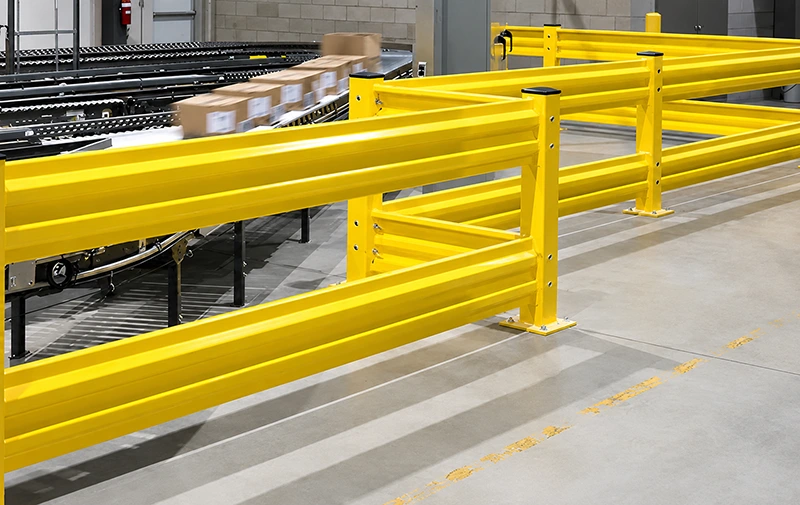
3. Bolted, Modular Install — No Welding Permit, No Sequence Stop
Premium-OEM paint shops are Class A zones for hot-work permits, and welding a perimeter into a JIS drop lane during a sequencing cycle is not an option. The Q235 warehouse guard rail installs through floor-anchored steel base plates with M12 / M16 expansion bolts into a ≥150 mm concrete slab — no welder, no spark, no fire watch, no line stop to commission the boundary. The same modular bolt-on approach means a misaligned drop lane can be re-tracked with new custom-length filler panels, and a lift-out segment can be specified at any rack-back point where the next body-style programme needs the AGV to cross the boundary in front of the line. One spec covers a paint-shop inbound, a body-shop sequencing aisle and the AGV charge cell across the same premium-OEM network.
Where the Static Inflow Boundary Delivers the Most
- JIS drop lane between the supermarket staging aisle and the line-side sequencing rack
- Parts-supermarket rack-back edge in mixed-model body shops
- Incoming milk-run drop zone where supplier tug trains hand off to the AGV buffer
- AGV inbound charge-cell perimeter at the inbound logistics hub
- Cross-dock pallet-staging area fed by hand pallet jacks and electric pallet trucks
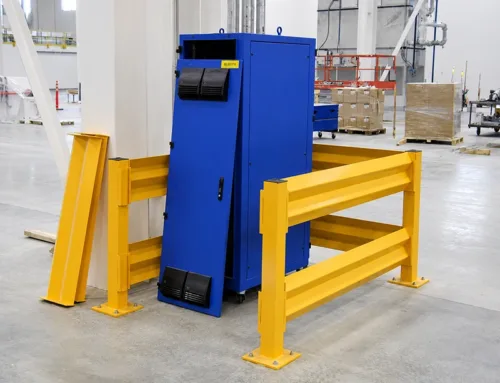
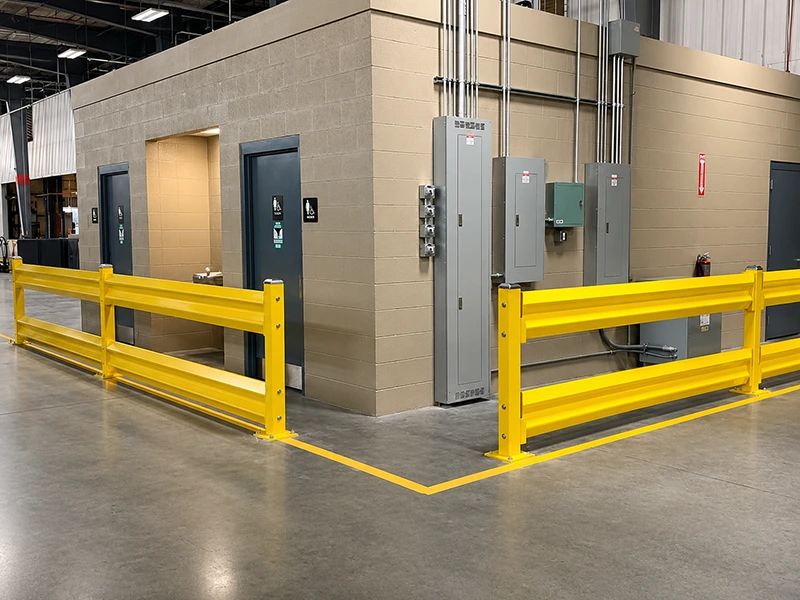
- High-value electrical rooms, paint-shop control cabinets and conveyor control panels sitting inside the inbound envelope
- Sub-assembly kitting benches with pallet-jack traffic beside the kitting rack
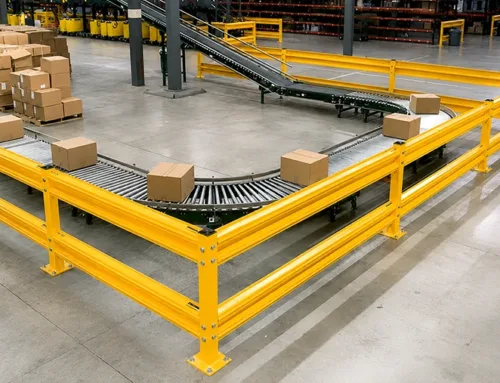
Outside the JIS boundary, the same warehouse guard rail also deploys on the conveyor drive cabinet row, the conveyor cross-member support stands and the cell-side equipment cabinets that drive the paint-shop takt. What changes between zones is the panel length and the post count; the barrier module, the base plate and the anchor bolt stay identical, so the maintenance team uses one set of spares across the whole inbound floor and across every premium-OEM plant on the multi-site rollout.
How to Specify the JIS Drop-Lane Boundary
To turn the static inflow boundary into a reproducible bill of materials, lock four numbers down before the layout review: 1. Drop-lane length along the supermarket edge — measured between the two end posts, not walked off the rack length. Custom 680 mm, 780 mm, 1,040 mm or 1,140 mm filler panels close the asymmetric gap that 1,500 mm standard modules cannot. 2. AGV / hand-jack envelope that crosses the boundary — drives the 2-rib vs 3-rib choice and the 3 mm vs 4 mm panel thickness decision. 3. Concrete slab thickness at each anchor point — the ≥150 mm baseline must hold at every post location; pre-survey slab thickness before ordering to keep field modifications off the sequencing schedule. 4. Surface and visibility requirement — yellow powder coat for the standard signalling layer, hot-dip galvanising for cold-storage or dock-side drops, reflective tape for low-illumination audit-trail zones.
Each shipment is packed in independent paper wrap with banding to keep paint film intact, and palletised at approximately 2,243 kg ±5% across two pallets sized 1,500 × 1,000 × 1,500 mm and 1,000 × 800 × 750 mm for outbound logistics.
Lock the JIS Drop Lane Before the Next Sequence Call
Send the drop-lane dimensions, the supermarket rack-back elevation and the AGV / hand-jack envelope that crosses the boundary. We will return the panel layout with 1,500 mm modules and 680–1,140 mm custom fillers, the post and base-plate bill of materials, and the concrete-anchor pre-survey checklist — sized for the 1,000 mm high static inflow boundary that lets a stray pallet jack stay outside the paint-shop takt and outside the next brand-safety disclosure.