EN
EN  DE
DE  RU
RU  PT
PT  JA
JA  ES
ES  IT
IT AUTOMATION INTEGRATION | MACHINE GUARDING
Automated Packaging Line Safety Interlock Installation Without Field Rework
For pallet nailing and packaging-line integrators, a machine safety fence should do more than define a boundary. It should provide a clear interface for safety interlock devices, support fast equipment isolation, and help the line stop when an access gate is opened. Mdfence Machine Fencing is designed around that integration requirement, helping teams reduce hidden engineering hours while building a configurable industrial automation safety perimeter.
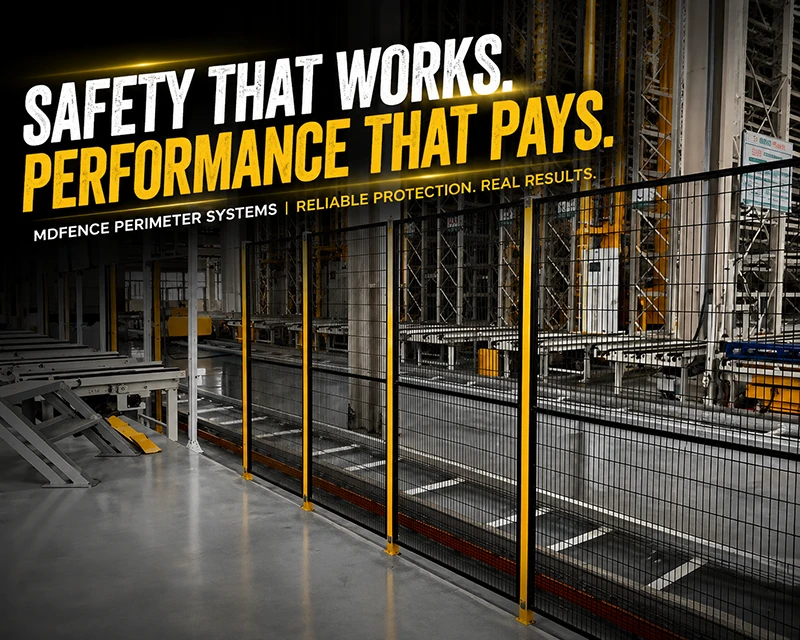
Why Standardized Safety Fence Interfaces Matter on Automated Lines
A conventional welded safety fencing project often leaves the final interface to the installation crew. After the fence arrives, engineers measure the gate, mark the carrier, drill new holes, adjust the switch position, and repeat the process until the actuator and guard door align. On a pallet nailing line or packaging line, that work is rarely visible in the purchasing quotation, yet it consumes engineering time and can delay commissioning. It also creates avoidable variation between machine cells, making later maintenance and LOTO procedures harder to standardize.
| Integration requirement | Machine Fencing design response |
|---|---|
| Gate-open emergency stop circuit | Safety lock mounting provision supports integration with Omron D4NL and Pizzato safety interlock devices; final circuit logic remains with the integrator. |
| Repeated site drilling and alignment | Pre-planned interface hole positions reduce field modification and make safety interlock installation more predictable. |
| Equipment perimeter guarding | Modular mesh panels, framed gates, posts, and bolted base plates create a configurable physical guarding solution. |
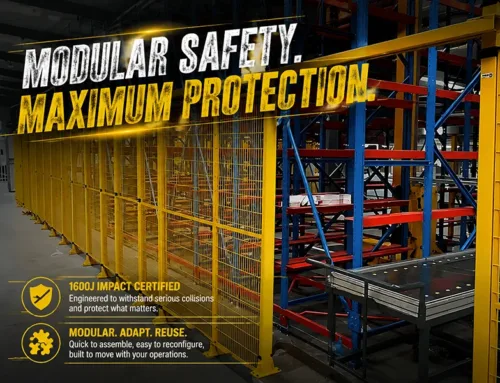
| Impact and line-side protection | Indexed product evidence shows a 1600J impact-performance reference for the guarding system; confirm the required configuration for the project. |
| Different machine-cell layouts | Standardized panels and access modules can be arranged around conveyors, palletizers, and automated handling zones. |
Four Design Details That Connect the Fence to the Safety Circuit
1. A defined interlock interface at the access gate
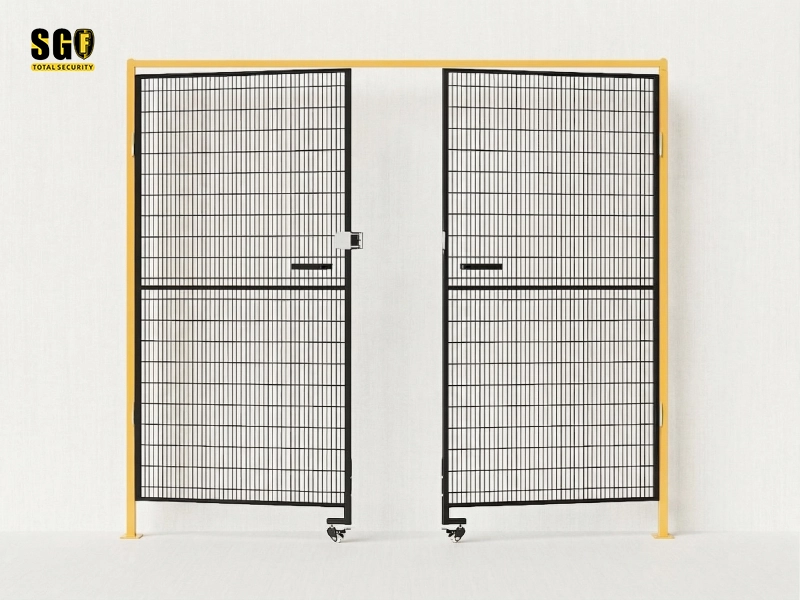
The gate is the point where physical guarding meets control-system responsibility. Mdfence provides a planned safety lock mounting carrier/interface for mainstream devices such as Omron D4NL and Pizzato FS-series components. Instead of treating the switch as an afterthought, the integrator can position the device with the gate hardware, verify actuator travel, and connect the guard-door signal into the machine safety circuit. The result is a cleaner path toward gate-open stop behavior and repeatable safety interlock installation.
2. Panel and gate dimensions that support planning before delivery
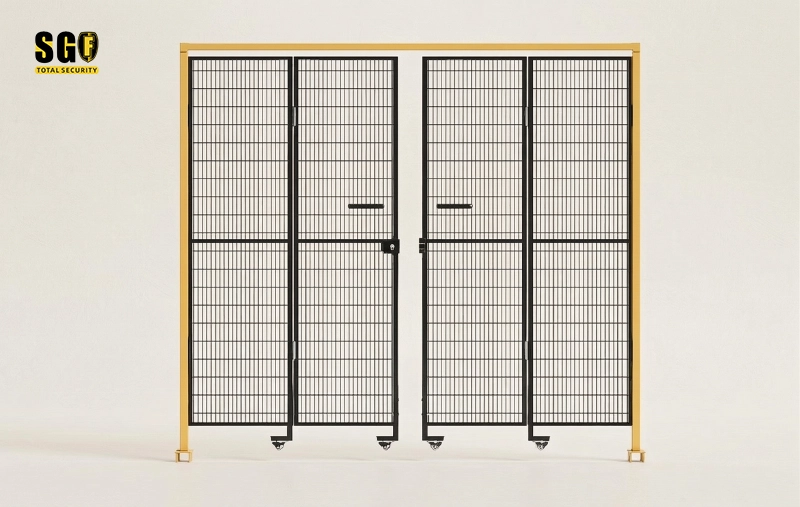
The engineering reference shows a three-panel safety gate arrangement with a total width of 2400 mm, 800 mm panel modules, and a standard height of 2000 mm. That dimensional logic gives an automation integrator a practical starting point for CAD layout, operator access, and maintenance clearance. The same reference identifies an interlock latch, folding hinges, heavy-duty casters, and independent foot brakes, so the access solution can be reviewed as a complete module rather than as separate pieces on site.
3. Welded mesh panels built for a visible, maintainable boundary
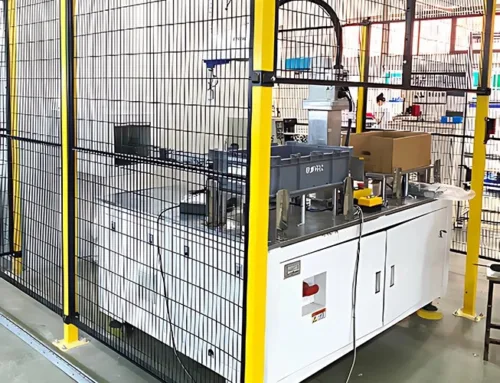
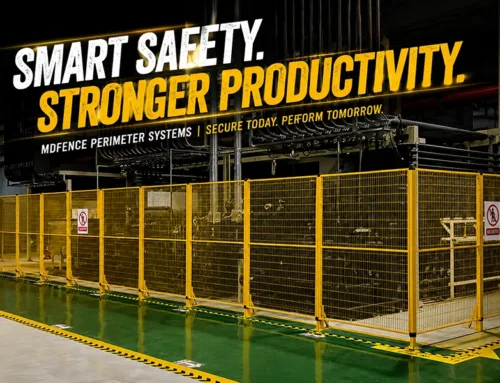
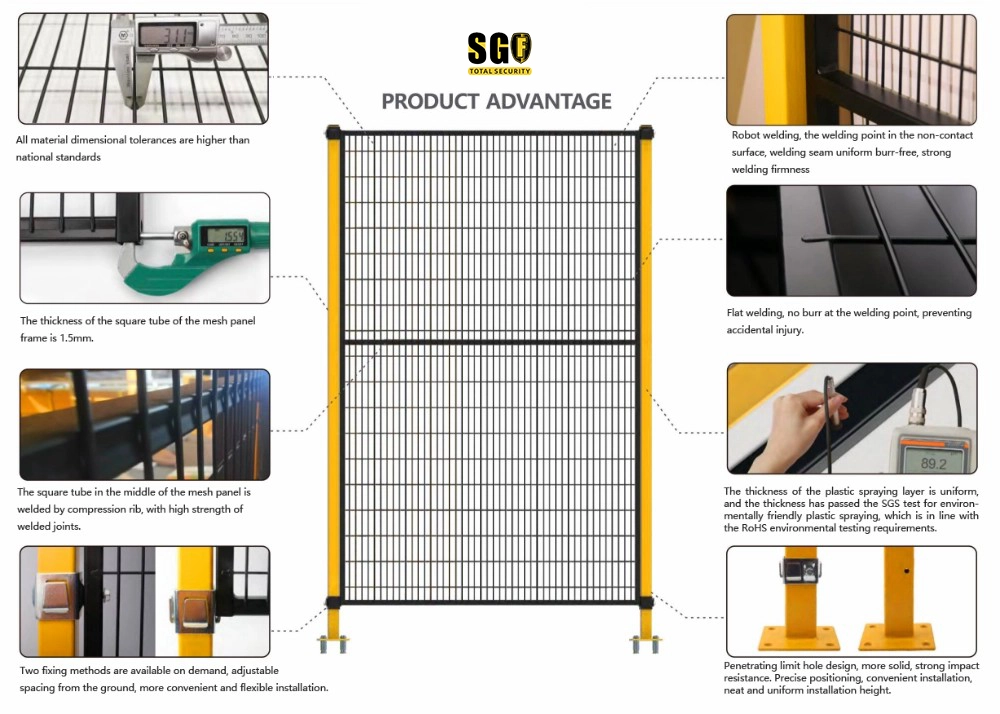
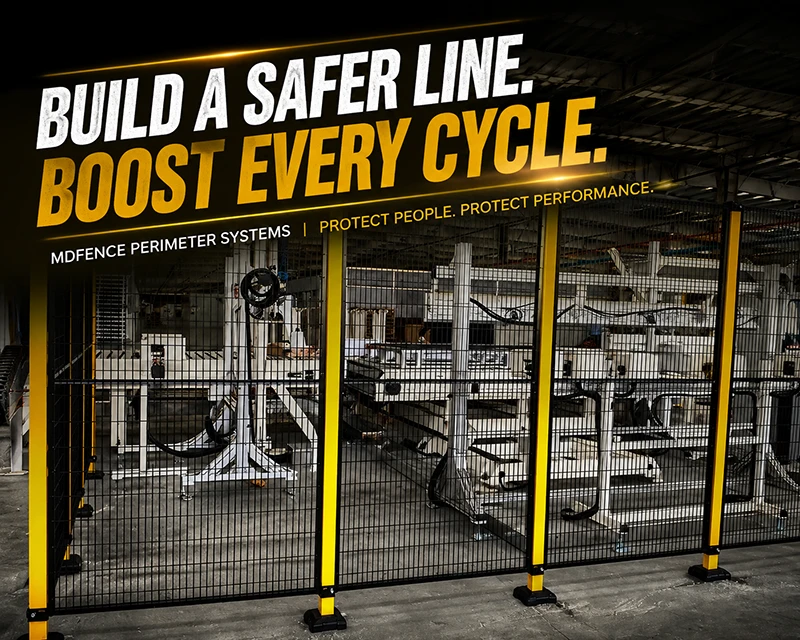
The product evidence shows black welded mesh panels inside a square-tube frame, with reinforcement through the panel and full, flat weld details highlighted in the construction overview. Q235 carbon steel is identified for the frame, while the yellow powder-coated posts make the boundary easy to see across a busy production floor. This combination supports machine perimeter guarding without hiding the equipment from operators and maintenance technicians.
4. Modular layout for automation system isolation
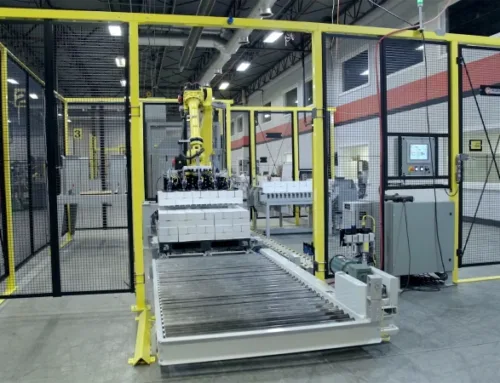
Once the safety interface is standardized, the rest of the perimeter can follow the line layout. The modular system uses mesh panels and floor-mounted steel posts with bolted base plates, allowing an integrator to define a robot cell, conveyor approach, palletizer zone, or maintenance access route without designing a bespoke welded enclosure for every project. For future line changes, a configurable safety fence can be adapted instead of discarded.
Where This Interface-Led Approach Fits
- Pallet nailing and packaging lines: coordinate hinged safety doors with the line safety circuit and reduce commissioning rework.
- Conveyor line safety guarding: separate transfer points from pedestrian routes while keeping service access defined.
- Robot cell guarding: establish a visible robot safety fence with controlled gate access and equipment isolation.
- Automated material handling: combine perimeter guarding with forklift and pedestrian safety zoning around machine cells.
- Future line modifications: use modular safety barrier components to improve production-line layout flexibility.
For projects targeting OSHA machine guarding requirements, ISO 14120 alignment, or ANSI/RIA R15.06 robot safety, the fence is one part of the risk-reduction system. The integrator must validate the complete safeguarding architecture, switch selection, safety PLC logic, stopping performance, and site installation. Mdfence contributes the physical boundary and the planned interface that makes those checks easier to execute consistently.
Specify the Interface Before the Fence Reaches Site
Before issuing a guarding purchase order, provide the machine-cell drawing, gate quantity, required access direction, switch model, actuator orientation, panel height, service clearance, floor condition, and safety-circuit requirements. The Mdfence approach lets the project team review Omron D4NL or Pizzato integration at the design stage, rather than discovering a mounting mismatch during installation. That is where the hidden cost is removed: fewer field holes, fewer alignment iterations, and less engineering time spent converting a generic fence into a machine safety fence.
Build a More Predictable Machine Guarding System
When an automated line depends on a gate-open stop signal, the safety fence should be specified as an integration component, not a loose perimeter product. With modular panels, visible welded construction, bolted floor mounting, and planned safety lock interfaces, Mdfence helps automation integrators shorten project cycles, simplify access control, and reduce the risk of costly commissioning delays.