EN
EN  DE
DE  RU
RU  PT
PT  JA
JA  ES
ES  IT
IT Mefence Industrial Safety Fencing | Low-Cost Compliance for Fulfillment Centres
CFC Capex Gets Scrutinised to the Metre — Mefence Industrial Safety Fencing Costs a Fraction of Certified Brands
A customer fulfillment centre sinks most of its capital into robots, racking, software and the building shell, so the isolation fence around the floor is a small line that still gets cut when the quote looks expensive. Mefence industrial safety fencing ships factory-direct at about $10–32 per linear metre, against $105–213 for Troax- and Axelent-class certified brands — so a thousand-square-metre CFC perimeter comes in at a fraction of the certified quote, and the saving stays with the automation budget.
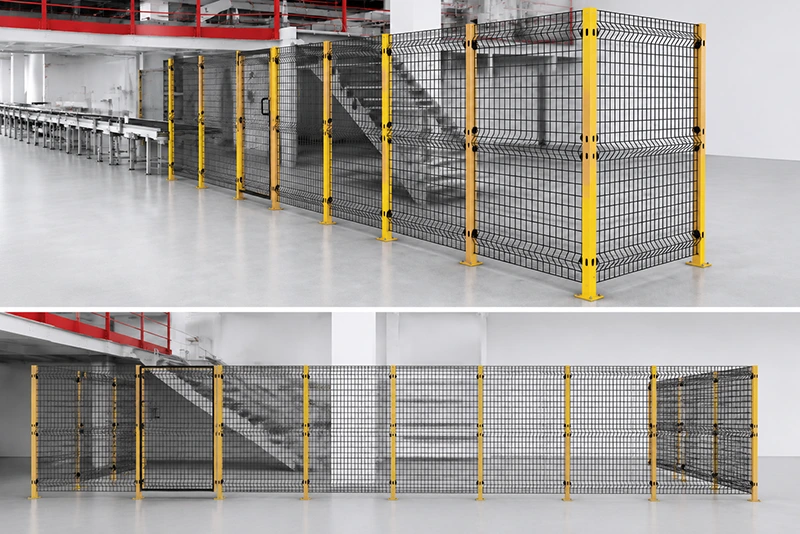
A Metre of Fence Should Not Decide the Robot Spend
An e-commerce automated fulfillment centre is a capital-intensive build. The robots, the automated storage and retrieval system, the sortation software and the building shell absorb the budget, and the perimeter and internal isolation fencing is a small slice of the total. But because it is specified late and judged on unit price, a fencing line quoted like a certified European brand — Troax- or Axelent-class, around $105–213 per linear metre — can quietly consume the budget meant for throughput. When the quote lands high, the easy move is to cut the fence, which leaves automated equipment guarding, robot safety fence duty and pedestrian-vehicle separation either thin or missing at go-live. Emerging fulfillment operators, who are often cash-constrained and sensitive to cost per square metre of isolated floor, feel this most sharply: a perimeter that blows the budget can stall the whole project.
- Factory-direct ex-works pricing: about $10–32 per linear metre, roughly a fifth to a tenth of the certified-brand quote, because no brand and distributor margin is stacked on a welded mesh panel.
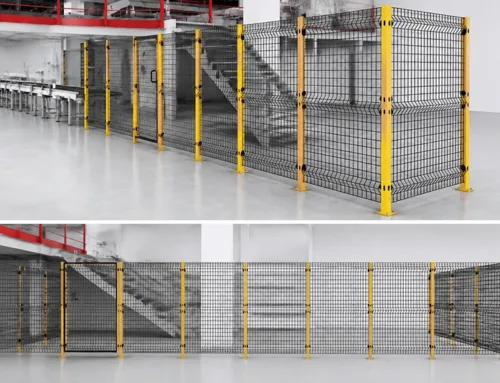
- Clip-fixed, no fabrication premium: plastic clips and self-tapping screws hold panels to posts, so there is no site-welded frame to pay a fabricator to build.
- On-site cutting: mesh panel widths of 200–1400 mm and heights of 200–3000 mm are cut to the receiving layout on site, so there is no custom-frame surcharge or long lead time.
- Base plate posts: 40×60 mm and 60×60 mm posts with base plates and expansion bolts fix to hard flooring with one-person, three-step assembly and more than 50% less install time than welded construction — the labor line stays small.
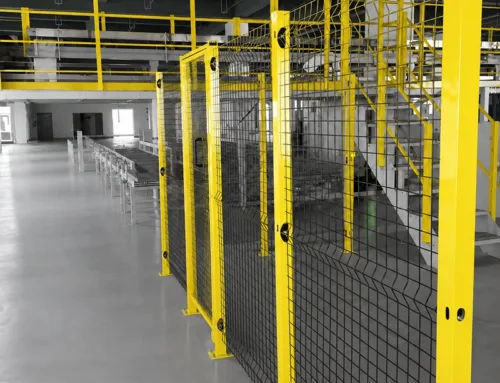
- Q235 carbon steel, powder coated: a welded wire mesh panel in yellow and black electrostatic powder coating, custom colors available, that carries OSHA, ANSI B11.19 and ISO 14120 guarding duty without a premium finish.
- Modular and reusable: the same modules redeploy if the floor plan changes, so the fence cost is spent once, not per layout.
Why Mefence Holds the Line on Cost Without Cutting Safety
1. No welds, no fabrication premium
A Mefence panel is clamped to its post with plastic clips and self-tapping screws rather than a fabricated, site-welded frame. The $10–32 per metre covers the welded wire mesh panel and the hardware, not a custom steel frame bent and welded to your dimensions. Installers cut panels on site against real pipe runs, columns and corners, so there is no engineering surcharge for a “special” width. With no welding required, the work stays cold and off the critical path, and SGF installation material records install-time savings of more than 50% over welded construction — the labor cost lands with the product cost, not on top of it.
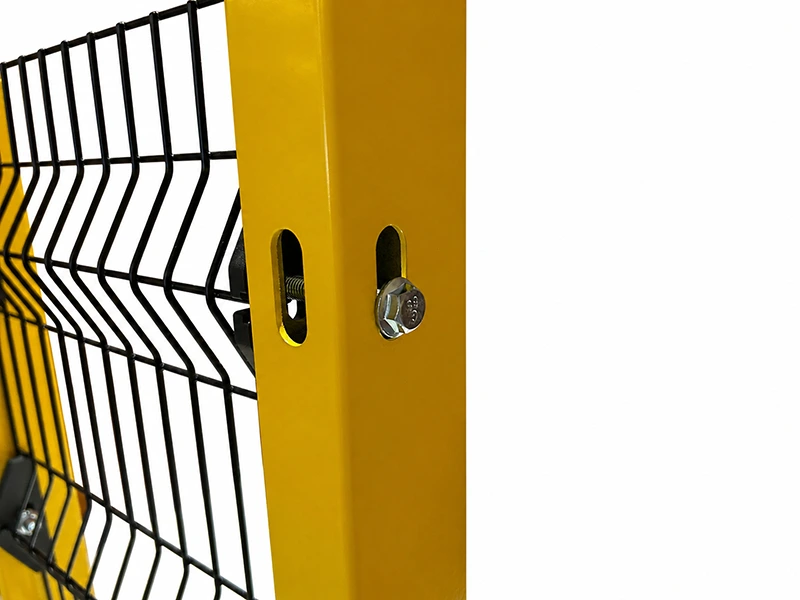
2. Buy the perimeter once, not per layout
A fulfillment centre floor plan is rarely final. As pick volumes shift, the fence around robotic workstation enclosures, conveyor belt isolation and storage area separation moves. Mefence modules are bolt-down on base plates, so a re-layout is a dismantle-and-relayout job, not a second capital purchase. The 3D bent mesh carries horizontal T-shaped ridges for cable management fence duty and accepts wood slat inserts where visual shielding is needed, so the same stock serves both a slim-profile barrier at a forklift path barrier and a taller machine guard fence — one buy, many layouts.
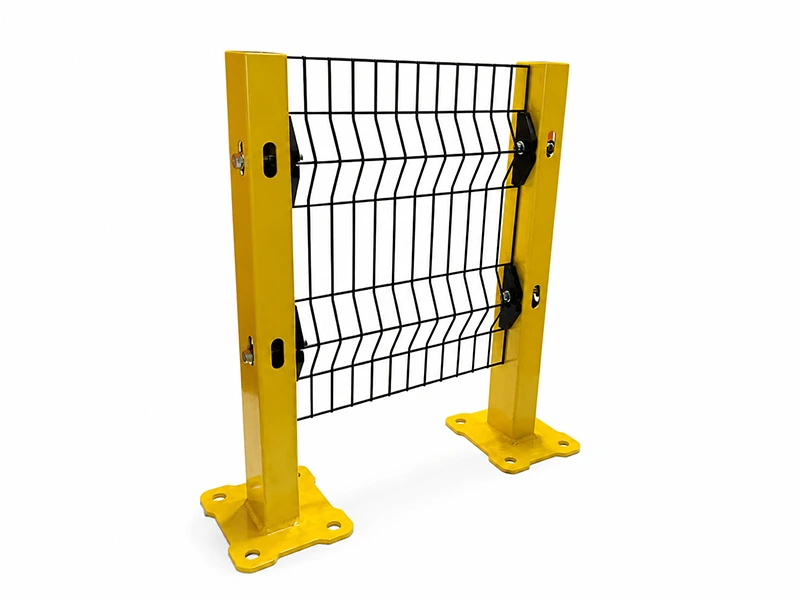
3. A thousand-square-metre perimeter on a fraction of the budget
Scale is where the arithmetic snaps into focus. A CFC perimeter of more than a thousand square metres, fenced at a certified brand’s $105–213 per metre, becomes a six-figure line that competes with the robots. At Mefence’s $10–32 per metre the same perimeter is a fraction of that, and the gap is the budget for an extra robot, more ASRS capacity or the sortation software. That is the trade emerging fulfillment operators actually face: spend the capital on throughput, and let the fence be the low-cost, compliant boundary it should be.
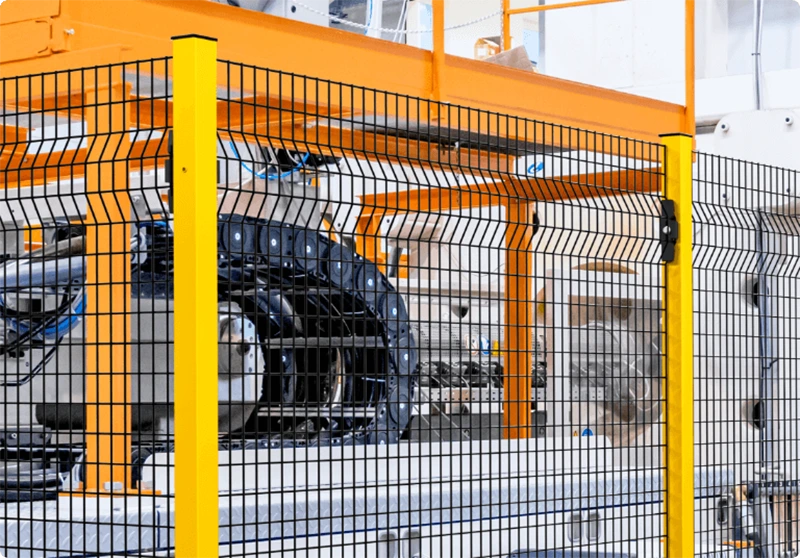
Where the Saved Budget Goes
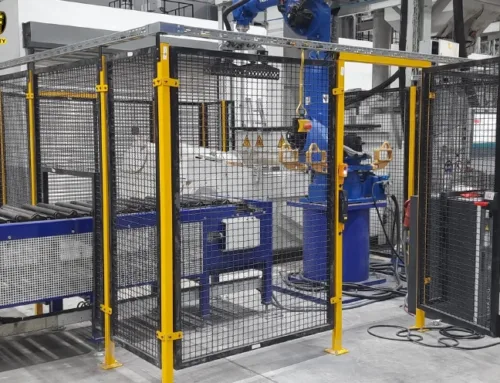
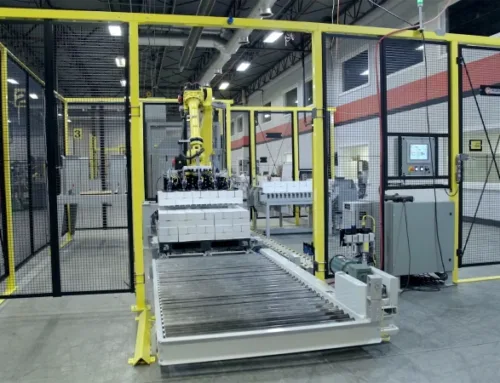
- Automated equipment guarding: the robot cells and CNC machinery that actually earn the revenue, fenced to standard instead of to a premium quote.
- Robotic workstation enclosures and conveyor belt isolation: protect people without costing a premium per metre of guarded run.
- Warehouse zoning and storage area separation: keep the floor legible as volumes swing, at a cost that scales with the building, not with the fence quote.
- Pedestrian-vehicle separation and forklift path barriers: meet OSHA, ANSI B11.19 and ISO 14120 without a branded surcharge on every metre.
- Area demarcation and traffic flow planning: a hazard zone separation and workplace safety barrier layer that grows with the operation.
For the finance and operations teams signing the build, the decision is not “cheap fence versus safe fence”. It is the same guarding duty at a fifth to a tenth of the fence line, with the rest of the capital working on throughput. Mefence industrial safety fencing meets the guarding standard at a price that lets the project clear the capex gate.
Specify the Perimeter Before the Robots Are Ordered
Share the perimeter length, the internal zones, floor-fixing conditions, traffic routes, and any gate, cable-routing or visual-shielding needs. The Mefence team matches panel dimensions, wire diameter, mesh opening, post size, base-plate fixing and access-gate positions to the layout, so the fence is priced and delivered as a known, small line — not a surprise that reshapes the robot budget.
Spend on Throughput, Not on the Fence
Mefence Industrial Safety Fencing gives fulfillment-centre builders a compliant isolation boundary at factory-direct pricing — clip-fixed modules, on-site cutting and a frameless 3D mesh that holds the line on cost without cutting safety. Contact SGF to price the perimeter against your robot and software budget, and keep the capital where it earns.