EN
 DE
 RU
 PT
 JA
 ES
 IT
CUSTOM WIDTH MESH PANELS / FENCE LAYOUT BOM
A run that will not divide by the standard panel width is a procurement problem, not a cutting problem
Integrators and racking suppliers quoting per project know the phrase: two panels are short, three are long. Buying the extra bay wastes money, and trimming a framed panel on site destroys the coating, the frame and the evidence behind the specification. Custom width mesh panels solve it on the drawing. Standard widths at 200, 400, 600, 900, 1000, 1200 and 1500 mm levels are laid out from the gate position, and the remainder is closed with a narrow infill panel entered in the fence layout BOM. One recorded enclosure of roughly 56 m with a 45-degree corner was matched with 57 posts and more than 50 panels of differing widths, with no site cutting.
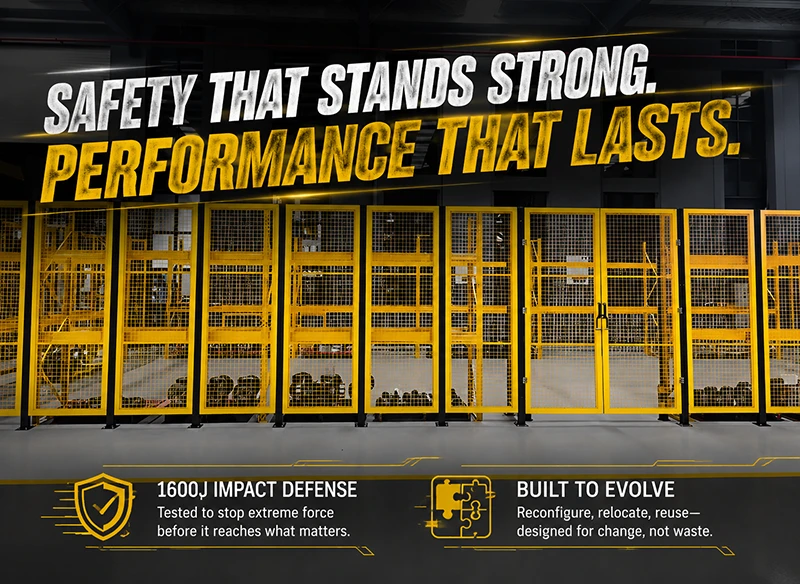
Send your perimeter dimensions and corner angles for a panel BOM
From perimeter length to a panel-by-panel BOM
A quantity take-off that says “approximately 60 panels” is not a fence layout BOM. Each bay has to land on a real post, each corner has to be closed at its actual angle, and each gate has to keep its lock carrier aligned. The remainder is a design input, not an installation surprise.
| Layout step | How it is resolved on the drawing |
|---|---|
| Gate first, then bays | Fix the gate position, leaf width and swing arc from the maintenance route. Standard width levels of 200, 400, 600, 900, 1000, 1200 and 1500 mm are then distributed to either side, so the post centres are derived from the access point rather than from an arbitrary start. |
| Remainder allocation | The indivisible length is placed as a narrow infill at a corner or on a maintenance side. It is never placed in the gate bay, where a shortened frame would move the lock carrier and interlock actuator out of alignment. |
| 45-degree corner | A dedicated corner post and two angle-matched infills carry the change of direction. Cutting a standard framed panel diagonally on site is not an accepted method of making a corner. |
| Why no site cutting | A framed mesh panel has a 20x30x1.5 mm tube border, flat full welds and a powder coated finish. Cutting opens the tube, exposes bare steel, breaks the coating and voids the flatness and corrosion evidence recorded for that unit. |
What the modular system contributes to the take-off
Every width is a real manufactured panel
Framed mesh panels are built as individual units: a Q235 square-tube post, a 20x30x1.5 mm frame, 3.0 or 4.0 mm wire on a 20×100 mm aperture, flat full welds and burr-free joints, then electrostatic powder coating in RAL1023 posts and RAL9005 panels. Because each width is manufactured and coded, it can appear as its own line in the fence layout BOM with a matching part code on the crate. M8 fixing rings and four M10 expansion anchors per base plate are counted per bay, not estimated per shipment.
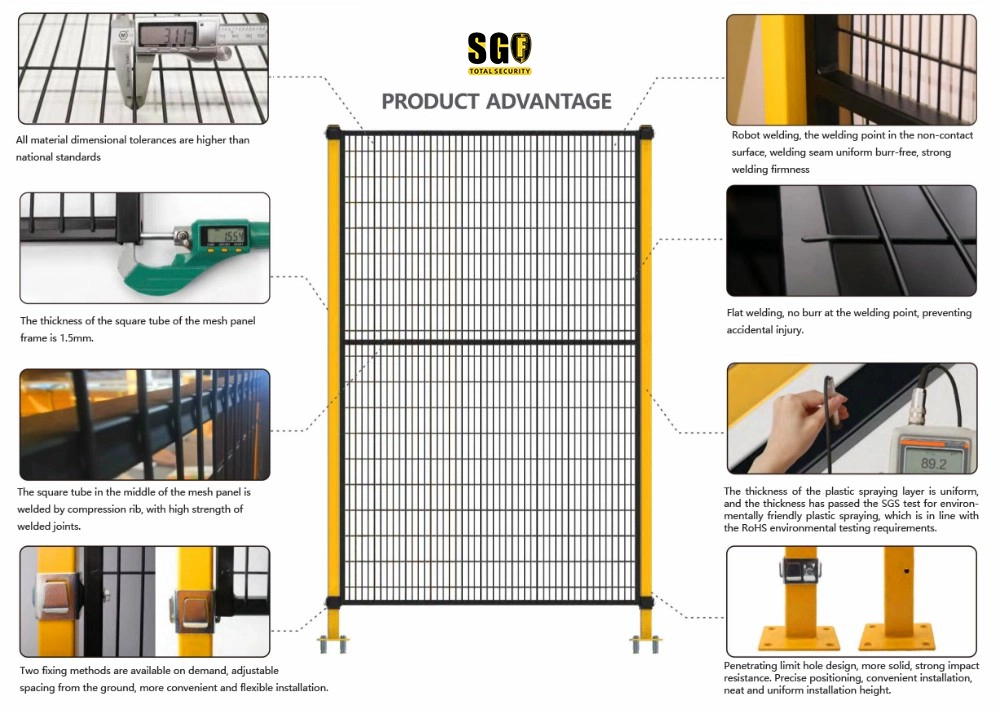
A 56 m enclosure with a 45-degree corner, as built
One project record describes a perimeter of roughly 56 m with a 45-degree change of direction, closed with 57 posts and more than 50 panels of differing widths. The point is not that every layout reaches that count; it is that the general arrangement drawing, the panel list and the delivered crates reconciled without a grinder. That is a single project record for a specific industrial safety fencing configuration, not a claim that every plant or every mesh variant is covered by the same figures. Custom sizes and door widths are re-drawn per project.
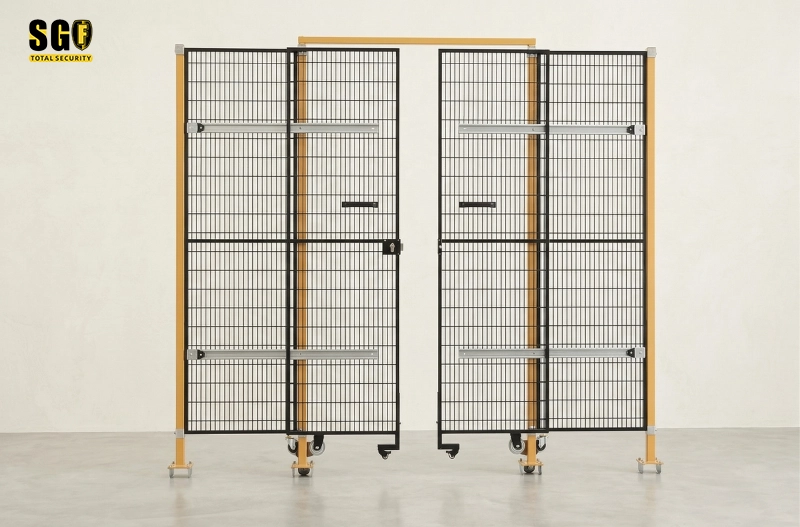
Gate alignment is where a bad remainder shows up
A short infill pushed into the gate bay changes the post spacing that keeps two leaves parallel. The leaf then sags, the latch misses, and the interlock actuator reports a fault that looks like an electrical problem. Gate leaves are dimensioned from the drawn bay, the safety lock mounting carrier is prepared for Omron D4NL or Pizzato FS switches, and acceptance includes three to five open-close cycles plus post verticality and panel flatness checks. A 1600 J impact figure applies to the tested standard configuration only and is confirmed against the actual build.
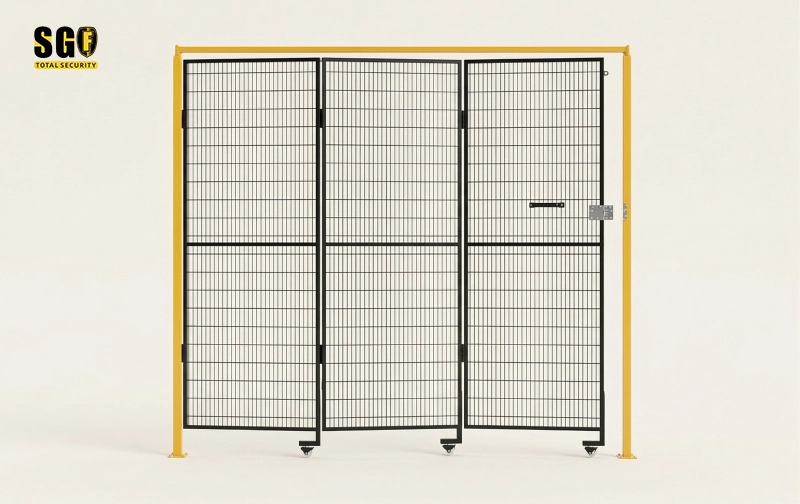
Projects that need a width schedule rather than a panel count
- Conveyor line safety guarding and long transfer routes: the cumulative remainder over a long run is where a generic quantity guess fails.
- Robot cell guarding and palletizer safety guarding: the gate bay must stay standard even when the surrounding bays are not.
- Smart warehouse zoning and flexible manufacturing: re-laid machine guarding fence panels keep their part codes when the line moves.
- 45-degree or irregular perimeters: corner posts and angle infills are drawn, quoted and shipped as identifiable parts.
Used this way, a modular safety barrier is a bill of materials that can be checked at goods-in, not a length of welded safety fencing to be finished on site.
The inputs for an exact fence layout BOM
Send the general arrangement with run lengths and angles, gate positions and leaf widths, transfer openings, hazard heights and opening sizes, floor and anchor conditions and the safety switch model. The returned pack carries a panel-by-panel width schedule, post and corner quantities, the gate and lock carrier schedule, a coded fastener and packaging list, and the acceptance checklist covering dimensions, welds, coating finish, burr-free joints and gate cycling. Guard design remains subject to ISO 14120 review and the local risk assessment.
Close the remainder on the drawing
Standard widths, a specified narrow infill and a dedicated corner post cost less than a cut panel and a rework visit. Procurement gets a list it can reconcile against the crate, and installation gets bays that fit.