EN
EN  DE
DE  RU
RU  PT
PT  JA
JA  ES
ES  IT
IT 
Scenarios for low and high Profile Rack Guard

Here are some examples of application scenarios for low and high Profile Rack Guard:
A company has a small server room with limited space, and they need to protect their racks from accidental damage caused by equipment carts or people walking too close. Installing a low-profile rack guard will provide a barrier between the racks and the surrounding area, preventing any accidental bumps or collisions from causing damage.
A warehouse has a large number of racks with low clearances between them, making it difficult to install traditional rack guards. Installing a low-profile rack guard that is designed to fit in tight spaces will help protect the racks from forklifts or other equipment that may accidentally bump into them.
A retail store has racks that are close to the customer traffic flow. Installing a low-profile rack guard will protect the racks from shopping carts, strollers, or other items that may be pushed into them.
High Profile Rack Guard:
A manufacturing facility has a high volume of forklift traffic in the warehouse. Installing a high-profile rack guard will protect the racks from accidental collisions with forklifts and other heavy equipment.
A data center has tall racks with expensive equipment that needs to be protected from accidental damage caused by people or equipment. Installing a high-profile rack guard will provide an extra layer of protection for the racks and the equipment stored on them.
A distribution center has racks that are located in high-traffic areas, and there is a risk of accidental collisions with carts, forklifts, or other equipment. Installing a high-profile rack guard will provide a visible barrier that will help prevent accidents and protect the racks from damage.
Interlock Switch Mounting Without Drilling: Why Alfence T-Slot Posts End Phantom Stops
Bolting an interlock switch bracket through a powder-coated steel post drills the coating, drops swarf into the cell and leaves a rust line — and when the hinged leaf sags, the tongue misaligns and the PLC reports a phantom guard fault. Alfence mounts sensors, e-stops and conduit in the T-slot groove of a 40×40 mm or 45×45 mm aluminum post, with door hardware sized to keep the safety switch aligned.
Phantom Safe Torque Off Stops: T-Slot Guarding Fence Posts Mount Interlocks Without Drilling
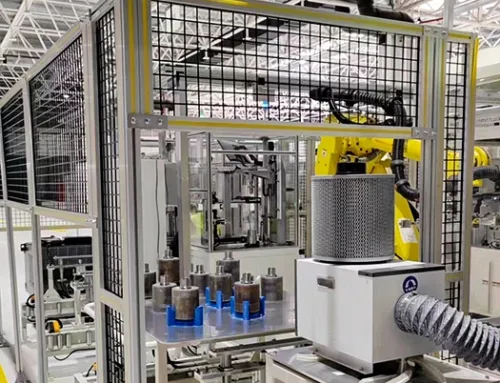
Painted steel guarding posts force maintenance to drill for interlock switches, dropping swarf in the cell and breaking the coating where rust starts. Sagging hinge doors then misalign the interlock tongue and the PLC trips Safe Torque Off while the gate is closed. Alfence industrial safety fence mounts sensors, e-stops and cable routing into the T-slot aluminum profile post without drilling, and uses hinged, folding or sliding door frames that keep interlock geometry stable - protecting OEE through phantom stops and line changes.
Automotive Plant Industrial Safety Fence: Keep the Robot Cell Close to the Hazard
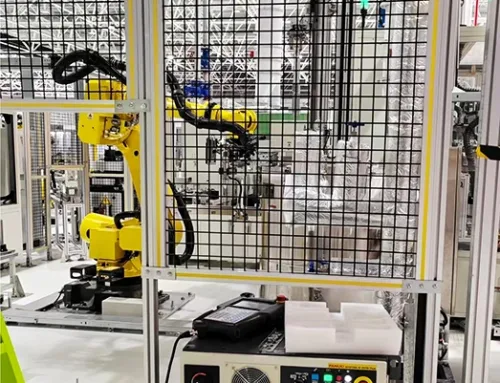
Automotive plants cannot afford to lose production floor to an oversized machine guarding perimeter. Alfence combines 20×100 mm mesh with slim 40×40 mm or 45×45 mm aluminum posts for a compact, reconfigurable industrial safety fence layout, with final clearance confirmed by the project risk assessment.