EN
EN  DE
DE  RU
RU  PT
PT  JA
JA  ES
ES  IT
IT Mefence Industrial Safety Fencing | Sunk-Cost Zoning for Food Plants
Welded Fences Are Sunk Cost When Food Lines Re-Tool Every Season — Mefence Stays Relocatable
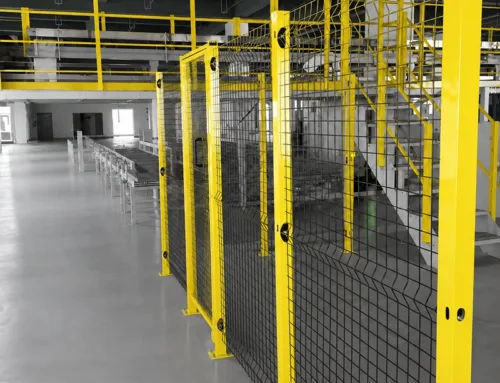
A global food and beverage group runs seasonal, co-branded and trial SKUs that churn faster than the floor plan. The welded square-tube fence built around a line is cut out and scrapped at every re-tool, then purchased and installed again at the next one. Mefence frameless safety fence modules are clip-fixed instead of welded, so plant teams dismantle the boundary without a torch, cut panels on site and redeploy the same industrial safety fencing for warehouse zoning, machine guarding and pedestrian-vehicle separation — turning a sunk cost into a relocatable plant asset.
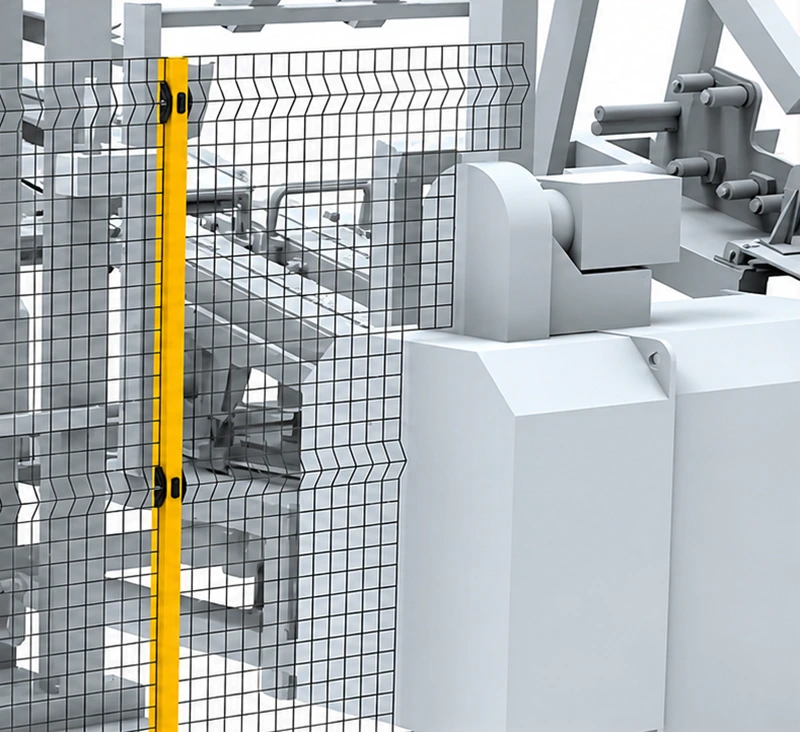
A Welded Boundary Dies With the SKU
Food and beverage portfolios now turn over on seasonal and promotional cycles. A co-branded run, a limited trial batch or a retired line frees floor space that the next product immediately claims. The welded square-tube fence built to protect the old process was never meant to move: on teardown day it is an obstruction that has to be cut apart and hauled away, and the receiving line buys a second boundary for the same process. The cost is not only the second purchase. Cutting out the old fence, scrapping the steel, redrawing the new footprint and re-installing all land inside the same consolidation window, while the same crew is moving fillers, conveyors and utilities. Chain link, barrier tape and rope barriers dodge the demolition bill by giving up the visible, controlled boundary that machine guarding and hazard zone separation depend on.
| Mefence design point | What it changes during a re-tool |
|---|---|
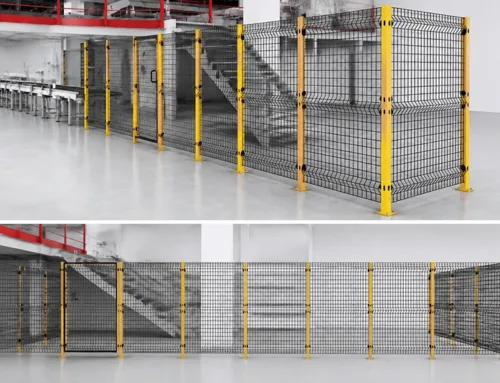
| Frameless 3D welded mesh | There is no perimeter frame to cut through, so a panel taken down at one site can be trimmed and reused as a shorter section at the next one. |
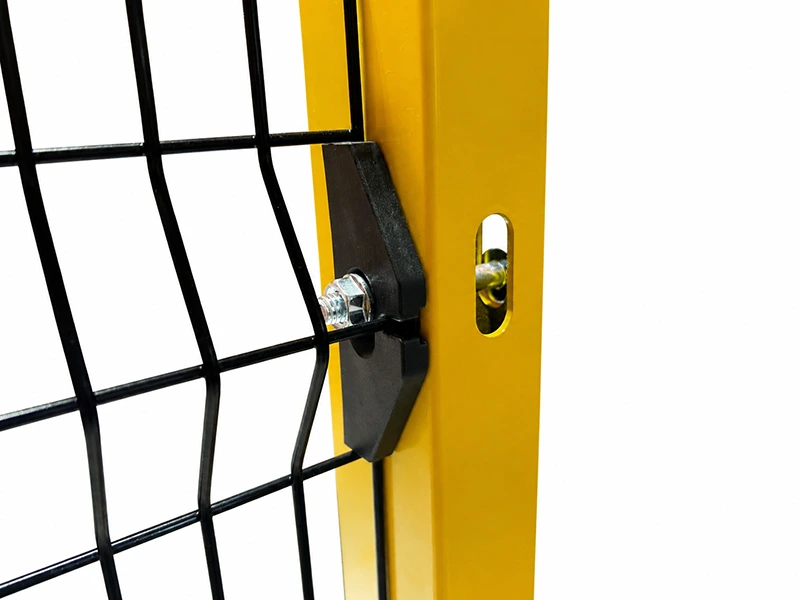
| Clip-fixed assembly | Plastic clips and self-tapping screws hold panels to posts, so dismantling is non-destructive and modules stay complete for the move. |
| On-site cutting | Panel widths of 200–1400 mm and heights of 200–3000 mm adapt to the receiving plant’s pipe runs, columns and odd corners without a factory redraw. |
| Base plate posts | 40×60 mm and 60×60 mm posts with base plates and expansion bolts fix to hard flooring; the fixing points move with the fence. |
| Material and finish | Q235 carbon steel with electrostatic powder coating; standard yellow and black finish, custom colors available to match a group standard. |
| 3D bent profile | Horizontal T-shaped ridges carry cable routing and accept wood slat inserts where visual shielding is required. |
Why a Frameless Fence Survives a Re-Tool
1. Dismantle the boundary into modules, not demolition debris
A Mefence panel is held to its post by plastic clips and self-tapping screws rather than a site-welded frame. During a line re-tool the fence comes down section by section: posts unbolt from their base plates, panels come off as intact sheets, and the fasteners stay with the modules. The documented installation method is one-person, three-step assembly, and SGF installation video material records installation-time savings of more than 50% compared with welded construction. The saving repeats at the receiving plant, because the second install is the same three steps with the same hardware, not a new fabrication job. For a plant closing or shifting capacity, the modules ship as racking-ready bundles instead of scrap.
2. Re-cut the panels on site for the next footprint
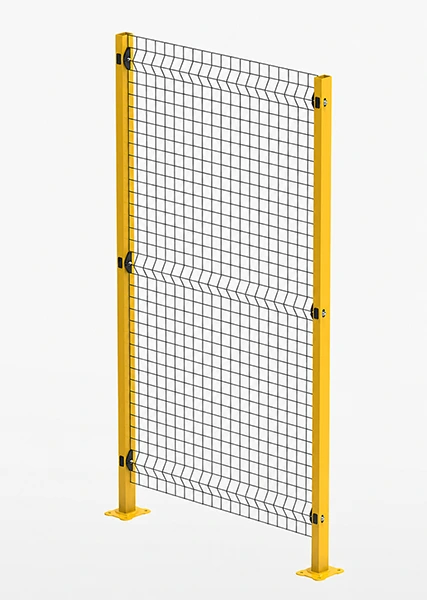
A re-tooled line rarely lands on the footprint it left. Frameless welded mesh can be cut on site, so installers trim panel width and height against real conditions — a pipe run, a structural column, an existing wall corner, or the 140 mm ground clearance where a floor slopes or a drainage channel crosses — instead of waiting for a factory to redraw a frame. Wire diameters of 3 mm or 4 mm with mesh openings of 20×100 mm or 50×50 mm let the same shipped stock serve both a tight machine-guarding perimeter and a longer warehouse partition run. No welding is required, so the work stays cold and off the critical path.
3. Rebuild the zone with access, cable routing and sightlines intact
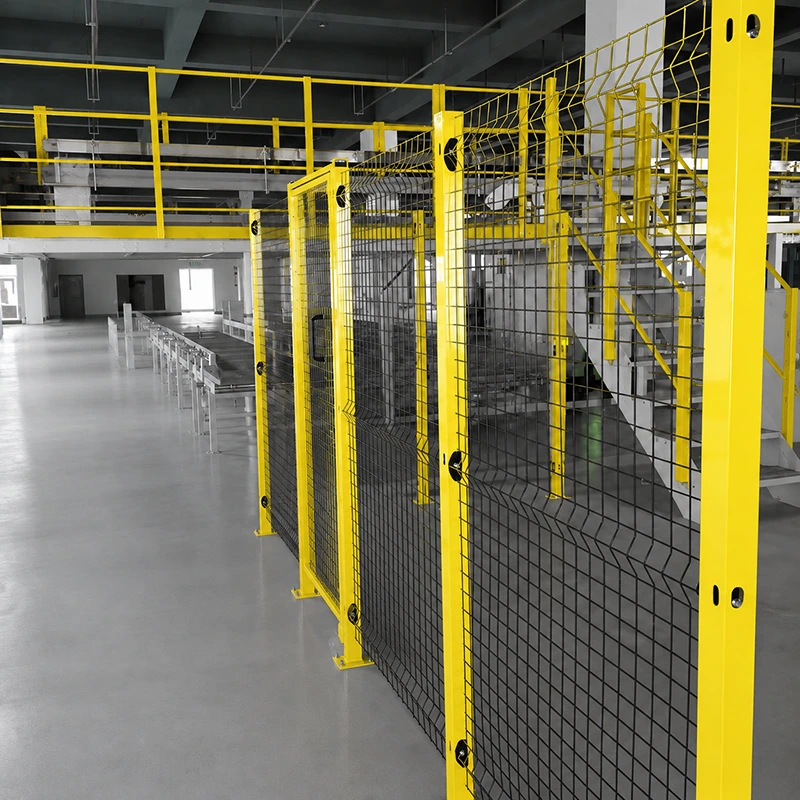
The receiving plant has its own traffic plan, and the boundary has to work inside it: a gate where operators actually enter, a cable route that does not hang into the aisle, and a mesh that keeps forklift and pedestrian routes visible instead of turning the lane into a blind wall. The raised T-shaped ridges of the 3D bent mesh give cables somewhere to run and accept wood slat inserts where shielding is needed. Mefence is built for area demarcation and traffic control, not certified impact containment; where a forklift aisle needs direct impact protection, specify the higher-spec Machine Fence line.
Where Relocatable Zoning Pays Back First
- Seasonal and co-branded runs: recover the fence when the promotion ends, then reinstall it around the product that takes the floor space.
- Trial and pilot batches: zone a short production run without committing capital to a layout that may be gone in two quarters.
- Plant closure or capacity shift: dismantle at the closing site, ship the modules as racking-ready bundles and reinstall them at the plant that inherits the volume.
- Warehouse zoning during transition: re-establish storage area separation, forklift path barriers and pedestrian-vehicle separation while layouts are still moving.
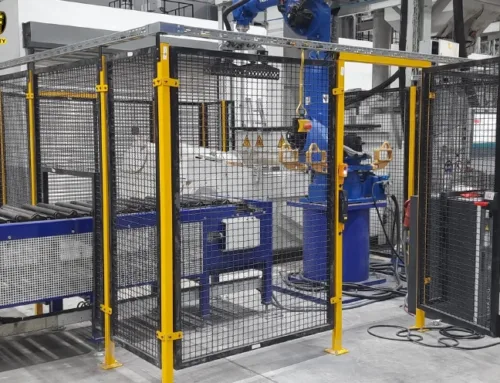
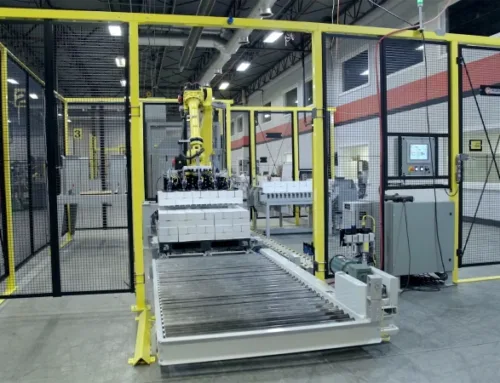
- Machine guarding and robot cells: rebuild an automated equipment guarding perimeter around machinery that has been relocated and re-based.
For engineering and finance teams the accounting changes with the hardware. The fence stops being a site-specific installation written off together with the line, and becomes plant equipment that carries across layouts and sites. That is the difference between paying for a boundary twice and paying for it once across several product generations.
Specify the Re-Tool Before the Teardown Starts
Share the current layout, the next footprint, floor-fixing conditions, traffic routes, and any gate, cable-routing or visual-shielding requirements. The Mefence team can match panel dimensions, wire diameter, mesh opening, post size, base-plate fixing and access-gate positions to both sites, so the modules that come down at one plant are the modules that go back up at the next.
Make the Fence Follow the Volume
Mefence Industrial Safety Fencing gives food and beverage manufacturers a practical way to re-tool a line without scrapping the boundary around it: clip-fixed modules, on-site cutting and a frameless 3D mesh that adapts to the next footprint. Contact SGF to plan the next re-tool around a frameless safety fence that stays relocatable.