EN
EN  DE
DE  RU
RU  PT
PT  JA
JA  ES
ES  IT
IT 
In any busy facility, there is a constant, silent negotiation for space. Forklifts, pallet jacks, and maintenance carts move with purpose along their designated paths, while employees, engineers, and managers navigate the same environment on foot. We manage this negotiation with painted lines, safety vests, and extensive training—all essential elements of a modern safety program.
But these measures all share a common vulnerability: they rely on constant, shared situational awareness. They assume that both the vehicle operator and the pedestrian will see each other, correctly interpret intentions, and react perfectly in time.
What happens when this silent negotiation breaks down? What happens when a forklift operator’s view is momentarily obscured by a tall stack of pallets, or a quality inspector is rightfully focused on a component and takes a step backward without looking?
In these moments, a painted yellow line offers no protection. It is an invisible wall, respected only when conditions are perfect. The consequence of this vulnerability is the single most unacceptable outcome in any workplace: a serious injury to a member of your team.
This article isn’t about the financial cost of an accident; it’s about the human cost, and how we can move from a culture of hopeful awareness to a culture of engineered, physical safety.
Beyond Lines and Vests: The Psychology of a Protected Walkway
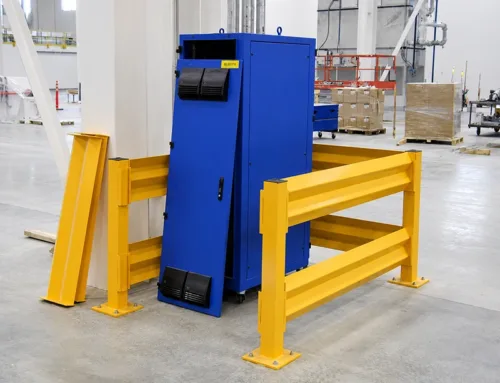
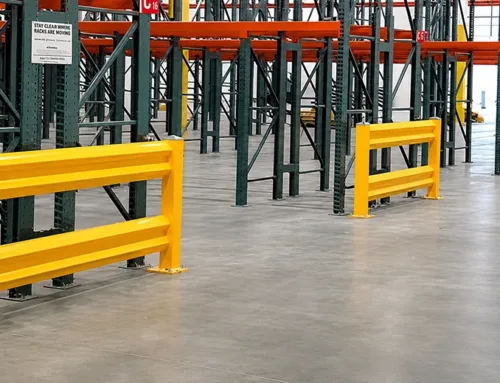
Creating a truly safe pedestrian environment requires a shift in thinking. Instead of simply marking out a path and asking people to stay on it, we must create an environment where it feels natural and secure to do so. This is where engineered warehouse guard rails serve a purpose that goes far beyond simple impact protection.
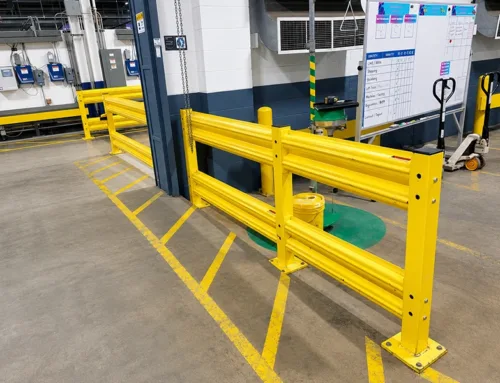
By using a physical barrier like a single or double-rail guardrail to construct a dedicated pedestrian walkway, you are doing more than just separating people from traffic.
- You are eliminating ambiguity. A physical barrier is a clear, unmistakable statement. There is no question about where the vehicle zone ends and the pedestrian zone begins. This clarity reduces the cognitive load on everyone. Operators don’t have to guess a pedestrian’s intention, and pedestrians don’t have to constantly look over their shoulders.
- You are creating a sense of psychological safety. For an employee walking through a busy plant, a protected walkway provides a tangible sense of security. They can focus on their work, move with confidence, and feel that their well-being has been actively considered and engineered into the environment. This feeling of being cared for is a cornerstone of a positive safety culture. It demonstrates that safety is not just a policy, but a physical reality.
- You are formalizing traffic flow. Just as guardrails on a highway prevent chaotic lane changes, a walkway system in a factory formalizes movement. It guides people along safe, predetermined paths to workstations, break rooms, or offices-in-plant, preventing unpredictable shortcuts through dangerous areas.
Designing for People: Integrating Access and Flow
A common concern when creating physical walkways is that they will impede movement and create frustrating detours. A poorly designed system can do just that. However, a modern, modular system of warehouse guard rails is designed with human flow in mind.
This is where components like integrated swing gates become essential. A well-placed, spring-loaded gate allows for easy pedestrian access into a protected work cell or across a traffic aisle. It maintains the integrity of the protective barrier while ensuring that workflow is not disrupted. The gate swings closed automatically, ensuring the barrier is never accidentally left open.
The goal is to create a system that feels like a natural and helpful part of the environment, not an obstacle. By thoughtfully planning walkways and access points, you can guide people safely and efficiently, enhancing both safety and productivity.
An Investment in Your People
Protecting your critical equipment with heavy-duty barriers is a wise financial decision. But protecting your people is a moral and cultural imperative.
Building a network of physically protected walkways and work zones is one of the most powerful statements you can make about your company’s values. It tells every employee, from the new hire to the 30-year veteran, that their safety is not just a slogan on a poster, but a non-negotiable, physical commitment built into the very steel and concrete of their workplace.
It transforms safety from an abstract rule that must be remembered into a tangible reality that can be felt. And in doing so, it helps build the most valuable asset of all: a culture of trust, where every team member knows they are working in an environment designed, first and foremost, to ensure they go home safely at the end of every shift.