EN
EN  DE
DE  RU
RU  PT
PT  JA
JA  ES
ES  IT
IT

|
Designing a dedicated manufacturing line is complex enough without the safety sign-off becoming a bottleneck. Whether you are integrating high-speed assembly machines or robotic welding cells, the physical barrier shouldn’t be an afterthought—it needs to be as engineered as the automation itself. We provide modular, TUV-certified guarding that integrates seamlessly with your PLC logic and fits your CAD layout perfectly. |
The Engineering Reality of Dedicated Manufacturing Lines
In the world of system integration—specifically for automotive and high-precision electronics—a “dedicated manufacturing line” is rarely a static entity. You deal with cycle time optimizations, last-minute footprint adjustments, and the rigorous demands of ISO 14120 compliance. The old school method of fabricating angle-iron fences on-site is obsolete. It requires hot work permits, ruins epoxy floors with welding spatter, and offers zero flexibility when the client decides to add a new conveyor spur.
Your dedicated manufacturing lines safety system must be modular. It needs to act as a plug-and-play component of your turnkey solution, not a construction project.
Structural Integrity Meets Modular Design
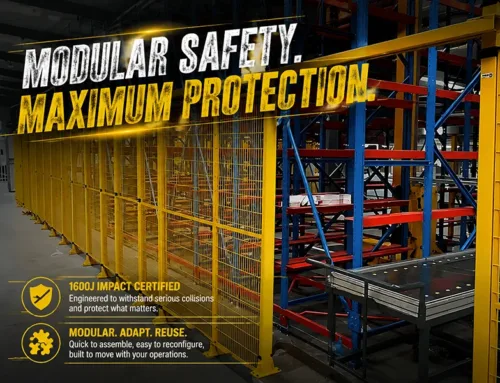
When you are protecting expensive assets like KUKA or FANUC robotic arms, a simple wire mesh isn’t enough. You need impact resistance calculated against the kinetic energy of a potential robot crash or a flung workpiece.
Our system utilizes Framed Panels. Unlike “fence on a roll,” our Q235 carbon steel mesh is fully welded into a 20x30mm square tube frame. This provides the rigidity required to maintain the safety distance (ISO 13857) even under impact load. The flattened weld points ensure there are no sharp edges to snag operator clothing or PPE.

Figure 1: Standard Framed Panel construction showing the 20x30mm steel tube frame essential for structural rigidity.
Integrating Safety Logic with Physical Barriers
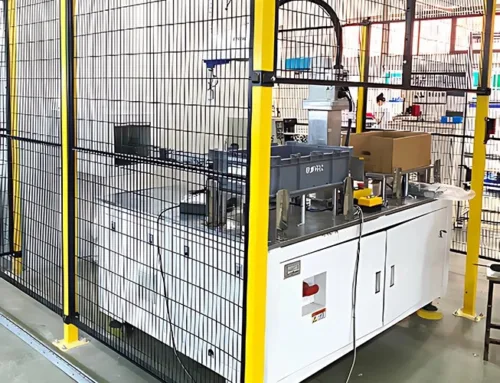
A physical barrier is only half the equation in a modern Machine Guarding System. The critical pain point for electrical engineers is mounting the safety interlocks. Drilling holes into steel posts on-site to fit an Omron or Pizzato switch is time-consuming and risks compromising the powder coating, leading to rust.
We solve this with pre-engineered Safety Interlock Carriers. Our system is designed to accept standard industry interlocks directly. We provide the mounting kits (like the KKCK-LCK series) that allow your “E-stop” logic to function immediately upon installation. This turns the fence from a passive wall into an active part of the machine safety circuit.

Figure 2: Modular locking options and mounting interfaces designed to integrate with safety switches.
Managing Material Flow and Maintenance Access
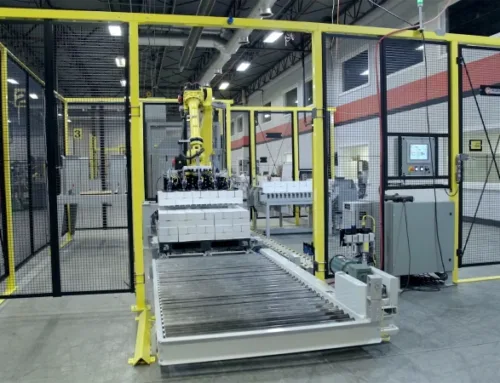
On a dedicated line, flow is everything. You need to get raw materials in (e.g., via AGVs or forklifts) and finished assemblies out, without triggering downtime. Standard hinged doors often fail here because they require a large swing radius, which eats into valuable floor space in tight cells.
For these scenarios, we deploy Sliding Door Systems. These are critical for robot cells where the operator needs to load a jig or fixture. Our double sliding doors can provide openings up to 4300mm, allowing forklifts to place heavy pallets directly onto the transfer line. The upper track system ensures smooth operation even in high-cycle environments.

Figure 3: Double Sliding Door system providing wide access for material handling without obstructing the aisle.
From CAD to Reality: The “Build to Print” Advantage
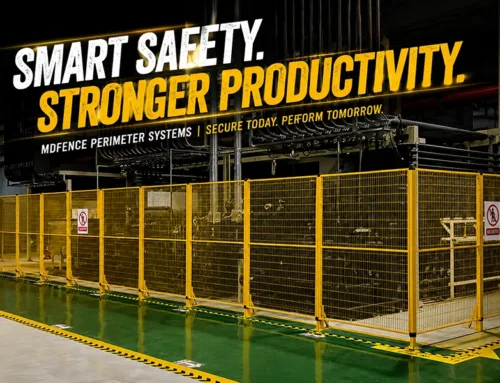
We understand that you work in CAD. Your layout defines the safety perimeter. We don’t just sell standard panels; we analyze your DWG or DXF files to generate a precise bill of materials.
Whether you need to navigate around a structural column, create a 45-degree corner for a conveyor turn, or isolate a high-voltage testing area from the main assembly line, our modular components adapt to the geometry. This “design for automation” approach minimizes the “cut and shut” work required during the final installation phase.

Figure 4: Complex CAD layout execution for a large-scale area isolation project, matching specific client dimensions.
Frequently Asked Questions
1. Can your fencing system withstand a direct impact from a robotic arm?
Yes, our system is TUV certified for high impact resistance. The combination of 60x60mm posts (2.0mm wall thickness) and framed panels allows the system to absorb significant kinetic energy, containing the hazard within the cell as per ISO 14120 requirements.
2. How do we integrate our specific safety switches (e.g., Allen-Bradley or Sick)?
We provide specialized mounting plates and “lock carriers” that act as an adapter between our door frames and your specific safety hardware. You simply specify the switch model during the design phase, and we supply the compatible interface.
3. We have a clean room environment; is welding required during installation?
No. The Mdfence system is 100% bolt-together. It utilizes expansion bolts for floor anchoring and mechanical fasteners for panel connections. This eliminates the need for hot work permits and keeps your facility clean.
4. Can the system be modified after the production line is installed?
Absolutely. This is the primary advantage of modular Robot Safety Fencing. If you need to expand a work cell or move a conveyor, you can unbolt sections, add new posts or panels, and reconfigure the layout without scrapping the existing material.
5. What is the standard lead time for a custom layout?
Because we utilize modular standard components (posts, panels, door kits) to build custom layouts, our lead times are significantly shorter than custom fabrication shops. Once the CAD layout is approved, we can typically ship the complete kit rapidly to meet your project commissioning deadline.