EN
EN  DE
DE  RU
RU  PT
PT  JA
JA  ES
ES  IT
IT Global Packaging Integration
Industrial Safety Fencing for Global Packaging Integration: One Standard, Every Site
When a packaging group merges plants across countries, Industrial Safety Fencing has to do more than block access. It has to copy the same drawing, the same install method, and the same cost model from site to site without local variation.
What integration teams need from a fence standard
A merged packaging group does not have time for a different fence detail in every country. The fence must support warehouse zoning, pedestrian vehicle separation, machine guarding, and short shutdown windows, while still fitting one global procurement spec.
| Integration problem | Mefence response |
|---|---|
| One standard across many plants | Frameless safety fence modules built from the same mesh panel, post, and clip logic, so every site copies the same result. |
| Short shutdown window | Quick install safety fence with no welding required, so ordinary maintenance crews can complete the work inside a tight changeover slot. |
| Cost synergy pressure | Factory-direct supply and OEM support reduce the purchase model to a lower-cost standard part, with savings from no specialist install crew and reusable modules. |
| Site closures and re-layouts | Relocatable reusable fence panels can be dismantled and moved to the retained site instead of being scrapped. |
| Safety review | Machine guarding for hazard zone separation, automated equipment guarding, and controlled access around live equipment. |
Common specification points are easy to lock into one global drawing set: wire diameter 3mm or 4mm, mesh opening 50×50 or 20×100, mesh panel width 200-1400mm, mesh panel height 200-3000mm, and post sections such as 40×60 or 60×60 with powder coated steel finish.
Why Mefence fits a cross-border standardization program
1. One drawing, many countries
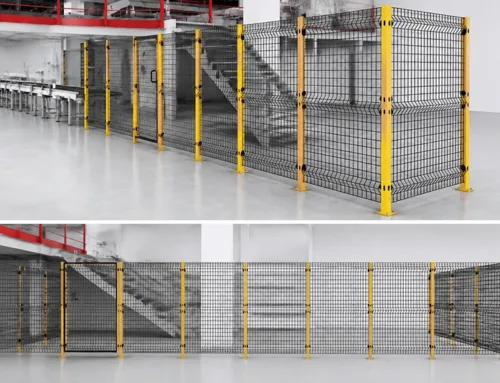
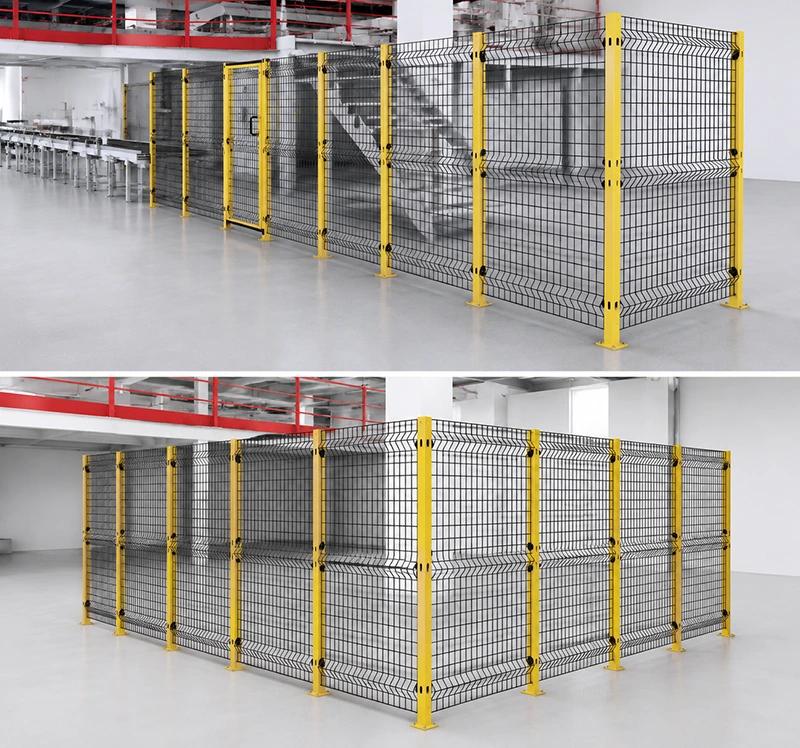
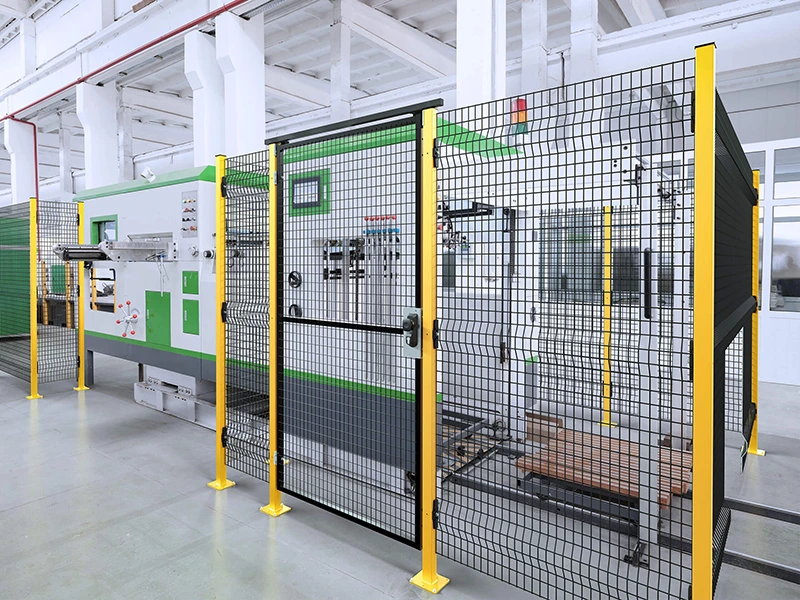
Image evidence matters here: the modular industrial safety fencing layout shows yellow steel posts, welded wire mesh panels, and base feet built as a repeatable system. That is exactly what a procurement team needs when the instruction is “copy the same spec everywhere.” The fence can define warehouse zoning, a robot safety fence line, or a workshop isolation perimeter without changing the core build.
2. No welding on site
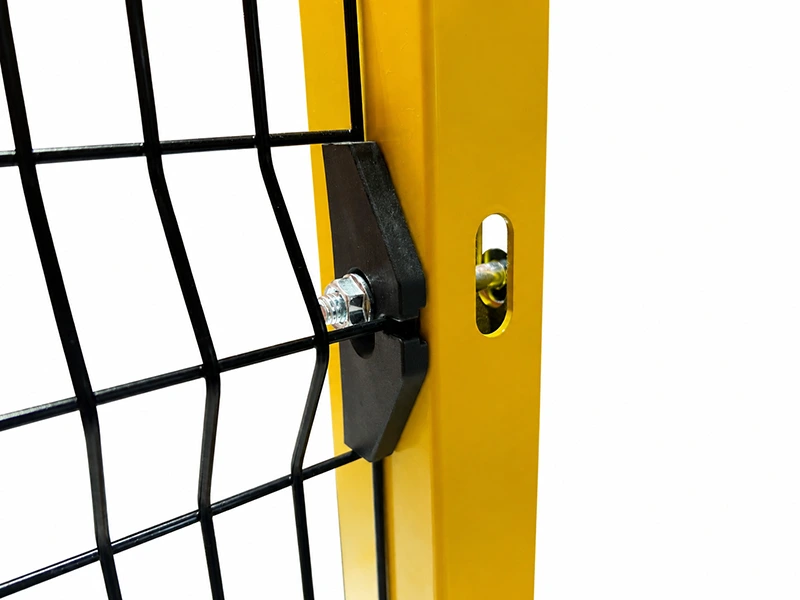
The close-up connection photo shows the real advantage: clamped welded mesh panel, bolt-mounted yellow steel post, slotted mounting holes, and a bolt-down base plate. That means the installation logic is mechanical, not artisanal. Ordinary maintenance staff can follow a three-step install method and achieve the same quality in every plant, with no dependence on welders or local fabrication habits.
3. Move it when the site changes
The access-gate image is important because integration programs do not end neatly. Some sites are resized, some lines are shut down, and some buildings are kept while others are sold. With Industrial Safety Fencing, the panels can be removed, transported, and reused at the next site. That is a savings line welded square tube fence cannot deliver. The same modular asset keeps working after the merger dust settles.
Where the standard is useful
- Warehouse zoning for merged distribution or production sites
- Pedestrian vehicle separation around shared internal logistics routes
- Robotic workstation enclosure and automated equipment guarding
- Machine guarding around conveyors, palletizing cells, and line ends
- Workshop isolation during phased renovation or line changeovers
- Temporary construction fence use during plant retrofit windows
For a packaging group under synergy pressure, the winning spec is not the heaviest frame. It is the Industrial Safety Fencing system that can be copied, installed quickly, and moved again without losing consistency.
What to lock before you issue the RFQ
Keep the spec simple enough to copy globally: choose the mesh size, wire diameter, panel width, panel height, post section, finish, base plate or floor fixing method, and OEM supply requirement. If the roll-out covers Europe, Asia, or North America, the point is to keep the drawing fixed and let only the site layout change.
Need one fence standard for every plant?
Send the site count, the target safety zones, and the shutdown window. Mefence can quote a factory-direct, OEM-ready Industrial Safety Fencing package that supports global replication, lower install cost, and reuse after site consolidation.