IT
IT  EN
EN  DE
DE  RU
RU  PT
PT  JA
JA  ES
ES Robot Welding Cell Retrofit | Industrial Safety Fence
Why a Welding Cell Needs Solid Arc Screens, Not Thin Mesh Alone
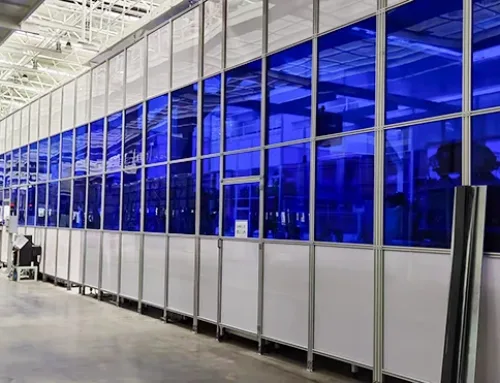
In a robot welding cell, hot spatter can melt through a thin wire panel or leave it sagging like a hammock, while an open mesh boundary does little to control arc light reaching nearby personnel. Alfence modular safety fence lets the welding unit use solid PC/polycarbonate or acrylic panels—available in tinted or red arc-screen versions—while reinforced welded mesh protects adjacent areas. The result is a reconfigurable aluminum profile guarding layout that separates the hazard without turning every future line change into a cutting and rewelding job.
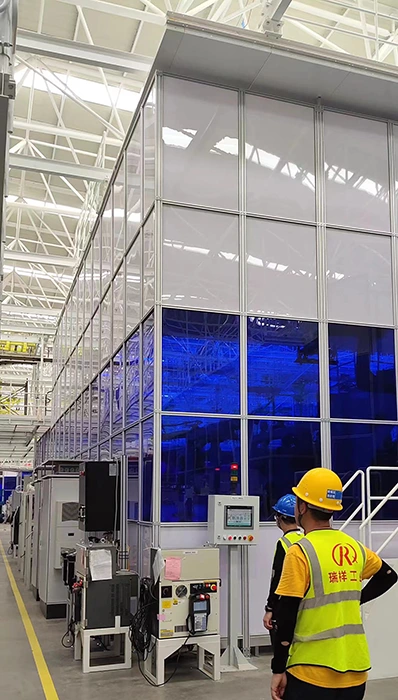
Specify the Boundary by Heat, Impact, and Visibility
A welded steel fence or ordinary thin mesh may define a perimeter, but it does not automatically solve welding spatter or arc-flash exposure. Alfence uses a post-and-panel system: place a solid panel in the welding unit where visual screening and spatter separation are required, then use the appropriate mesh construction in the surrounding robot cell and service zones. The panel heat-resistance limit is stated as ≤60 °C, so the final drawing must confirm the panel offset, shielding, process heat and any direct-spatter exposure before release.
| Voce di design | Alfence reference for the welding cell |
|---|---|
| Solid welding-zone screen | PC/polycarbonate board, durable polycarbonate or acrylic solid panel; tinted or red options can be specified to screen welding arc light. |
| Panel thermal boundary | Plastic panel heat resistance ≤60 °C; validate distance and shielding against the actual welding process rather than treating the panel as a direct-contact molten-metal shield. |
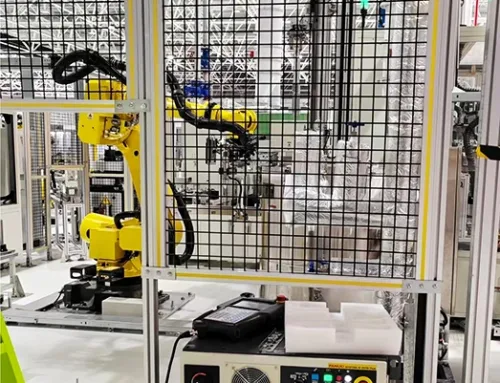
| Standard welded mesh | 20 × 20 mm outer frame with 3 mm wire for suitable surrounding guarding zones. |
| Reinforced welded mesh | 20 × 30 mm outer frame with 3.5 mm wire; use around welding cells where higher impact exposure is expected. |
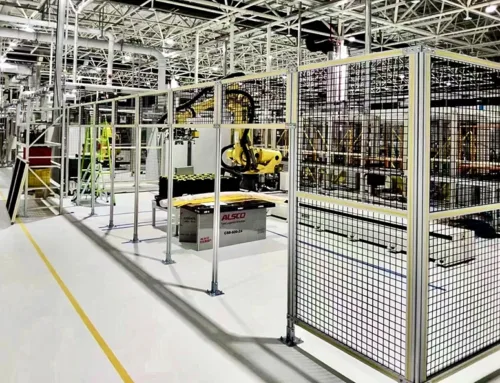
| Modular frame | 40 × 40 mm or 45 × 45 mm aluminum profile posts with T-slots and bolt-free panel assembly through profile connectors. |
| Floor installation | Foot connectors and expansion-bolt floor anchoring create a defined boundary without on-site welding. |
| Project drawing control | Product references also include a 20 × 100 mm mesh grid; confirm the selected panel version, opening and dimensions on the project drawing. |
How Alfence Matches the Welding Cell Problem
1. Replace the weak point with a solid panel
The failure mode is familiar: thin mesh is left directly beside the weld, hot particles attack the wire, and repeated exposure can produce a melted opening or a deformed, hammock-like panel. Open mesh also leaves a direct optical path for arc light. In the welding unit, Alfence can replace the mesh module with a solid PC/polycarbonate or acrylic panel. Tinted or red panel versions are intended for arc-light screening; the ≤60 °C panel limit and the process-to-panel distance still need to be checked by the project engineer.
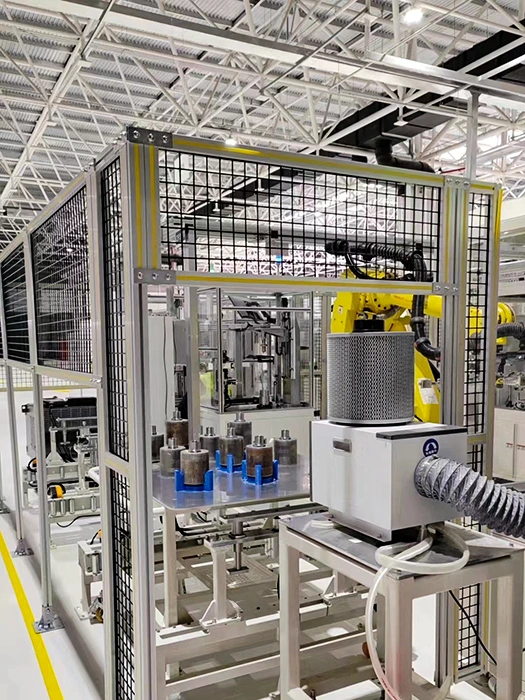
2. Use reinforced mesh where impact remains
A welding cell is not only a light-control problem. Robot motion, fixtures, material handling and maintenance traffic can still load the adjacent guarding. Instead of specifying one thin mesh everywhere, use the reinforced 20 × 30 mm outer frame with 3.5 mm wire in the exposed sections, and reserve the standard 20 × 20 mm frame with 3 mm wire for zones that match its intended duty. This hybrid specification controls cost and keeps the machine guarding fence matched to the actual boundary condition.
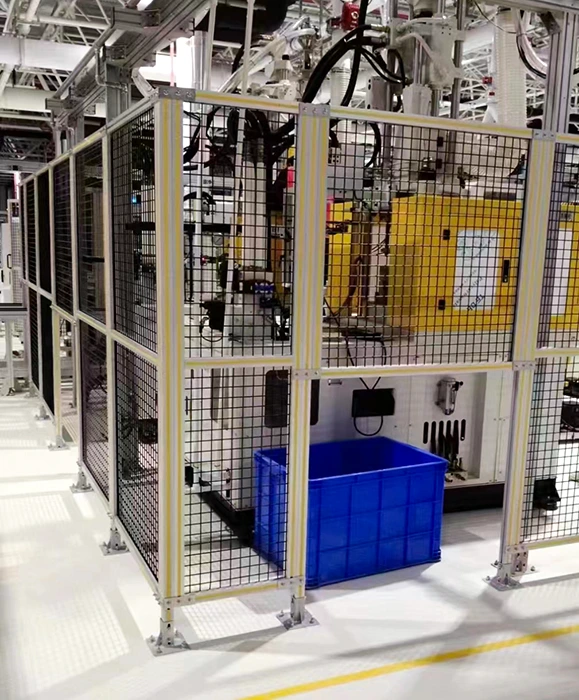
3. Keep access, visibility, and future changes in the same layout
The enclosure still has to support setup and maintenance. Aluminum profile posts, removable panels, hinged or sliding safety doors, a safety interlock switch and a safety light curtain can be coordinated with the robot cell rather than added afterward. The modular connection method avoids on-site welding, while floor anchors define the perimeter. When the production line moves, the panel-and-post system can be dismantled and reconfigured instead of cutting a welded steel fence into scrap.

Where This Hybrid Guarding Layout Fits
- Robot welding cells and automotive welding or assembly lines where arc light must be screened from nearby work areas.
- Welding-cell retrofit guarding where the existing wire fence is damaged by hot spatter or blocks a required maintenance opening.
- Adjacent robot, conveyor, CNC machine guarding and material-handling zones that need reinforced mesh without converting the entire perimeter to solid panels.
- Indoor plant installations, reconfigurable guarding projects and production lines that require a lighter, corrosion-resistant aluminum profile system.
For an EN ISO 14120 and EN ISO 13857 review, the panel type, safety distance, door access, interlock logic and light-curtain position must be evaluated against the complete machine risk assessment. Alfence supplies the modular boundary components; the final safeguarding design remains project-specific.
What to Put on the RFQ Drawing
Mark the weld source, expected spatter direction, nearest personnel route, panel-to-source distance, required arc-screen color, access-door position and the zones exposed to handling impact. Then identify solid-panel modules for the welding unit, reinforced mesh modules for impact-prone adjacent areas, and standard mesh only where its 20 × 20 mm frame and 3 mm wire meet the duty. Confirm the ≤60 °C panel limit, selected 40 × 40 or 45 × 45 mm aluminum posts, floor anchors and any safety interlock or light curtain before fabrication.
Build the Welding Cell Around the Actual Hazard
Send the cell layout and welding-zone conditions to SGF. We can help separate the solid arc-screen modules, reinforced mesh sections, doors and anchored aluminum profile frame into a guarding specification that is easier to install, inspect and reconfigure.