JA
JA  EN
EN  DE
DE  RU
RU  PT
PT  ES
ES  IT
IT 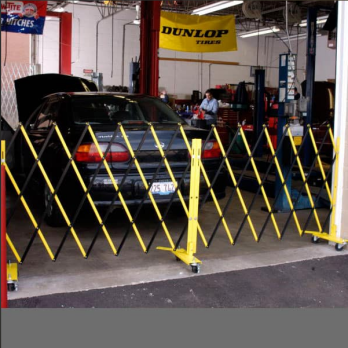
Step into a state-of-the-art distribution center today, and you are stepping into the future. Autonomous Guided Vehicles (AGVs) glide silently down aisles, their paths optimized in real-time by powerful logistics software. Collaborative robots, or “cobots,” work alongside human associates, augmenting their ability to pick and pack orders with incredible speed. Every pallet is tracked, every inventory movement is logged, and every process is data-driven.
We have built marvels of operational agility. Our facilities are flexible, intelligent, and designed for unprecedented speed.
Now, walk over to a temporarily blocked-off work area. What do you see? All too often, you’ll find the same tools we’ve used for the last fifty years: a handful of orange cones or a sagging piece of plastic tape tied between two posts.
There is a dangerous and growing disconnect between the dynamic, intelligent nature of our modern operations and the static, primitive nature of our safety equipment. As we build the “smart” facilities of tomorrow, we must ask a critical question: is our approach to safety still stuck in the past?
静的な時代の終わり
For decades, the warehouse was a relatively static environment. Aisles were fixed. Workflows were predictable. The primary hazards were known and located in specific, unchanging areas. In this static era, permanent, fixed-in-place steel guardrails and designated “danger zones” were a logical solution. The environment didn’t change, so the safety infrastructure didn’t need to.
That era is over.
The modern “agile” facility is defined by its ability to change. Work cells are temporary, layouts are modular, and traffic patterns for both humans and machines can change by the hour based on order flow. In this new paradigm, a hazard is no longer a fixed location on a map. A hazard is a temporary, moving “bubble” that surrounds a task—a maintenance technician’s diagnostic area, a cobot’s picking station, a trainee’s practice zone.
The safety tools of the static era are fundamentally incompatible with the needs of the agile era. A fixed guardrail cannot protect a moving hazard.
The Core Principle of Agile Safety: Protection Must Be as Mobile as the Hazard
To secure a dynamic environment, our safety philosophy must evolve. The new core principle is simple but profound: physical protection must be as mobile, flexible, and rapidly deployable as the hazards it is meant to contain.
We need to stop thinking of safety infrastructure as a permanent architectural feature. We must start thinking of it as a dynamic, on-demand resource. We need the ability to “write” and “erase” a safe zone in physical space with the same speed that our software reroutes a fleet of AGVs.
This requires a new class of tools. Tools that are not anchored to the floor. Tools that are not a collection of disparate, cumbersome pieces. Tools that understand that in a modern facility, the most valuable resource is time.
最新のセーフティ・エコシステムの基礎層
Before we can have IoT-enabled sensors and AI-driven alerts, we must solve the physical challenge first. You cannot build a smart safety system on a foundation of flimsy tape or easily-ignored cones. You need a reliable, adaptable, and physically robust platform.
This is where the modern barricade gate serves as the essential foundational layer for an agile safety strategy. It is the first, crucial step away from outdated, static thinking. Its core design principles are perfectly aligned with the needs of a dynamic environment:
- 機能としてのモビリティ: With integrated swivel casters, the barrier is not tied to a single location. It is a mobile asset that can be brought directly to the point of need, wherever that may be.
- オンデマンド・デプロイメント: The accordion-style expansion allows a single person to create a full-width, 141-inch barrier in seconds. This allows your team to create safety zones “just-in-time,” matching the pace of your operations.
- モジュール性と柔軟性: The ability to interlock multiple units means you are not limited to a single straight line. You can create L-shaped work cells, three-sided perimeters, or any configuration the specific task demands.
This tool is, in essence, an “API for physical space.” It allows your team to quickly execute the command to create a safe zone, with predictable and reliable results every time.
A Glimpse into the Future: The “Smart” Barrier
Once this flexible physical platform is in place, it becomes the foundation upon which future “smart” safety features can be built. Imagine a smart barricade gate integrated with simple sensors. When deployed, it could automatically update your facility’s digital twin, rerouting AGV traffic around the new temporary obstacle. Imagine it sending a notification to a supervisor’s tablet when a zone is secured or cleared. Imagine integrated LED strips that begin to pulse when motion is detected nearby.
These innovations are not far off. But they all depend on having a robust, mobile, and physically present platform to build upon first.
あなたの安全戦略は明日に備えていますか?
The transition to smarter, more agile operations is not a future trend; it is happening now. The technology that powers our logistics is evolving at a breakneck pace. We must ensure our safety philosophy evolves with it.
The first, most critical step is to critically evaluate the tools you provide your team. Are they relics of a static past, or are they designed for the dynamic reality of today and tomorrow? Your logistics are agile, your inventory is smart, and your workforce is dynamic. Isn’t it time your safety equipment was too?