JA
JA  EN
EN  DE
DE  RU
RU  PT
PT  ES
ES  IT
IT WAREHOUSE SAFETY / FORKLIFT IMPACT PROTECTION
フォークリフトエリアにおける倉庫歩行者分離用産業用ガードレール
When people and forklifts share aisles, an industrial guard rail creates a visible physical boundary that does not depend on memory, attention, or perfect training. Hsafety warehouse guard rails provide a passive safety layer around rack ends, equipment, walls, and loading areas—working alongside IoT alerts to reduce collision exposure and protect people and assets.
Why Mixed-Traffic Warehouses Need More Than Alerts
In a distribution center or production warehouse, a pedestrian may enter an aisle while a forklift is turning, reversing, or carrying a blocked load. Training, floor markings, signs, and radio instructions remain useful, but each depends on a person noticing the risk and acting in time. A steel pipe railing made on site can be difficult to modify; rope or strap barriers provide little impact resistance; concrete bollards can protect a point without creating a continuous pedestrian-vehicle separation line. An IoT monitoring system can detect movement and issue an alert, but it does not physically stop a vehicle from reaching a rack, wall, conveyor, or worker. The practical control is an active-plus-passive protection stack: monitoring for awareness, and a floor-mounted industrial guard rail as the last physical boundary.
| プロジェクト要件 | Hsafety design response |
|---|---|
| Separate people and vehicles | Double-rail steel guard rail establishes a continuous, highly visible boundary beside aisles, equipment, and loading dock protection zones. |
| Resist routine forklift contact | Q235 carbon steel corrugated beams, square posts, and bolted floor anchoring create a fixed external protection structure. Final impact selection requires engineering review. |
| Fit multiple warehouse zones | Modular 1,500 mm rail sections can be combined with custom-length sections for straight runs, corners, rack-end protection, and equipment isolation. |
| Keep installation serviceable | Bolted rail-to-post connections and anchor base plates support segmented installation, inspection, replacement, and future layout changes. |
Physical Design Details That Close the Safety Gap
1. A continuous barrier at the rack edge
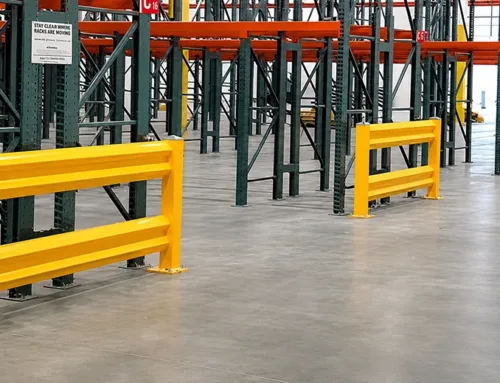
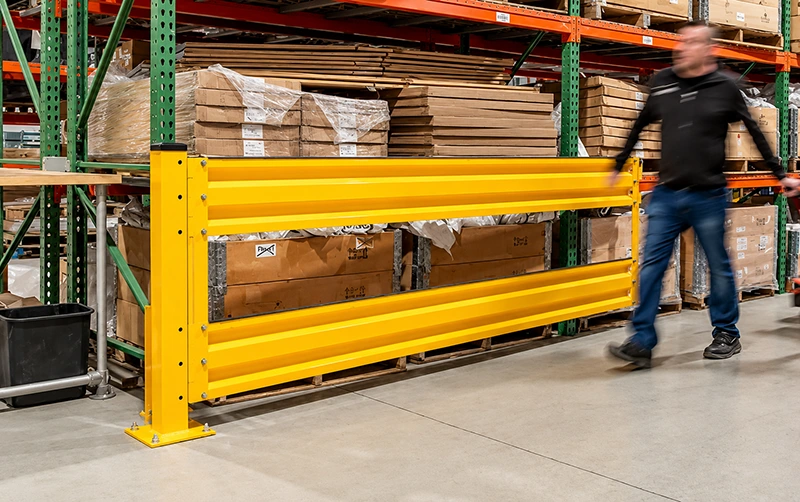
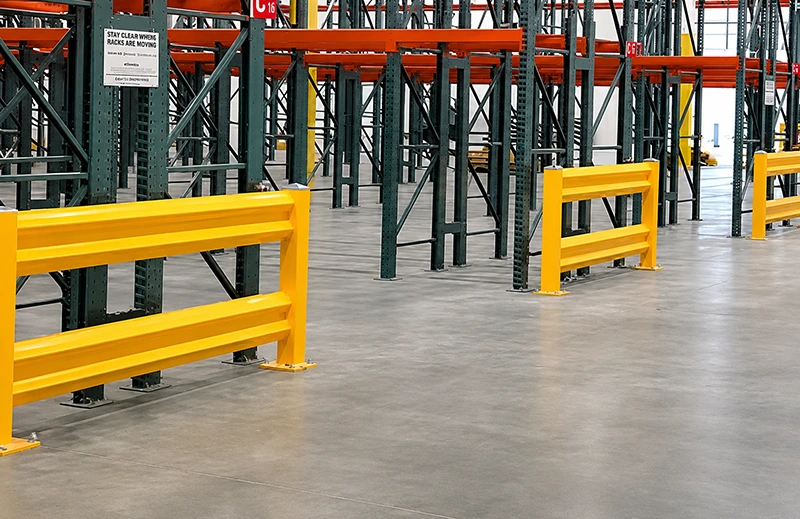
The warehouse photograph shows the industrial guard rail positioned in front of pallet-rack uprights, exactly where a turning forklift can cause concentrated damage. The double corrugated rail arrangement gives the barrier two horizontal impact members, while the yellow safety coating improves visual recognition in a busy aisle. In a typical Hsafety configuration, the system is approximately 1,000 mm high, with the posts anchored to the concrete floor. This is an asset protection guardrail, not a substitute for traffic planning or a collision certification claim.
2. Bolted components that can match the layout
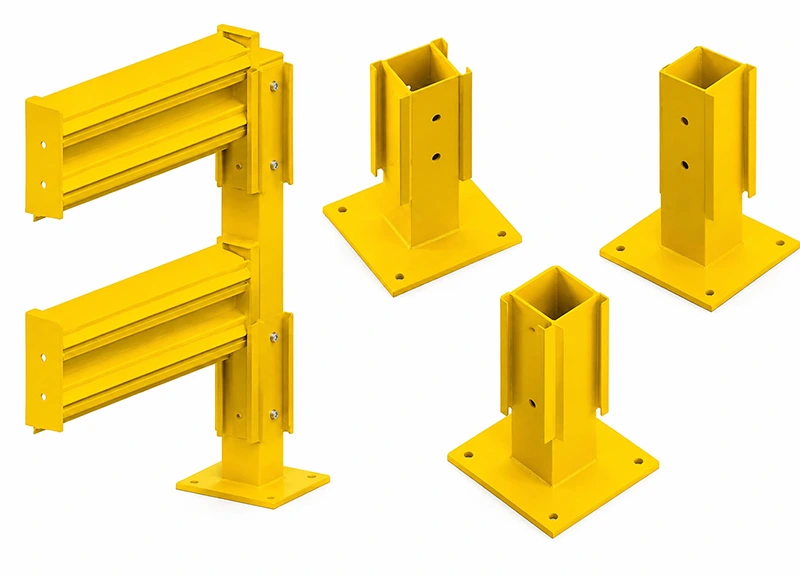
For procurement and installation teams, the component view makes the system logic clear: corrugated guardrail beams connect to square steel posts through brackets and exposed fasteners, and each post transfers the barrier to a bolted base plate. Available discussions can include 2-rib or 3-rib guardrail, single-rail or double-rail arrangements, 3 mm or 4 mm beam thickness, and Q235 steel guardrail construction. A project layout should confirm the selected configuration, anchor type, concrete condition, and required impact calculation before release.
3. Protection that follows walls and vehicle routes
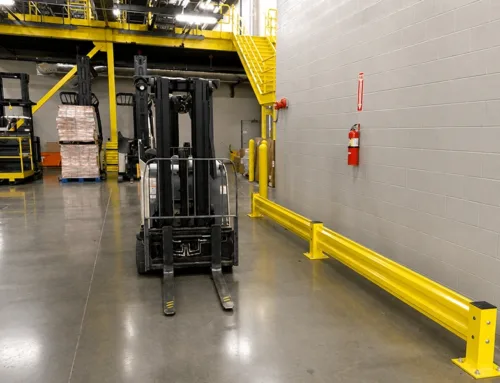
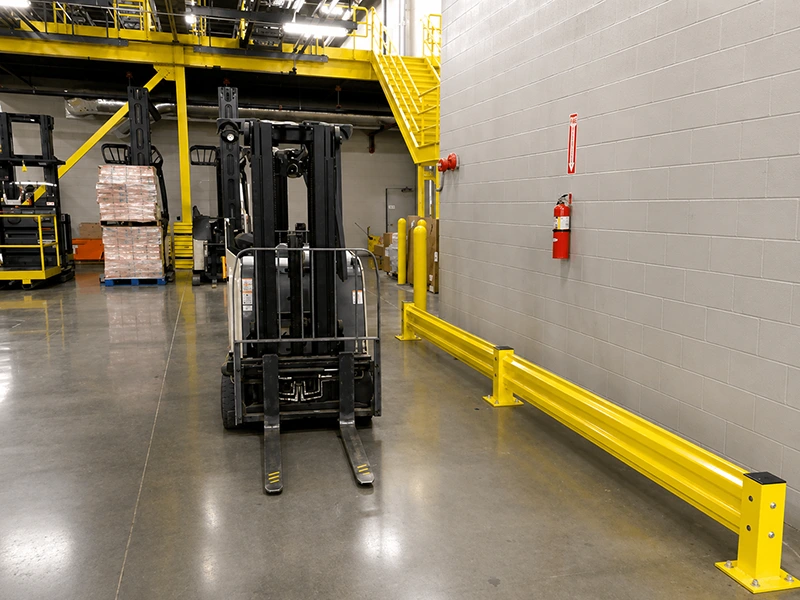
At a warehouse wall, electrical room, pipe route, or loading area, the risk is not limited to one rack upright. A floor-mounted guard rail can run alongside the wall and define a clear vehicle boundary, protecting fixed infrastructure while supporting pedestrian safety separation. Hsafety can be specified with powder coated guardrail finishes, hot-dip galvanized steel, custom colors, or reflective tape where the environment and visibility requirement call for them. These are selectable options, not automatic inclusions.
Where This Industrial Guard Rail Fits
- Warehouse and distribution center aisles: protect rack ends and maintain pedestrian-vehicle separation at turning points.
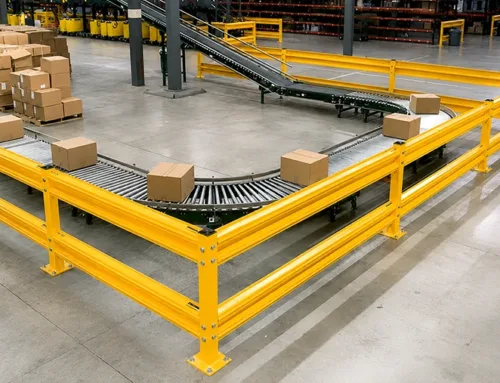
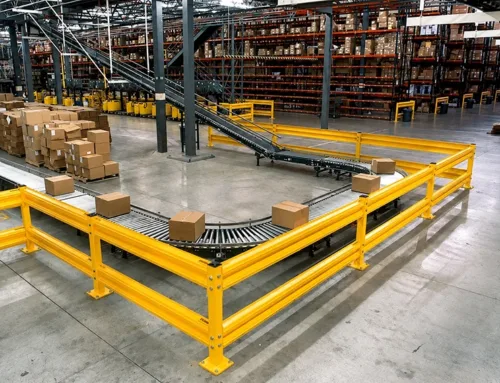
- Conveyors and sorting areas: create machine guarding around moving equipment while keeping access routes visible.
- Loading dock and staging zones: define the edge between vehicle movements, stored pallets, and people.
- Factories and automated lines: isolate robots, electrical cabinets, walls, and production-line equipment from forklift impact.
- Cold storage and high-visibility routes: use yellow safety coating or specified reflective options where lighting and traffic conditions require them.
For longer or irregular runs, the same modular principle avoids forcing a standard section into the wrong position. One recorded multi-zone design used 1,500 mm standard rails with special sections of 680–1,140 mm to complete four separate runs. The quantities, post spacing, and anchoring must be confirmed from the site drawing rather than assumed from a catalogue image.
Specify the Boundary Before the Vehicle Arrives
Start with the people-and-vehicle map: mark rack ends, wall lines, conveyor corners, loading dock interfaces, emergency access, and required inspection points. Then provide each run length, desired height, rail configuration, concrete condition, finish requirement, and the forklift design condition. In one recorded project, the customer’s target was a 3-ton forklift at 10 km/h with an approximately 16,680 N design load; this was a project design condition, not an independent certification result. SGF can use these inputs to review the industrial guard rail arrangement, custom lengths, posts, base plates, and accessories.
Build the Active-plus-Passive Protection Stack
IoT monitoring can warn a warehouse team that a vehicle or person is entering a conflict zone. Hsafety warehouse guard rails add the physical line that remains in place when an alert is missed, a response is delayed, or training is not remembered. That combination supports collision protection, injury prevention, and fewer avoidable equipment-repair stoppages without pretending that a barrier alone replaces site risk assessment.