EN
EN  DE
DE  RU
RU  PT
PT  JA
JA  ES
ES  IT
IT Machine Fence
Machine Fence for WES-Connected Warehouse Safety Interlocks
When an automated warehouse safety gate must connect to WES software, the project usually slows down at the field integration stage. Engineers still have to fit interlocks, cable paths, and mounting points on site, and the old way often means drilling, cutting, and welding around a non-standard fence. Machine Fence solves that by turning the guard into an active safety integration system with reserved hardware positions and a standard lock carrier module.
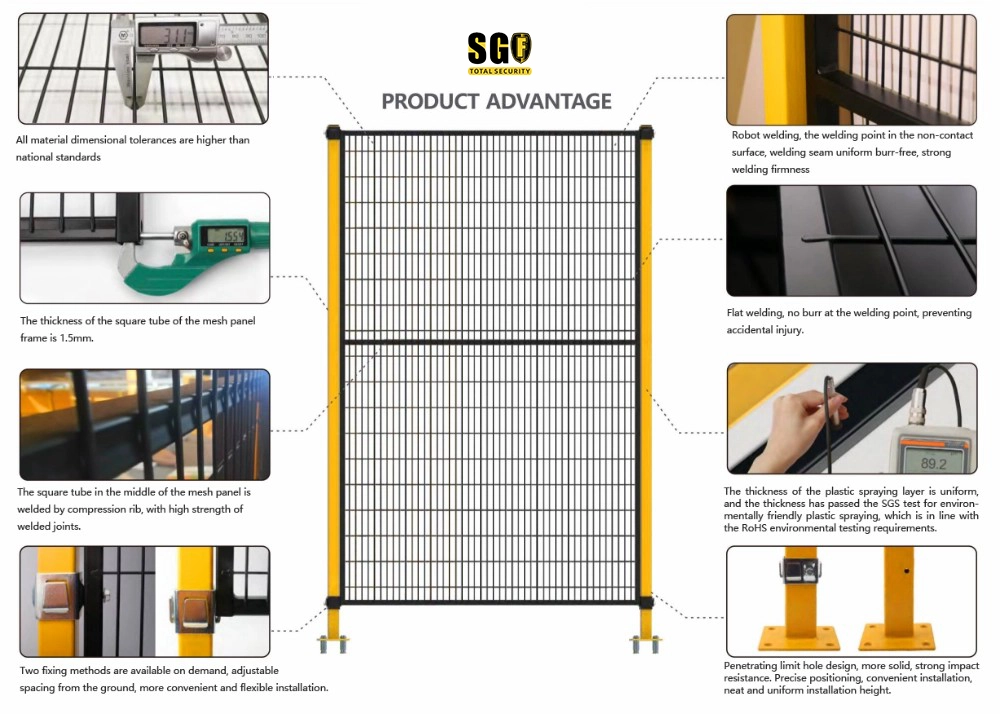
Why Machine Fence fits interlocked warehouse gates
Traditional guarding panels are built to close a boundary, but they do not give the integrator a clean interface for electronic safety hardware. Machine Fence is pre-engineered for that job. The KKCK-LCK style lock carrier module creates a standard mounting zone for electronic interlocks, so Omron, Pizzato, and similar switches can be fitted without improvising brackets on the floor. That means less现场 fabrication, less vibration-related misalignment, and a faster handoff to controls commissioning.
| Field issue | Machine Fence answer |
|---|---|
| Manual drilling, cutting, and welding on site | Pre-reserved hardware interface and bolt-on lock carrier reduce hot work |
| Interlock switch moves after vibration | Standardized carrier and repeatable fixing points help keep alignment stable |
| WES-connected gate needs clean safety logic | Dedicated mounting area supports a neat electrical handoff to the control system |
| Mixed switch brands across projects | Compatible with major electronic interlock families, including Omron and Pizzato |
Built for the real integration work
1. A lock carrier that gives the switch a proper home
Machine Fence is not asking the field team to invent a mounting point. The carrier module creates a fixed, standardized position for the electronic interlock, which is exactly what a warehouse gate needs when the safety circuit must be repeatable from one line to the next. Instead of making the switch fit the fence, the fence is already prepared to accept the switch.

2. Installation moves from fabrication to fastening
The installation guide image shows the point clearly: base plate positioning, drilling, expansion bolts, and retaining rings. That sequence is straightforward for an electrical integrator or site engineer, and it avoids the slow and risky pattern of cutting and welding around the final interlock location. For commissioning teams, that means the gate can be installed as a controlled assembly step, not a workshop repair job on the warehouse floor.

3. The post and clamp geometry keeps the system repeatable
The technical front view shows the post, mesh panel, and fixing clamp relationship. That matters because an interlocked safety gate only works when the geometry stays consistent. A clean clamp layout helps the door and switch line up correctly, and the structure is easier to maintain after vibration, cleaning, or repeated access cycles. The result is a guarding system that behaves like a standard module instead of a one-off site modification.

Where Machine Fence makes the biggest difference
- Automated warehouse safety gates that must connect to WES software and stop access at the right point.
- Robot cells and machine perimeters that need a reliable electronic interlock without custom welding.
- Conveyor and transfer zones where the guard must be installed fast and stay aligned under vibration.
- Projects using Omron, Pizzato, or similar interlock hardware that need a standard mounting pattern.
In every one of these cases, the value is the same: the site team spends less time fabricating brackets and more time completing the safety logic. Machine Fence gives the integrator a defined interface, so the physical gate and the control system are easier to finish together.
What to specify before you place the order
For a WES-connected warehouse gate, specify the door width, opening direction, switch brand, cable entry side, reset behavior, and whether the interlock must be fitted to a single access door or a multi-panel enclosure. The point of Machine Fence is that these items map to a pre-built structure, not to a site-built workaround. If the project requires an active safety integration path, the KKCK-LCK style carrier and compatible electronic interlock interface are the right starting point.
Stop treating the safety gate like a fabrication problem
When the gate has to talk to software, the hardware should already be ready for the switch. Machine Fence removes the hot-work step, reduces misalignment risk, and shortens the path from installation to commissioning.