EN
EN  DE
DE  RU
RU  PT
PT  JA
JA  ES
ES  IT
IT 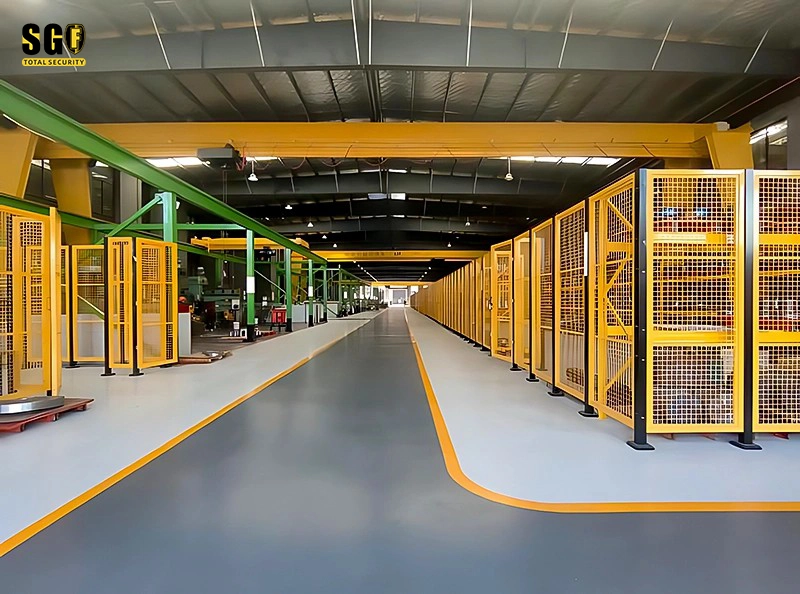
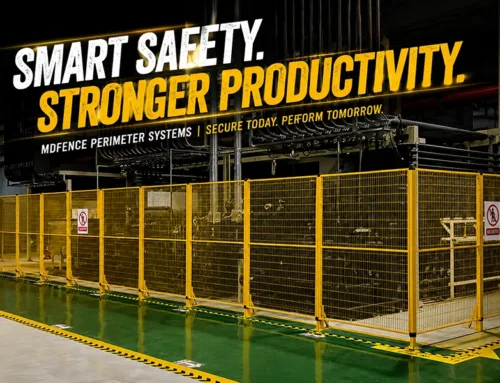
Mdfence machine guard fencing helps automation builders reduce the hidden cost of oversized safety offsets in crowded plants. By using a 20×100 mm finger-safe mesh concept instead of ordinary 50×50 mm large-mesh fencing, integrators can position the perimeter far closer to the hazard zone within the applicable machine-guarding framework, preserve forklift lanes, recover productive floor area, and deliver compact robot cells that are easier for end users to install inside existing buildings.
Why floor area becomes a safety cost problem in automated plants
Many robot cells are engineered around process capacity first and guarding second. That usually works on paper until the layout reaches a real factory with fixed columns, narrow logistics aisles, existing conveyors, and expensive square meters already allocated to production. At that point, the fence is no longer a minor accessory. It becomes a direct driver of total footprint, service access, and internal traffic flow.
When a standard large-mesh fence forces the guarding line to stand far away from the hazard, the result is predictable: more dead space around the machine, longer conveyor transitions, tighter forklift turning envelopes, and fewer options for maintenance doors or pallet exits. The end user does not just buy a fence. They pay for every additional square meter that the fence consumes over the life of the equipment.
Typical pain point
Generic 50×50 mm mesh often pushes the perimeter out to a large setback, which can consume valuable aisle width and reduce the number of workable layout options in a retrofit project.
Mdfence response
Mdfence applies a compact machine-guarding approach based on framed steel panels and a fine 20×100 mm mesh logic that supports much tighter placement around the protected zone.
How Mdfence creates a compact automation footprint
The commercial advantage of Mdfence is not only that it creates a physical barrier. It allows the barrier to be placed much closer to the machine envelope than ordinary large-mesh fencing in the same class of automation projects. In the user-provided scenario, a conventional 50×50 mm mesh solution can force the fence line to stay about 850 mm away from the hazard source, while the Mdfence 20×100 mm anti-reach mesh concept allows a legal close-in position at about 120 mm under the applicable guarding-distance framework.
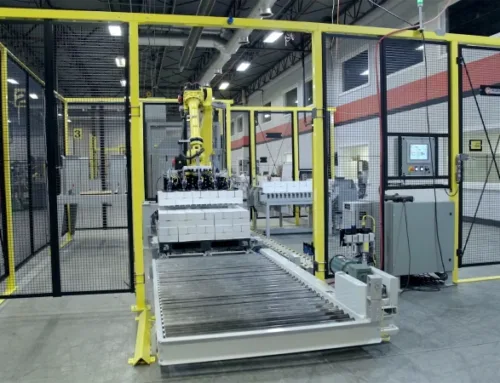
That difference changes the economics of an automation cell. On a palletizer, conveyor transfer station, or robot assembly island, hundreds of millimeters saved around each side quickly turn into meaningful floor-area recovery. Integrators gain more freedom to keep forklift lanes usable, maintain operator walk paths, and fit turnkey equipment into plants that otherwise would have required civil changes or a less efficient production arrangement.
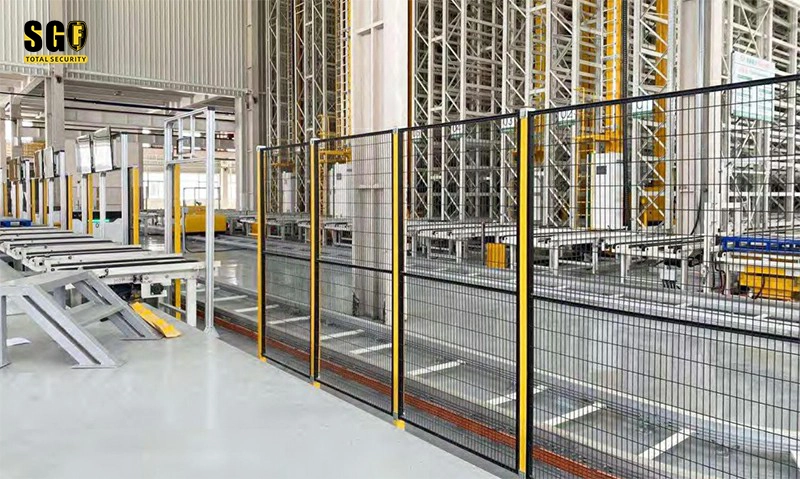
Why framed mesh matters when you move the fence closer
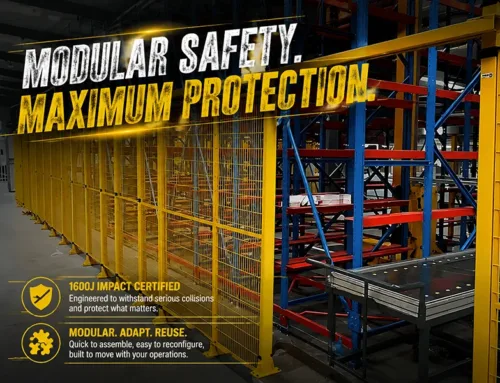
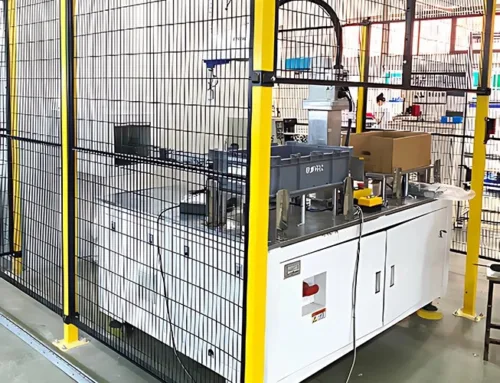
A compact layout only works if the guarding system remains structurally credible after installation. Mdfence is positioned as framed machine guarding built from Q235 carbon steel, with modular clamp-based assembly and a mesh specification centered on 20×100 mm openings for machine-risk applications. This framed construction matters because a tighter layout usually means the fence becomes part of the daily operating envelope, not a remote background barrier.
| Design element | Why it matters in space-constrained plants |
|---|---|
| Framed mesh panel | Improves stiffness and dimensional stability compared with flimsy open-wire partitions that can sag or distort near active equipment. |
| Q235 steel structure | Supports an industrial-duty guarding position suitable for robot cells, conveyors, palletizers, and automated handling zones. |
| 20×100 mm mesh focus | Supports close-in guarding logic for compact layouts while preserving visibility into the protected area. |
| Clamp-based modular assembly | Reduces on-site welding, shortens installation disruption, and makes later reconfiguration practical. |
| Interlock-ready gate options | Allows access control without forcing oversized access corridors just to accommodate poor door planning. |
Better access planning without giving back the saved space
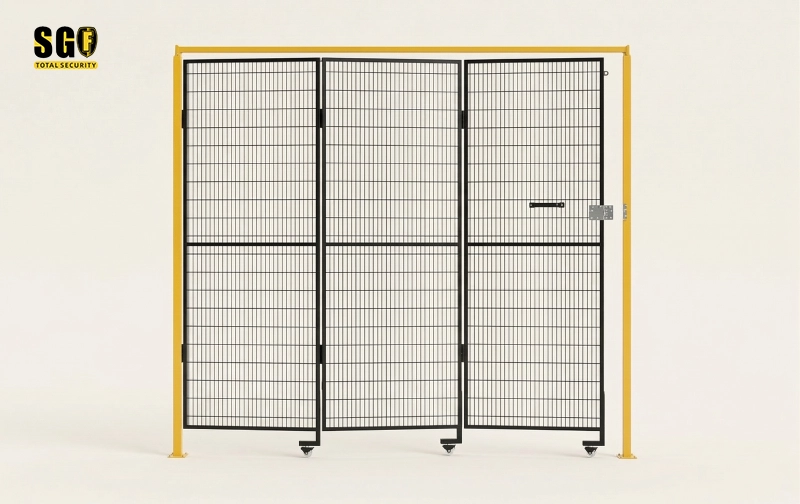
One common failure in tight layouts is that the project saves space on the panel line, then wastes it again on awkward door swings or maintenance clearances. Mdfence addresses that issue with multiple gate families, including hinged, sliding, folding, double-opening, and telescopic concepts. This matters because compact guarding is not just about the panel distance to the hazard. It is also about how a technician, pallet jack, or replacement component enters the cell.
For wide service openings, designers can choose gate formats that preserve throughput while keeping the perimeter disciplined. For maintenance points, interlock-ready door structures and support-wheel logic help the access point remain usable over time instead of becoming the first component to misalign.
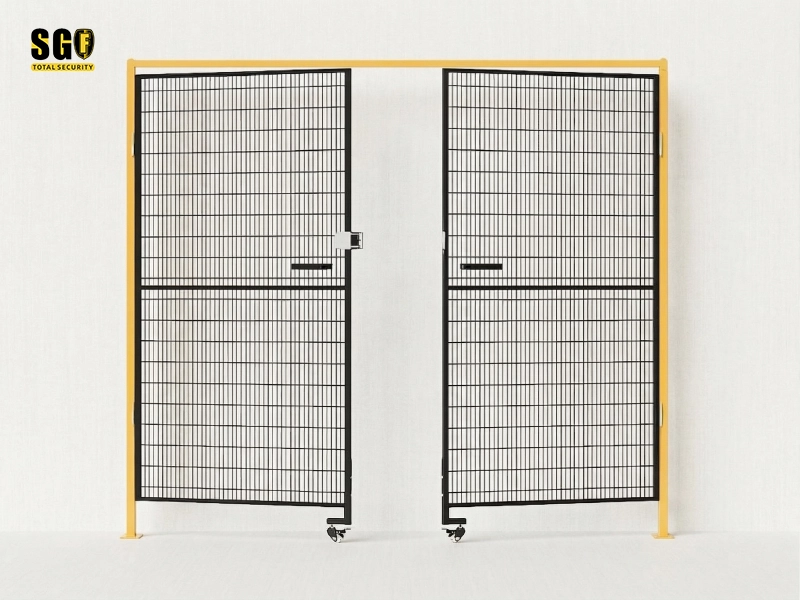
Where the space savings become commercially valuable
Compact machine guard fencing becomes a real sales advantage when the automation supplier must fit high-output equipment into an existing building footprint. That is especially relevant in the following cases:
- Robot palletizing cells located beside active forklift lanes
- Conveyor automation inside distribution centers where every aisle meter affects throughput
- Retrofit machine guarding in brownfield factories with fixed columns and limited clearance
- ASRS interfaces where racks, transfer points, and personnel routes already compress the layout
- OEM export lines where the end user wants maximum capacity inside a pre-approved floor plan
In these situations, the hidden value is not only compliance support. It is the ability to deliver a more compact automation package than competitors using ordinary large-mesh fence systems. That can reduce building modifications, simplify acceptance, and improve the end customer’s return on installed floor area.
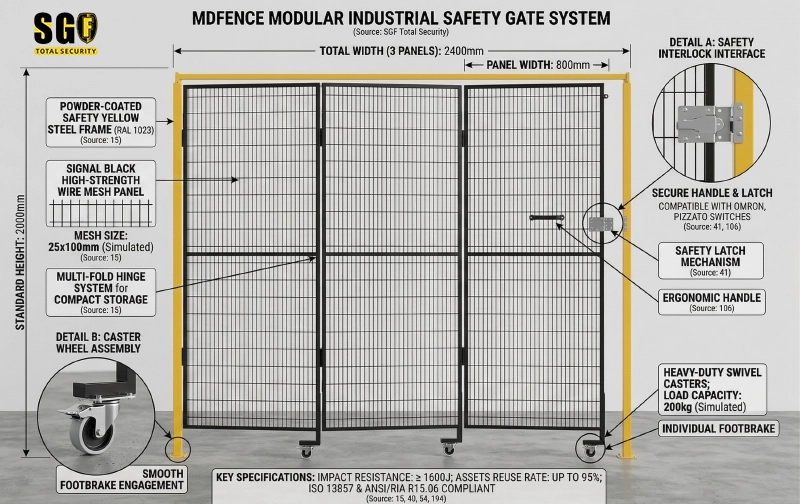
What buyers should verify before choosing a compact guarding system
Not every fine-mesh fence delivers the same project outcome. Buyers evaluating a compact layout should check more than opening size alone. They should verify the framed construction, support for interlock devices, gate type suitability, anchoring method, and whether the supplier understands machine-guarding applications rather than general warehouse partitioning.
Mdfence is best evaluated as an industrial safety fencing system for robot cells, conveyors, palletizers, and controlled service access. That positioning is important because the project target is not simply to separate space. It is to protect people while recovering usable factory area that would otherwise be lost to conservative fence setbacks and poorly planned access points.
Need a compact guarding layout for a robot or conveyor project?
If your team is trying to protect a machine without sacrificing aisle width, service access, or billable production area, Mdfence can be configured as a modular machine guard fencing solution for compact automation footprints, interlock-ready access, and future line changes.