PT
PT  EN
EN  DE
DE  RU
RU  JA
JA  ES
ES  IT
IT 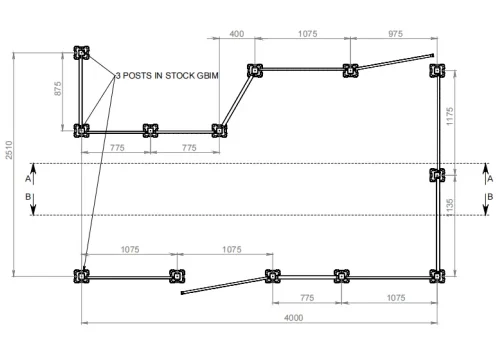

|
Your PLC logic is flawless, and the KUKA robots are calibrated. But if the physical perimeter guarding fails the final risk assessment (ISO 12100), that automated line isn’t moving an inch. We bridge the gap between mechanical barriers and your safety control circuits, ensuring your integration project passes inspection on day one. |
The “Last Mile” Problem in Automotive Automation Integration
For system integrators and automotive plant safety managers, the Cerca de Segurança para Robôs is often the last component installed, yet it holds the power to derail the entire commissioning schedule. A fence is no longer just a steel barrier; it is a critical node in the safety functional chain. If the interlock doesn’t align, or the impact resistance doesn’t meet the calculated risk level for a high-speed robotic arm, you face costly retrofit delays.
This checklist is designed to help you verify that your perimeter guarding meets the rigorous demands of modern automated cells, moving beyond simple segregation to fully integrated machine safety.
1. Verify Structural Impact Resistance (ISO 14120)
In an automotive welding station or a heavy part handling cell, the risk isn’t just an operator walking in; it’s a part being ejected or a robotic arm over-traveling. Standard warehouse mesh cannot withstand the kinetic energy of a rogue manipulator or a 50lb workpiece.
The Check: Ensure your guarding system utilizes high-tensile materials capable of absorbing significant energy without catastrophic failure.
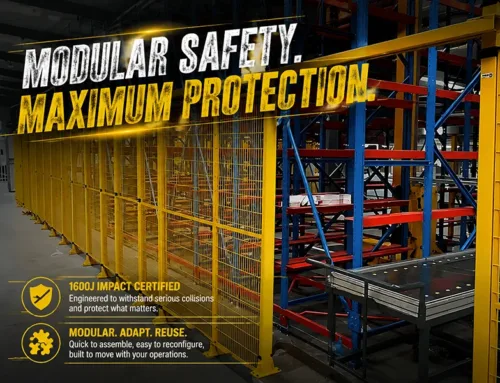
Our Solution: We utilize Aço carbono Q235 for all posts and frames. Our system is TUV certified for high impact resistance. The framed panel design, featuring 20x30mm steel tubing fully welded to the mesh, provides the rigidity required to contain hazards within the cell, satisfying the retention requirements of ISO 14120.

The framed panel construction ensures rigidity and impact absorption, critical for robot cell containment.
2. Seamless Safety Interlock Integration
The biggest friction point during installation is often the mating of the physical door with the electronic safety switch (e.g., Omron D4NL, Pizzato, or Keyence). Field-modifying steel posts to fit these switches creates metal shavings in clean zones and often results in misalignment that triggers nuisance tripping later.
The Check: Does the fence system provide native mounting solutions for your specific safety interlocks, or will your technicians be drilling and tapping on-site?
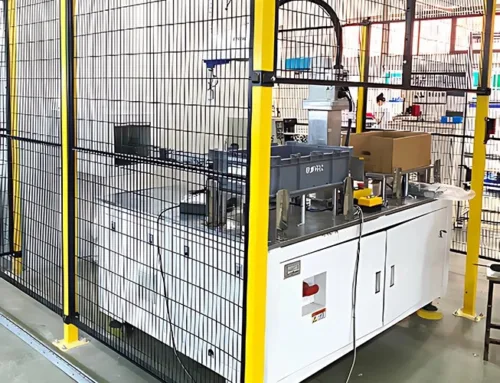
Our Solution: We treat the fence as an Safety Interlock Carrier. We provide pre-engineered mounting kits (like the KKCK-LCK-B-D4NL-SET) that serve as a precise adapter between our door framing and your specified safety switches. This “plug-and-play” mechanical integration ensures the tongue key aligns perfectly every time the door closes, maintaining the integrity of your safety circuit.

Pre-engineered mounting brackets for safety switches eliminate on-site fabrication and ensure reliable circuit integration.
3. Access Control Logic & Space Optimization
In dense automotive assembly lines, floor space is at a premium. A standard swing door might block an AGV path or interfere with an adjacent operator station when opened. Furthermore, large end-of-arm tooling often requires wider openings for maintenance access than a standard door allows.
The Check: Have you selected the correct door configuration (Sliding, Folding, Hinged) based on the operational flow and maintenance access requirements?
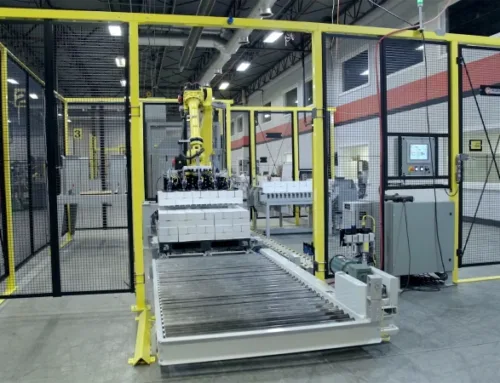
Our Solution: We offer a highly modular door system. For tight aisles, our sliding doors (single or double) glide parallel to the fence line, requiring zero swing clearance. For large maintenance bays where forklifts need to enter to swap dies or motors, we provide wide-span Cercas de segurança para máquinas doors supported by heavy-duty rails and caster wheels to prevent sagging.

Sliding door configurations maximize floor space in tight automation layouts.
4. Layout Precision for “Build to Print” Accuracy
Automated lines rarely follow simple squares. You often deal with 45-degree chamfers to clear building columns, or complex perimeters that snake around conveyors and electrical cabinets. Using a rigid system that requires field cutting destroys the protective powder coating and compromises corrosion resistance.
The Check: Can the fencing system adapt to the specific geometry of your CAD layout without on-site modification?
Our Solution: We analyze your CAD layouts (like the example below from a US integration project) and provide a “kit” of standard and custom-width panels. Our adjustable connection system allows for flexible angle installation, ensuring the physical barrier matches your digital twin simulation within tight tolerances.

We translate complex CAD layouts into precise bills of materials, handling non-90-degree angles and specific cutout requirements.
5. Housekeeping and Cleanability (5S Standards)
In modern automotive plants, 5S standards are strict. Exposed anchor bolts are not just a tripping hazard; they are debris traps that make cleaning difficult. A professional installation must look as clean as the robots it guards.
The Check: Does the system include finishing details that protect the floor anchors and prevent debris accumulation?
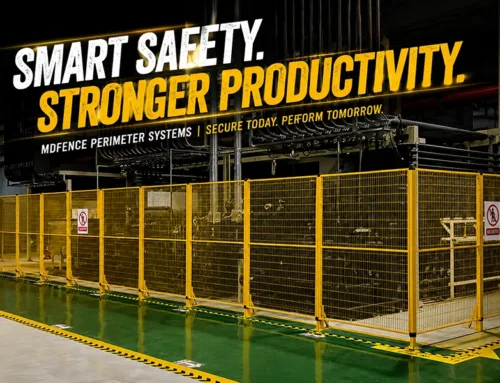
Our Solution: Every post in our system comes with a two-piece plastic base protective cover. This completely shrouds the Expansion Bolt assembly, preventing workers from tripping on exposed studs and allowing for easy sweeping or floor scrubbing around the perimeter.

Base covers ensure compliance with 5S standards and eliminate tripping hazards.
Frequently Asked Questions: Automation & Robotics Safety
Q1: Can Mdfence integrate with Fortress or Euchner trapped key interlock systems?
Yes. While we have standard kits for Omron and Pizzato, our engineering team can design custom mounting plates for Fortress, Euchner, or any specific trapped key system you specify in your controls architecture.
Q2: What is the safety distance calculation for your standard mesh?
Our standard mesh openings (typically 20x100mm) are designed according to ISO 13857 (Safety of machinery – Safety distances). This prevents finger or hand intrusion, allowing you to install the fence closer to the hazard zone compared to larger mesh sizes, saving valuable floor space.
Q3: Do you offer welding screens for robotic weld cells?
Yes. We can replace the standard wire mesh with solid steel sheet or dark polycarbonate panels for specific sections of the cell to block UV radiation and welding flash, protecting passersby without needing separate curtains.
Q4: How do you handle height requirements for tall robot manipulators?
Standard height is 2000mm, but for large 6-axis robots with high reach, we provide systems up to 2440mm (8ft) or higher using custom posts, ensuring the robot cannot reach over the guard during a singularity or fault condition.
Q5: Is the system compatible with AGV/AMR entry/exit points?
Absolutely. We design specific “tunnel” openings or automated sliding gates that can interface with your fleet management system to allow AGVs to enter the cell to drop off pallets while maintaining safety protocols.