PT
PT  EN
EN  DE
DE  RU
RU  JA
JA  ES
ES  IT
IT 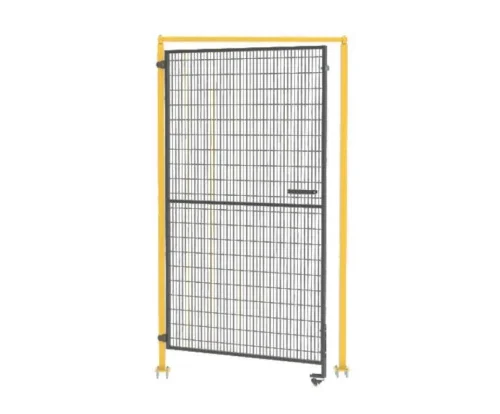

|
Your robot controller just threw another communication fault. Is it the cable shielding, or is your 50-meter safety fence acting as a giant antenna? In high-voltage automotive welding cells and sensitive electronics assembly, a “floating” metal barrier isn’t just a safety violation—it’s a production nightmare waiting to happen. Here is the engineering reality of grounding your perimeter. |
The Physics of Potential: Why Un-Grounded Fencing Kills OEE
In the world of automotive system integration, we often treat Cerca de Segurança Industrial as purely mechanical—a barrier to keep operators away from a KUKA arm or a high-speed press. However, from an electrical engineering perspective, a steel fence installed on a concrete floor is a massive conductive body.
If you are integrating high-amperage spot welding robots or high-frequency VFDs (Variable Frequency Drives), an ungrounded fence becomes a hazard in three critical ways:
- EMI/RFI “Antenna” Effect: A floating metal structure can pick up electromagnetic interference from nearby power cables. This induced voltage can wreak havoc on 24V DC safety loops, causing “ghost trips” on your safety PLCs or light curtains.
- ESD (Electrostatic Discharge): In automotive electronics assembly (like ECU manufacturing), a conveyor rubbing against plastic pallets generates massive static charge. If the fence isolates this charge, a technician touching the fence and then a component can fry a $500 circuit board.
- Fault Current Path: If a 480V cable chafes against a post due to vibration, an ungrounded fence becomes live. Without a low-impedance path to ground to trip the breaker, the fence remains energized, posing a lethal risk to personnel.
The Challenge: Powder Coating as an Insulator
Our Mdfence system is engineered with Q235 carbon steel, which is an excellent conductor. However, to survive the harsh environment of an automotive plant (oil mist, coolant), we apply a high-durability electrostatic powder coating.

Standard assembly relies on mechanical clamping; electrical continuity requires specific attention to the coated joints.
This coating is a dielectric—an insulator. If you simply bolt the panels together, you might not achieve electrical continuity between the mesh and the post. For Equipotential Bonding (as required by IEC 60204-1 and NFPA 79), you cannot rely on standard mechanical contact alone.
Execution Strategy for Integrators
To ensure your cell passes the electrical safety audit, follow these protocols when installing our modular system:
- Serrated Washers (Star Washers): When securing the mounting clips, use external tooth lock washers. These are designed to bite through the non-conductive powder coating and establish metal-to-metal contact between the bolt, the clip, and the post.
- The PE Connection: You do not need to run a ground wire to every single panel. Typically, the posts are anchored to the floor. You must tap a hole (usually M6 or M8) near the base of specific posts (e.g., every 3rd post or at corners) to connect your Protective Earth (PE) wire back to the machine’s main ground bus.
- Continuity Testing: After assembly, use a multimeter to verify low resistance (< 0.1 Ohm) between the farthest panel and the grounded post.
The Moving Target: Grounding Gates and Doors
The most common failure point in safety audits is the gate. Hinges and sliding bearings are lubricated and often have non-conductive bushings. This electrically isolates the door from the rest of the fence.

Hinged doors require a flexible copper bonding jumper to ensure continuity across the moving joint.
For any Cerca de Segurança Industrial door equipped with electronic interlocks (like Omron D4NL or Pizzato), grounding is mandatory to prevent static discharge from damaging the switch internal electronics.
The Fix: Install a flexible braided copper jumper strap (bonding wire) across the hinge side. Connect one end to the door frame and the other to the stationary post. This ensures that even when the door is swinging, the ground path remains unbroken.
Summary: Compliance is Non-Negotiable
In automotive manufacturing, reliability is everything. A fence that acts as an EMI antenna can cost thousands of dollars in downtime due to mysterious sensor faults. By treating the Mdfence system as an integrated part of your machine’s electrical ecosystem—rather than just “furniture”—you ensure compliance with ISO/IEC standards and protect the integrity of your automation controls.
Frequently Asked Questions (Automotive Integration)
Q1: Does the Mdfence system come with pre-drilled grounding holes?
Standard posts are not pre-tapped for grounding lugs because local electrical codes vary (M6 vs M8 lugs). However, the Q235 steel wall thickness (1.5mm/2.0mm) allows for easy on-site drilling and tapping by your electrical team.
Q2: Can we rely on the anchor bolts for grounding?
No. Concrete is a poor conductor, and anchor bolts do not provide a reliable low-impedance path to earth. You must run a dedicated PE wire to the facility’s ground bus or the machine’s electrical cabinet.
Q3: How do we handle grounding on sliding doors?
Sliding doors are particularly prone to isolation because they ride on nylon rollers. A drag chain (cable carrier) or a long coiled bonding wire is required to maintain connection throughout the travel stroke.
Q4: Is grounding required if we only use the fence for storage areas (non-automated)?
Generally, no, unless there is a risk of static buildup (ESD) that could ignite flammable materials or damage stored electronics. For pure mechanical isolation, grounding is optional.
Q5: Will the powder coating interfere with our ESD test?
Yes, the coating is an insulator. For ESD-sensitive areas (like PCB assembly), we recommend using serrated washers at all joints to ensure the entire fence frame is at the same potential, allowing charge to bleed off to ground safely.