PT
PT  EN
EN  DE
DE  RU
RU  JA
JA  ES
ES  IT
IT 

|
In automotive manufacturing and robotics integration, production line layouts are never permanent. When a new robotic welding cell is introduced or a CNC machining center is relocated, traditional welded barriers become expensive scrap metal. You need a Machine Guarding System that adapts as fast as your turnkey solutions. Stop relying on hot work permits and angle grinders on the factory floor—discover how 100% modularity protects both your personnel and your capital investment. |
The Reality of Robotics Layout Reconfiguration
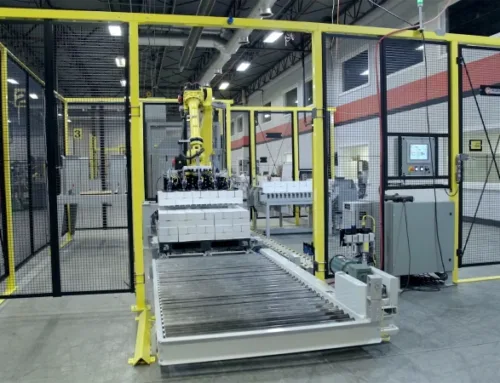
For system integrators and plant EHS managers, upgrading an automated production line is a logistical nightmare if the perimeter guarding is rigid. Traditionally, moving a high-speed mechanical assembly machine meant tearing down custom-welded fences. This process requires hot work permits, introduces fire hazards from welding sparks, and forces extended downtime that devastates your Overall Equipment Effectiveness (OEE).
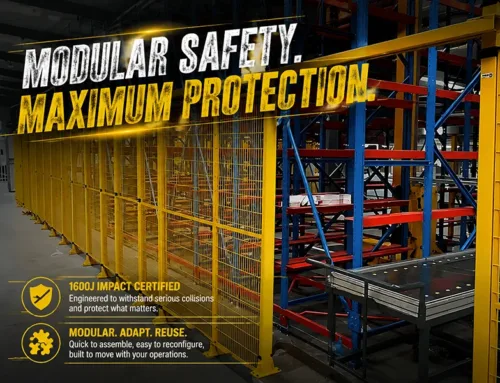
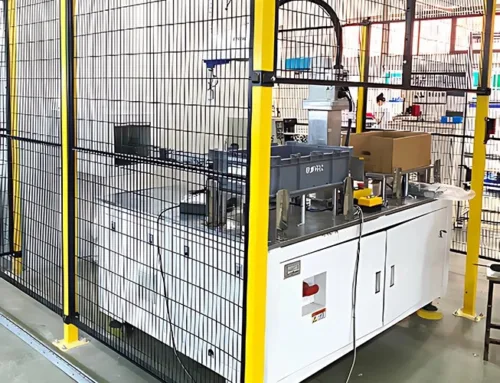
The Mdfence system changes this paradigm. Engineered specifically as Sistemas de Cercas de Segurança para Robôs, our solution is built on a Lego-like modular architecture. Utilizing standardized Q235 carbon steel posts (60x60mm) and framed wire mesh panels, the entire perimeter can be disassembled and reassembled in a new configuration with up to 95% asset reuse. When your AGV paths change or your robotic layouts expand, your fencing adapts without generating a single piece of scrap metal.

Cold Assembly: Eliminating “Hot Work” on the Factory Floor
One of the biggest bottlenecks during an automotive plant layout change is the requirement for field modifications. Drilling new holes into powder-coated posts to adjust panel heights compromises the ISO 9227 salt-spray corrosion resistance and leaves metal shavings in sensitive electro-optical environments.
Our patented connection clips and M8x16 hex bolts allow for 100% cold assembly. If a conveyor belt needs to penetrate a different section of the cell, maintenance crews simply unbolt the clips, swap a standard panel for a custom tunnel guard panel, and retighten. This reduces the Mean Time To Repair (MTTR) for layout adjustments by over 40% compared to traditional fabrication, allowing reconfigurations to happen during a standard weekend shift.
Maintaining ISO 13857 Compliance in Tight Footprints
When a production line layout changes, floor space usually becomes tighter. Moving a Cerca de segurança industrial closer to a hazard to save space often violates safety reach distances if you are using generic 50x50mm (2″x2″) mesh.
Because the Mdfence system utilizes a highly specific 20x100mm (approx. 0.78″ x 3.93″) “anti-climb” and finger-safe mesh, it inherently complies with ISO 13857 standards even when installed as close as 120mm (4.7 inches) from the hazard. This means when you redraw your CAD layouts to squeeze in an extra KUKA or FANUC robot, you can confidently shrink the perimeter footprint without risking OSHA violations or failing EHS audits.

Seamless Re-Integration with PLC and E-Stop Circuits
A physical barrier is only half of the safety equation in modern turnkey solutions; the other half is the electrical interlock. When a sliding door or hinged access point is relocated during a layout change, the safety switches (like Omron D4NL or Pizzato) must move with it.
Unlike generic barriers that require on-site fabrication of lock brackets, our system features pre-engineered safety interlock carriers. These mounting plates are designed to travel with the door module. When you move an access point to the other side of the CNC machining center, the lock carrier moves with it, ensuring perfect alignment. This guarantees that the mechanical separation instantly triggers the Safety Torque Off (STO) signal to the PLC, preventing nuisance machine trips caused by sagging doors or misaligned sensors.
Cost & Efficiency Matrix: Layout Reconfiguration
| Metric | Traditional Welded Guarding | Mdfence Modular System |
| Reconfiguration Method | Grinding, cutting, re-welding, field painting. | Wrench-only cold assembly; unbolt and slide clips. |
| Asset Recovery Rate | 0% – 10% (Mostly scrapped). | Up to 95% (Panels, posts, and doors are fully reusable). |
| Production Impact | Requires complete line shutdown due to hot work/fire risk. | Can be performed adjacent to active lines without disruption. |
| Interlock Realignment | High risk of misalignment leading to false E-stops. | Pre-drilled carriers maintain exact factory tolerances. |
Frequently Asked Questions (FMS & Robotics Integration)
1. Can we reuse the panels if we upgrade from a single robotic welding cell to a fully automated production line?
Absolutely. The system is designed for 95% asset reuse. Your existing 20x30mm framed panels and 60x60mm posts can simply be unbolted and integrated into the expanded perimeter layout without any structural loss.
2. Do we need to drill new holes in the posts if we change the height of the safety light curtains or access panels?
No. Our connection clips wrap around the post and secure via tension with an M8 hex bolt. You can slide the clips up or down to adjust panel heights infinitely without ever drilling into the Q235 steel or compromising the powder coating.
3. How fast can a maintenance crew remove a panel to replace a faulty servo motor on a CNC machine?
A standard mesh panel can be completely removed by one technician in under 10 minutes using a standard wrench. Once the servo motor is swapped, the panel locks right back into place, ensuring MTTR is kept to an absolute minimum.
4. Will the doors sag if we disassemble and move them to a different part of the warehouse AGV path?
No. Our doors utilize the same rigid 20x30mm framed architecture as our panels. Furthermore, wide hinged doors are supported by heavy-duty caster wheels, and sliding doors use precision bearing rails, ensuring they remain perfectly aligned regardless of how many times they are relocated.
5. Does reconfiguring the fence on-site invalidate the ISO 14120 compliance?
As long as the reconfiguration utilizes our standard mounting hardware and adheres to the safety distance calculations (ISO 13857) relative to the new hazard location, the physical integrity and compliance of the 1600J impact-rated barrier remain fully intact.