PT
PT  EN
EN  DE
DE  RU
RU  JA
JA  ES
ES  IT
IT Warehouse Forklift Zones · Food Plant Traffic Separation
Proteção Flexível de Estantes em Fábricas de Alimentos: Por Que Corredores de Tráfego Misto Precisam de Barreiras com Autorrecuperação
In a food plant, the highest-risk aisle is usually the shared one: forklifts bring pallets in, AGVs keep moving, operators step out to inspect lines, and a taped warning line does nothing when traffic peaks. Flexible Rack Protection gives that corridor a physical buffer. Its ARMORFLEX™ polymer is officially described as absorbing up to 80% of impact energy and rebounding after a hit, while the top DR190 / TR190+ rating reaches 28,950J — equivalent to an 8-ton vehicle at 9.6 km/h.
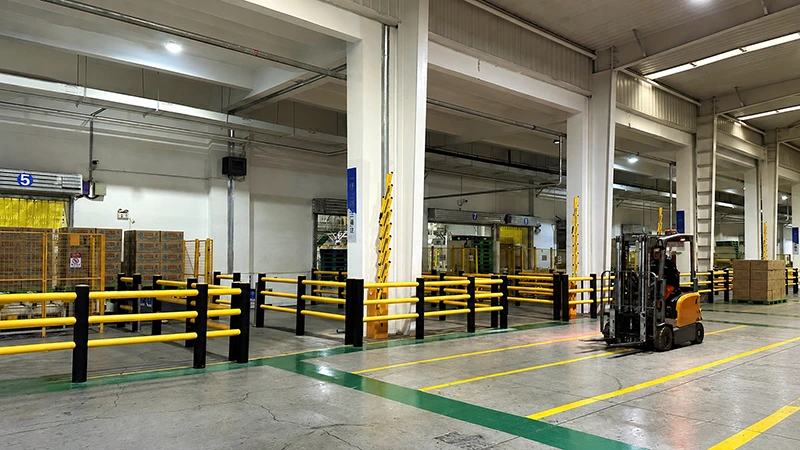
What the aisle needs, and what Flexible Rack Protection changes
If you are comparing Flexible Barrier vs Steel Barrier, the real question is not purchase price. It is how often the site gets hit, how much downtime follows each hit, and whether the barrier protects racks, columns, and people without turning the floor into a repair job. Flexible Rack Protection is built for that exact problem: repeated contact in warehouse safety barrier zones, forklift safety barrier corridors, loading dock protection points, and machinery protection edges.
| Mixed-traffic pain point | Flexible Rack Protection response |
|---|---|
| Forklifts, trolleys, AGVs, and pedestrians share one corridor | Create a permanent physical boundary instead of relying on training or floor warnings alone. |
| Repeated hits damage steel rails, anchors, and the concrete edge | Use ARMORFLEX™ polymer to absorb impact energy and rebound, reducing the need for full-segment replacement. |
| High-exposure rack ends and column faces need stronger protection | Specify DR190 or TR190+ where the site needs the 28,950J rated barrier level. |
| Food lines have narrow aisles and little spare floor area | Keep the section slim and modular so the safety line does not eat into already tight routes. |
| Existing layouts need retrofit work, not a full rebuild | Use modular installation, floor-anchored base plates, and local part replacement instead of long shutdowns. |
Why this barrier fits food plants, not just warehouses
1) It turns a shared aisle into a protected boundary
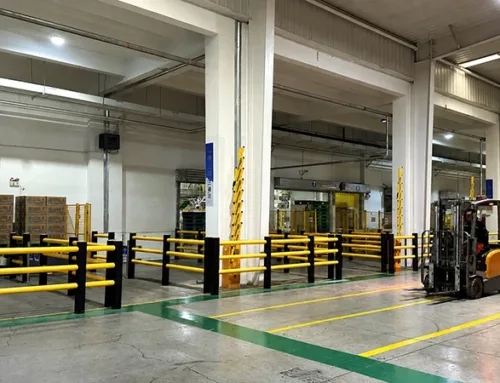
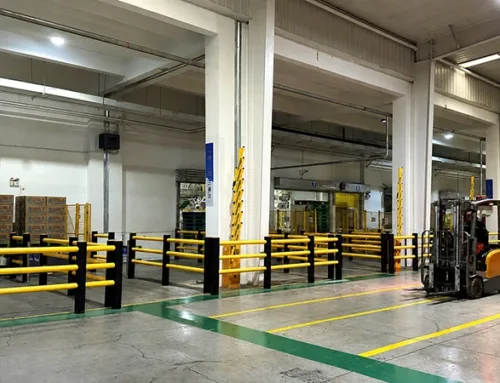
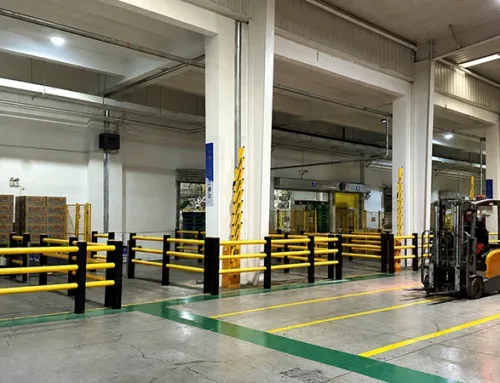
In food manufacturing, the traffic pattern changes by the hour. Raw material intake, pallet transfer, line replenishment, and waste removal can all pass the same point, which is why many sites see the same collision again and again. Flexible Rack Protection is useful here because it makes the boundary physical. The floor-mounted run shown here protects loading bays and column lines while leaving the route readable for operators, drivers, and maintenance staff.
The main value is not decoration or simple lane marking. It is collision control. By placing the barrier at the edge of the rack face or machine access line, the site gets a buffer that can take the hit before the structure does.
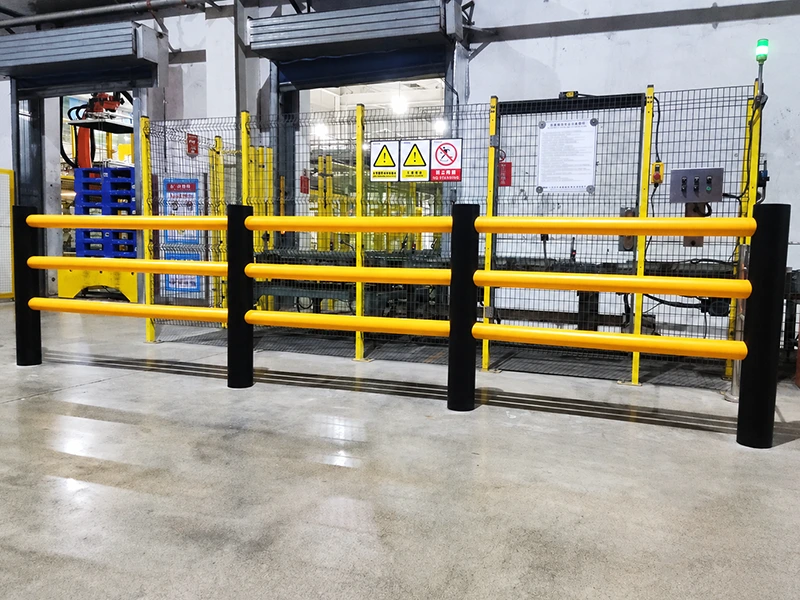
2) It protects people and equipment without swallowing aisle width
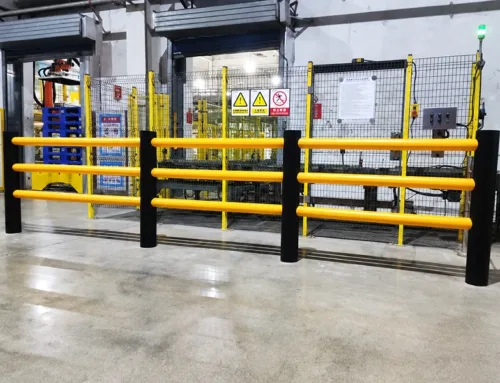
Many plants need a Pedestrian Barrier that is strong enough for equipment impact but compact enough for a busy aisle. The dual-rail layout is a good fit when the goal is Pedestrian Walkway Protection and Machinery Protection at the same time. It can define a walkway, separate equipment access, and still leave enough working width for carts and pallet movement.
This is where the product’s structure matters. The system is modular, bolted to the floor, and built for quick replacement at the damaged section rather than a full strip-out. For an operations team, that means less disruption when a single point takes the hit.
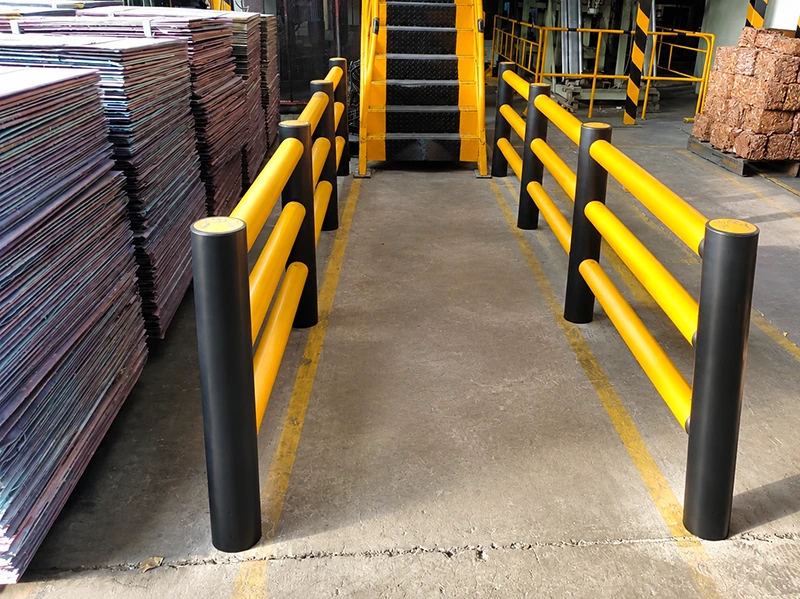
3) It gives you a clear rating path for the highest-risk points
Not every zone needs the same barrier spec. A rack end near a main fork lane is not the same as a light pedestrian boundary. That is why Flexible Rack Protection is more useful as a system than as one fixed rail. SR, DR, TR, and CTR let the site match the protection level to the actual impact risk. When the point is severe, DR190 and TR190+ provide the 28,950J rated barrier level — the number buyers can use when they must compare engineering data, not slogans.
The 3D layouts below make the structure obvious: bolted base plates, upright posts, and multi-rail configurations that can be combined for different exposure zones. If the site needs a column protector, a rack-end guard, or a longer warehouse barrier run, the layout can be built from the same product logic.
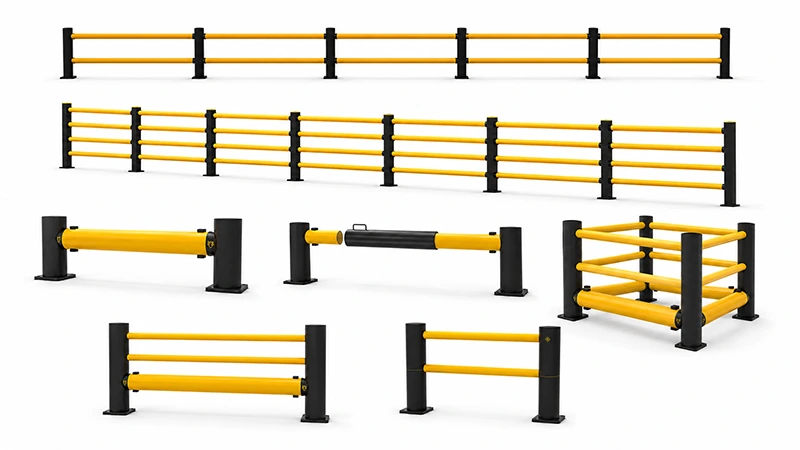
Where Flexible Rack Protection is a better fit
- Warehouse Safety Barrier — for main aisles where forklifts and pedestrians cross and the hit risk repeats every shift.
- Forklift Safety Barrier — for receiving corridors, pallet transfer points, and turning zones that repeatedly touch the same edge.
- Loading Dock Protection — for docks, bay edges, and column lines that need a physical buffer during intake and dispatch.
- Racking Protection System — for rack ends and exposed corners where one bad turn can trigger repair costs.
- Manufacturing Plant Safety — for food and beverage production lines where clean routing matters and floor space is tight.
- Logistics Centre Barrier — for AGV lanes, distribution corridors, and high-frequency material-handling routes.
- Pedestrian Walkway Protection — for operator paths that must stay open even when vehicle traffic rises.
- Machinery Protection / Column Protector — for conveyor entrances, structural columns, and equipment access points.
In practice, Flexible Rack Protection is the right move when the site does not need another warning line. It needs a barrier that can take repeated contact, rebound, and keep the line running.
What to send for a layout review
To specify the right SR, DR, TR, or CTR layout, send three things: aisle width, vehicle type, and the exact impact points you want to protect. If the exposure is severe, note whether the zone needs a 28,950J rated barrier such as DR190 or TR190+. That is the fastest way to turn a site sketch into a useful protection plan.
Replace passive warnings with a physical buffer
If your plant still relies on Steel Barrier, Concrete Barrier, or floor tape to separate traffic, Flexible Rack Protection gives you a more direct answer: absorb the hit, rebound, and protect the rack, the column, and the people around it.