EN
EN  DE
DE  RU
RU  PT
PT  JA
JA  ES
ES  IT
IT 

|
When a 6-axis robot in your automotive welding cell throws a 150 lbs part, or a forklift nudges your perimeter barrier, the entire kinetic shock load transfers directly to the floor mounts. If your system relies on cheap anchors or rigid floor welds, the concrete cracks, the posts shear, and your automated production line goes down. You need an anchorage system engineered for energy dissipation, not just static partitioning. |
The Hidden Vulnerability in Your Robotics Layouts
The Pain Point (Before): In Turnkey Solutions and high-speed mechanical assembly lines, system integrators often treat floor mounting as an afterthought. Fences are either bolted down with undersized hardware or welded directly to embedded steel plates. When an Autonomous Mobile Robot (AMR) bumps the fence, rigid welds snap, or weak bolts pull straight out of the floor. Worse, when you need to reconfigure the CNC machining center layout next quarter, you are forced into “Hot Work”—grinding off welds, generating sparks, and shutting down adjacent assembly systems due to fire hazards.
Our Logic (Why it works): The foundation of effective Safety Fence Industrial systems lies in the base plate engineering. Mdfence utilizes a 60x60mm Q235 carbon steel post with a welded horizontal “ear” base plate. Instead of rigid welding, it is anchored into polished concrete using four M10 x 70mm (approx. 3/8″ x 2.75″) wedge expansion bolts. Q235 steel features excellent plasticity; it bends rather than breaks.
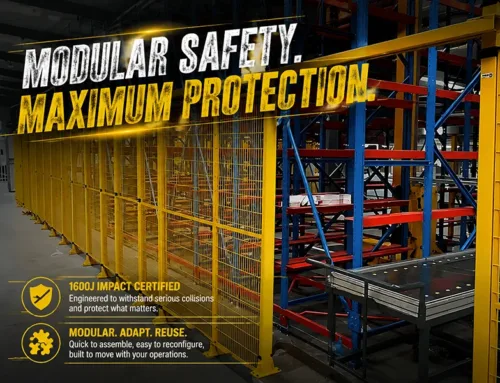
Actual Benefit (After): This specific mounting configuration converts overturning moments into tensile and shear forces spread across the concrete. It allows the system to absorb up to 1600 Joules of impact energy—equivalent to stopping a 220 lbs mass moving at 12 mph—without catastrophic failure. Furthermore, modifying your robotics layout becomes a “Cold Assembly” process. Just unbolt, move, and re-anchor in hours, maintaining 100% asset reusability and keeping your OEE (Overall Equipment Effectiveness) high.

Dynamic Load Dissipation: From Mesh to Concrete
The Pain Point (Before): Cheap, frameless wire mesh panels act like a hammock when struck. Workers leaning on them cause permanent deformation, and the localized stress rips the mounting brackets right off the posts, leaving your moving servo motors exposed and violating OSHA machine guarding standards.
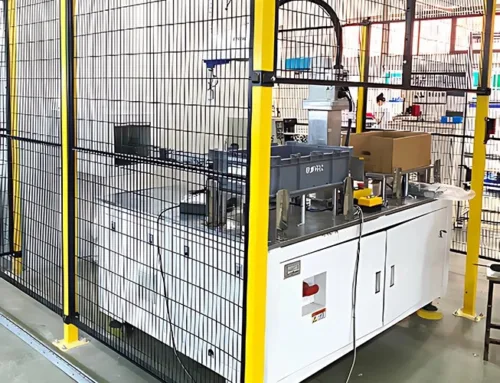
Our Logic (Why it works): True Machine Guarding Systems require a continuous load path. Our framed panels feature a 20x30x1.5mm seamless steel tube outer frame. When a stray part hits the 3.0mm flat-welded wire mesh, the point load is distributed across the rigid frame. The frame transfers the force to the high-strength connection clips, which grip the post without requiring drilled holes (which would compromise the post’s structural integrity). The post then acts as a cantilever beam, driving the force down into the M10 expansion bolts.
Actual Benefit (After): Your floor mounts never experience isolated sheer spikes. The entire structure shares the load. Combined with our 20x100mm “finger-safe” mesh, you can legally mount the barrier just 4.7 inches (120mm) away from the hazard per ISO 13857, saving roughly 10 square feet of premium floor space per robotic cell.
Base Stability Dictates Safety Interlock Alignment
The Pain Point (Before): In an automated high-speed manufacturing line, you need wide access doors for material handling. If the floor anchors allow even a 1/8-inch tilt in the main post, a 10-foot double hinged door will sag. This misalignment causes your Omron or Pizzato safety interlock switches to fail to engage. The PLC registers a fault, the robotics integration halts, and your maintenance team spends hours trying to “shim” the floor plates.
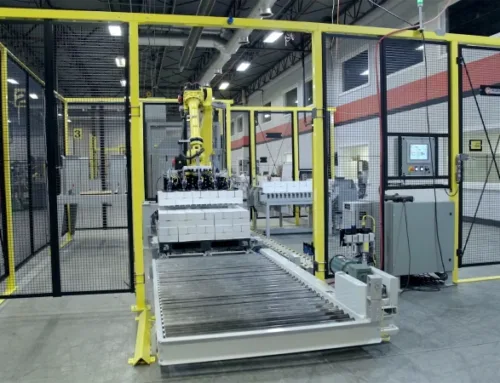
Our Logic (Why it works): Our Robot Safety Fencing door systems are engineered in tandem with the floor mounts. For wide spans, we utilize heavy-duty 40x60mm hinges, top door frame beams that lock the parallel verticality of the posts, and caster wheel kits that roll smoothly on the concrete, taking the rotational torque off the floor anchors.
Actual Benefit (After): Absolute dimensional stability. The lock carrier plates align perfectly every single time the door closes. You achieve seamless PLe/SIL3 safety circuit integration with zero nuisance trips, drastically reducing MTTR (Mean Time To Repair) and keeping your assembly systems running at peak capacity.

Protecting the Anchors: The Post Base Cover
The Pain Point (Before): On the factory floor, exposed floor anchors act as traps. They collect metal shavings from milling operations, get soaked in corrosive CNC coolants, and present a tripping hazard for operators managing the material handling area. Over time, the exposed threads rust, making future layout changes impossible without cutting the bolts.
Our Logic (Why it works): Every standard floor mount in our system includes a two-piece plastic post base protective cover. This cover snaps securely over the welded base plate and the M10 expansion bolts, completely encapsulating the anchoring hardware.
Actual Benefit (After): The hardware is shielded from industrial solvents and physical impacts from pallet jacks. It provides a clean, 5S-compliant aesthetic required by top-tier automotive manufacturers, ensures workers’ safety shoes don’t catch on sharp threads, and guarantees the bolts can be easily unthreaded years later when you need to upgrade the dedicated manufacturing line.

Mounting Methods Comparison for Automotive Automation
| Mounting Dimension | Traditional Welded / Light-duty Anchors | Mdfence Modular Anchorage System |
|---|---|---|
| Installation Process | Hot Work required. Sparks, fumes, fire watch needed. Floor gets scorched. | Cold Assembly. Uses a hammer drill and M10 expansion bolts. Clean and fast. |
| Impact Response | Rigid failure. Welds crack under forklift impact, creating flying shrapnel. | Kinetic dissipation. Q235 steel yields; expansion bolts hold up to 1600J impacts. |
| Reconfiguration | Destructive removal. Asset value drops to zero. High labor cost to replace. | 100% modular. Unbolt and move to the new CNC or robotics cell layout. |
Frequently Asked Questions (FAQs)
We recommend a minimum concrete depth of 4 to 6 inches (100-150mm) with standard industrial compressive strength. Polished or sealed concrete is perfectly fine, as our M10 x 70mm wedge expansion bolts grip the internal aggregate directly.
While no fence is indestructible, our system is TUV certified to withstand 1600 Joules of impact energy. The Q235 steel posts and heavy-duty base plates are designed to deform plastically rather than shear off, protecting your automated production line from catastrophic secondary damage.
Because our system uses mechanical expansion bolts instead of floor welds, reconfiguration is a “Cold Assembly” process. You simply unbolt the posts, move the modular panels, and drill new anchor holes. The old holes can be easily filled with industrial epoxy.
Uneven floors can cause issues, but our modular connection clips allow for vertical adjustments of the framed panels. Additionally, our door systems utilize top frame beams to force the posts into parallel alignment, ensuring your PLC/HMI never registers a false trip due to mechanical sagging.
No. Every floor mount is equipped with a two-piece plastic post base protective cover. This completely encapsulates the base plate and the M10 bolts, shedding coolant splashes and eliminating tripping hazards for your assembly operators.