EN
EN  DE
DE  RU
RU  PT
PT  JA
JA  ES
ES  IT
IT 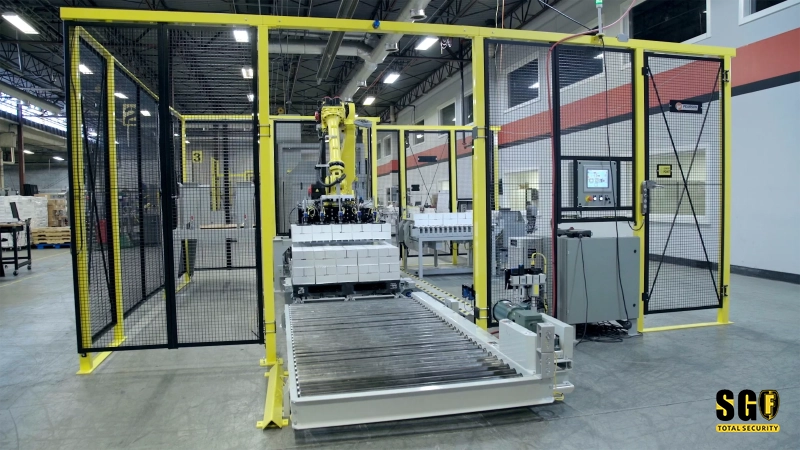
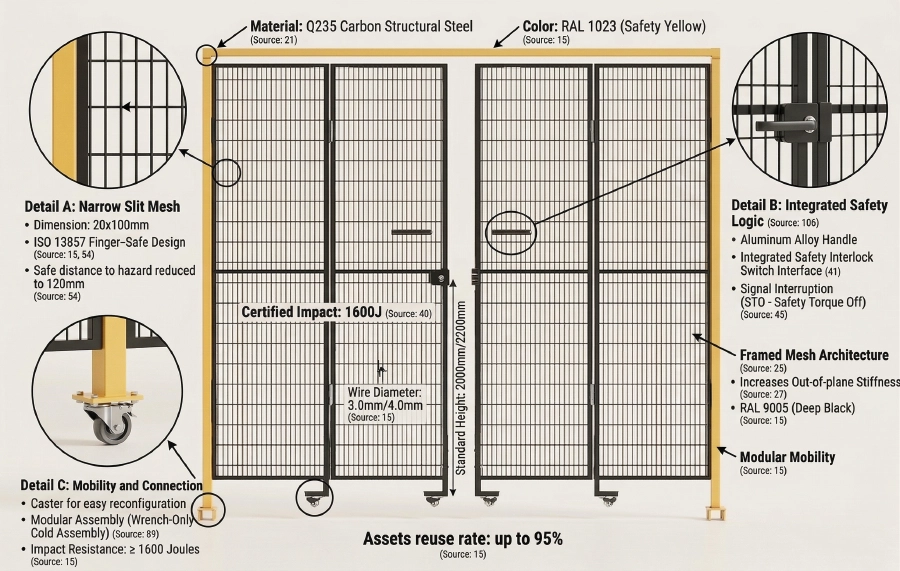
Mdfence industrial safety fencing helps automation integrators build compact robot and conveyor cells in plants where floor space is expensive and internal aisles are already under pressure. Instead of forcing the fence line far away from the hazard source like ordinary 50×50 mm mesh often does, the system uses a documented 20×100 mm finger-safe mesh concept that supports much tighter legal installation distances. The result is straightforward: more usable production area, better forklift circulation, and a smaller machine footprint delivered to the end user without turning access control into an afterthought.
Why floor-space cost should be part of every machine guarding decision
Many projects still treat machine guarding as a simple compliance box: pick a fence, draw a rectangle, and keep the hazard away from people. In reality, the mesh choice can directly affect how much real estate the finished cell consumes. When a coarse opening requires a larger offset from the dangerous movement zone, the perimeter expands outward and starts eating into forklift lanes, maintenance walk paths, raw material staging areas, and future machine expansion space.
That penalty becomes expensive in facilities where every square meter already carries a high operating cost. For an automation integrator, it also creates a downstream commercial problem. If the guarded cell occupies too much floor area, the end customer may need to redesign internal traffic routes, reduce nearby storage, or reject the proposed layout entirely. A safety fence that looks cheaper on paper can therefore make the overall project more expensive at the line-planning level.
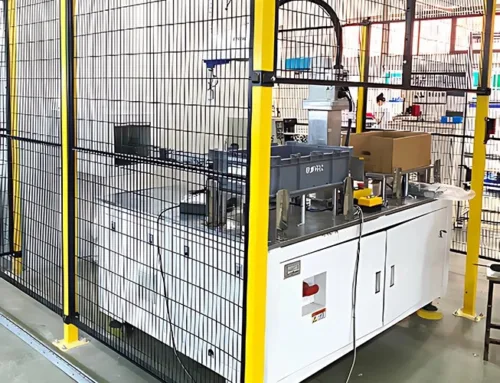
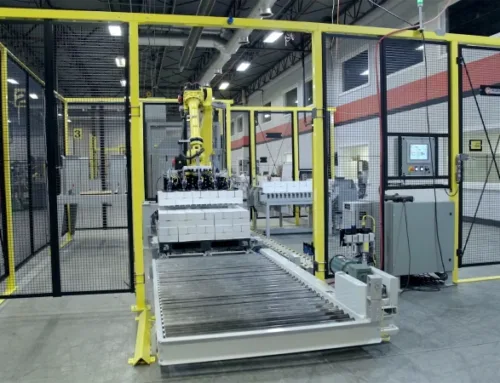
Mdfence is better positioned for this problem because it is designed as a machine guarding system rather than a generic partition. Its framed mesh structure, modular post-and-clamp assembly, and 20×100 mm guarding concept support compact perimeter design where a tight envelope matters. That is especially relevant around palletizers, robotic handling stations, test cells, and conveyor zones where equipment envelopes are already dense.
How tighter safety distance translates into real layout advantages
The user concern in this scenario is clear: automated equipment already occupies a large footprint, and ordinary guarding can make the usable plant even smaller. Where standard market fencing with large openings drives the barrier line back to around 850 mm from the hazard source, Mdfence uses a finer finger-safe mesh format that supports installation much closer to the risk area within the applicable standards framework. The practical implication is that the guard line can sit near the machine envelope instead of creating a wide dead zone around it.
What changes for the factory
- Forklift aisles are easier to preserve instead of being pinched by oversized offsets.
- Material infeed and discharge routes stay straighter around the cell.
- More room remains for neighboring machines, control cabinets, and service zones.
- Future line balancing or process additions become easier because less floor area was consumed on day one.
What changes for the integrator
- The delivered automation unit looks more compact and better engineered.
- Space savings become a measurable commercial advantage for the proposal.
- The guard package is easier to align with OEM export expectations for machine guarding.
- Project teams avoid many late-stage arguments about aisle width and usable floor area.
In other words, the fence is not just preventing entry. It is shaping the business case of the machine layout. A more compact perimeter can save several square meters on a single installation, and across multiple cells that turns into a significant cost and capacity benefit for the end user.
Compact does not mean compromised
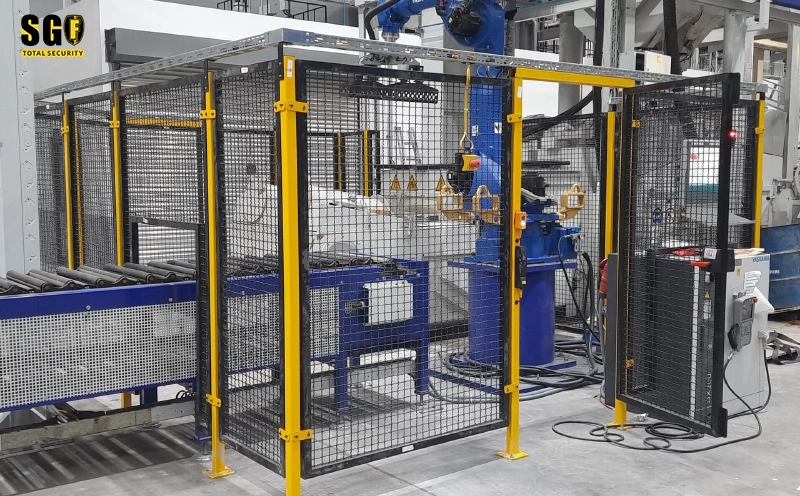
A common objection is that a smaller guarded footprint must be harder to access, maintain, or operate. That only happens when the fence is treated as a static wall. Mdfence is modular and supports hinged, sliding, folding, and telescopic gate concepts, which means a compact cell can still offer rational service access. Operators get controlled entry points. Maintenance teams get doors that fit the local aisle condition. Integrators get a fence line that adapts to conveyor pass-throughs and equipment corners instead of forcing awkward workarounds.
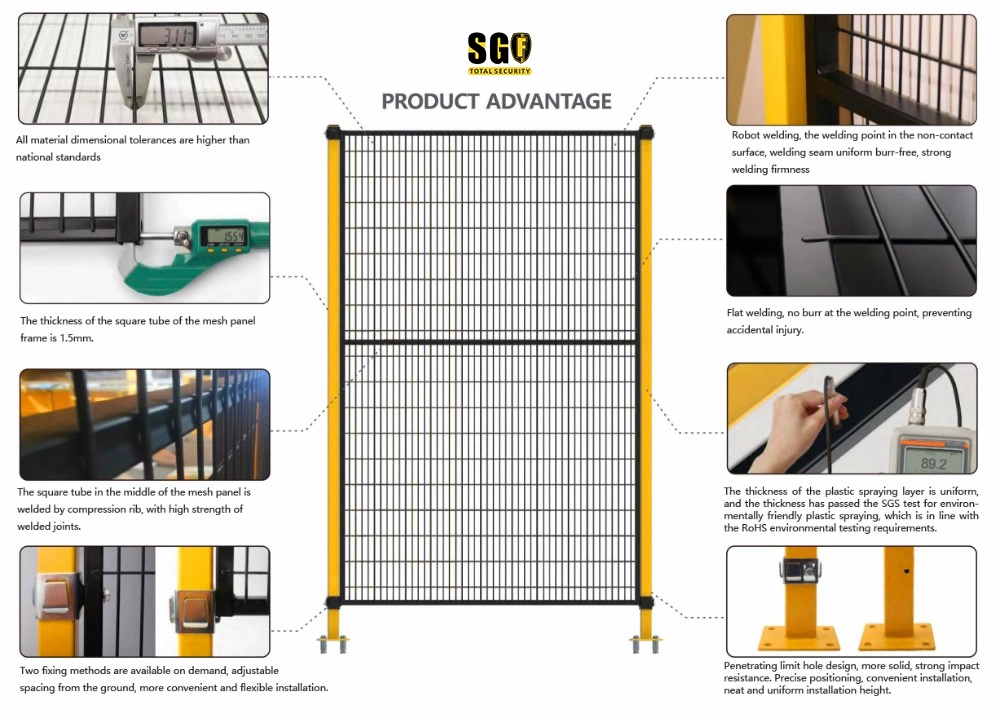
The framed panel format also matters. Unlike low-cost frameless mesh that can sag or deform, the framed structure helps keep alignment stable over time, especially where doors and interlock devices are involved. In high-cycle production environments, that stability protects both usability and safety logic. Compact layouts only stay efficient when the guard system remains square, functional, and easy to operate after months of use.
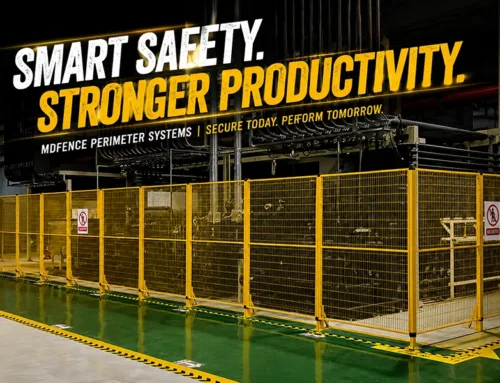
For space-constrained factories, visibility is another operational requirement. The yellow-and-black configuration keeps hazard recognition high while preserving clear sightlines into the cell. Supervisors can monitor machine status, operators can see product flow, and EHS teams can review boundaries without turning the enclosure into a blind box.
Where Mdfence fits best in tight plants
| Scenario | Typical layout problem | Mdfence response |
|---|---|---|
| Robot palletizing cells | Large robot sweep plus conveyor discharge creates aisle pressure | Close-in mesh concept helps reduce wasted perimeter offset while preserving controlled gate access |
| Conveyor and packaging lines | Long fence runs can steal staging and forklift maneuver space | Modular framed panels create a cleaner boundary with pass-through planning and visual monitoring |
| Retrofit automation projects | Existing plant columns, racks, or service lines leave little room for guard expansion | Clamp-based assembly and configurable openings help the fence adapt to tight legacy conditions |
| Test cells and compact workstations | Small machines still need compliant separation without wasting floor area | A compact guarding envelope gives better use of limited production space |
Why the structure supports long-term value, not just first-day compliance
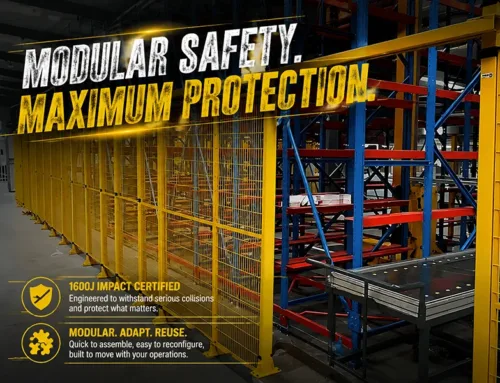
Space savings are only valuable if the fence can hold up in daily industrial use. Mdfence uses Q235 carbon steel framed panels, powder-coated yellow posts and black mesh, and modular clamp-based assembly. Across the documented source set, the system is also tied to machine-guarding standards such as ISO 14120 and ISO 13857, with repeated references to impact resistance around 1600 J for machine-risk applications.
Those details matter because tight layouts often sit near active traffic, tools, and repetitive door cycles. A poorly built barrier may bend, loosen, or create gate alignment problems that undo the benefits of the original design. A stronger, framed modular system is better suited to plants where guarding is part of daily production infrastructure rather than a one-time partition.
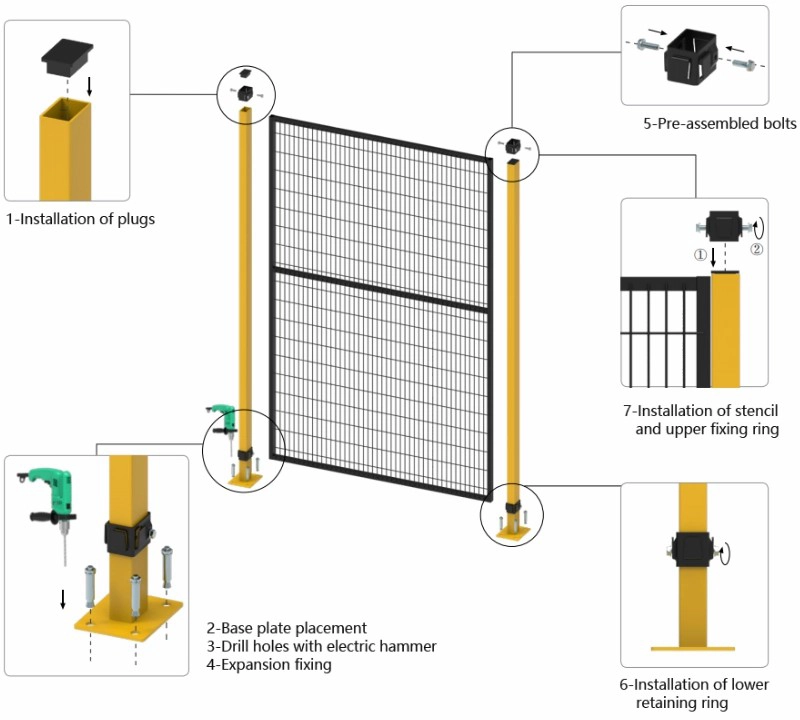
Cold assembly is another practical advantage. Instead of extensive site welding, panels and posts can be installed with mechanical connectors and anchors. That helps reduce shutdown disturbance, simplifies retrofit work, and makes future reconfiguration more realistic if the line changes later.
What buyers should ask before choosing a low-cost fence for a tight automation project
- What mesh opening is being proposed, and how does it affect the required safety distance?
- How much floor area will the final guard envelope consume around the hazard source?
- Will the chosen layout reduce forklift clearance, material staging, or service access?
- Are the doors engineered for real use, including support, alignment, and interlock integration?
- Can the fence be reconfigured if the equipment layout changes after commissioning?
- Is the system a framed machine guarding product, or just a generic wire partition being repurposed?
These questions push the evaluation away from unit fence price and toward total project outcome. In a high-cost factory, the cheapest panel is rarely the cheapest decision once floor area and traffic flow are included.
Build a smaller automation footprint without giving away safety performance
If your project needs machine guarding that protects operators but does not waste valuable plant area, Mdfence offers a compact, modular approach for robot cells, palletizers, conveyors, and retrofit automation zones.
Ask for a layout review based on your machine envelope, required access points, and internal traffic constraints so the guard line supports both compliance and factory productivity.