EN
EN  DE
DE  RU
RU  PT
PT  JA
JA  ES
ES  IT
IT Multi-Customer EMS Plant Demarcation
Shared-Plant Tool Cribs and Customer Material Zones: How Mefence Frameless 3D Safety Fence Segregates Multi-Customer EMS Lines
A multi-customer EMS plant cannot let tools walk off the floor, let WIP block a neighbour’s line, or let Customer A’s batch end up in Customer B’s outbound cart. Mefence frameless 3D industrial safety fencing creates lockable tool crib enclosures, see-through material zones, and customer-specific WIP buffers without turning into a blind wall that blocks supervisors, sensors, or 5S audits.
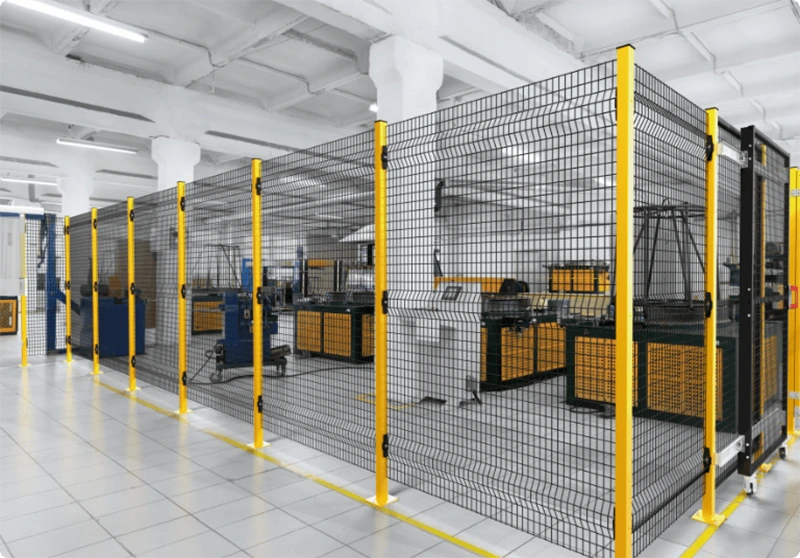
What Multi-Customer EMS Plants Are Actually Segregating
When a contract electronics plant runs three or four customer programs on the same floor, the demarcation problem is not “draw a line.” It is four parallel headaches that share one boundary line.
| Segregation Demand | What the Boundary Has To Do |
|---|---|
| Tool crib / fixtures / gauges | Lockable cage, single controlled access, visible inventory, no blind corners where a missing tool can hide |
| Customer material zones (A / B / C) | Clear visible separation so batches are not commingled, no mix-up at the outbound dock, traceable at a glance |
| WIP buffer queues | Defined lane for in-process trays, prevents one customer’s WIP from overflowing into another customer’s work envelope |
| Clean / inspection / packing area | Visible demarcation without solid walls that create dust-trap corners or block supervisor sightlines across the line |
Why Mefence Frameless 3D Safety Fence Fits the Tool Crib and Material Zone Problem
Lockable single gate turns a mesh perimeter into a controlled tool crib cage
The same yellow-and-black Mefence module that draws a boundary can also become a lockable enclosure. A single hinged access gate with a latch turns the open mesh into a tool crib cage where supervisors can scan the whole rack from outside. The 50 x 50 mm or 20 x 100 mm welded mesh lets the auditor see every fixture without opening the door, which removes the “tool walked off the floor” argument and shortens cycle-counts. Because the panels clip together with plastic clips and self-tapping screws, the cage can be expanded sideways whenever a new fixture rack arrives, without cutting concrete or pulling a welder onto an active EMS floor.
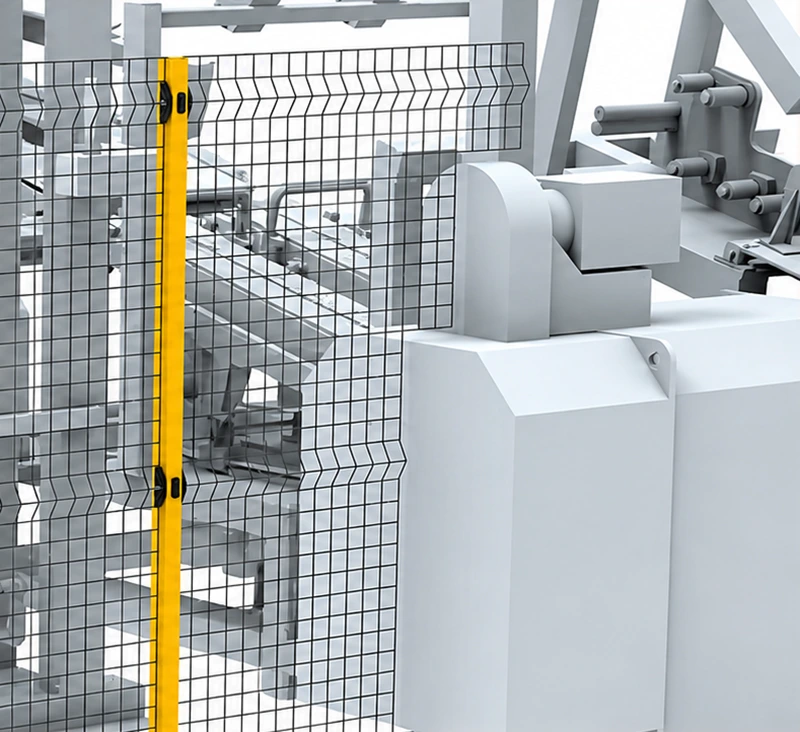
Open mesh panels keep customer material zones visible for 5S and serial-number checks
Painted lines fade, barrier tape snaps, and chain-link panels block the supervisor’s view of what is actually on the rack. Mefence’s frameless welded mesh, with 3 mm or 4 mm Q235 carbon steel wires and a 200 – 1400 mm panel width range, gives every customer zone a visible, yellow-edged boundary. The supervisor can read batch labels through the mesh from two meters away, and the auditor can complete a 5S walkthrough without entering the cell. For multi-customer plants running incoming inspection, this removes the “is that Customer A’s reel or Customer B’s reel” question before it reaches the SMT line.
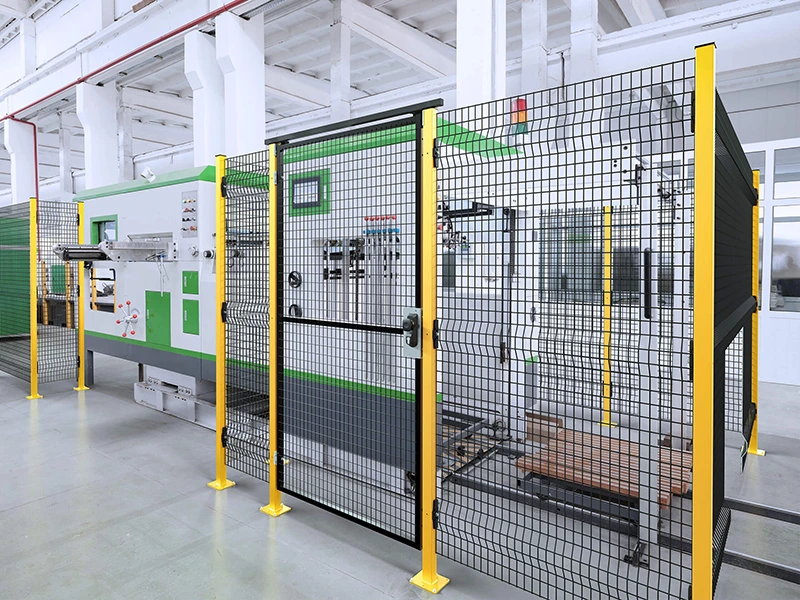
T-ridge cable channel keeps WIP buffer zones free of dangling scanner and inventory lines
WIP buffer zones are usually surrounded by barcode scanners, label printers, and customer-owned MES terminals. Mefence’s 3D pressed mesh leaves a horizontal T-shaped ridge along the panel face that doubles as a cable routing trough. Instead of stapling Cat6 along the floor or zip-tying it to the post, the WIP station’s scanner cable, the customer’s MES drop line, and the access-control reader all sit inside that T-ridge. The buffer lane stays clean, the WIP trays stay visible, and the customer’s audit team does not see a bird’s nest of cables crossing the pedestrian aisle.
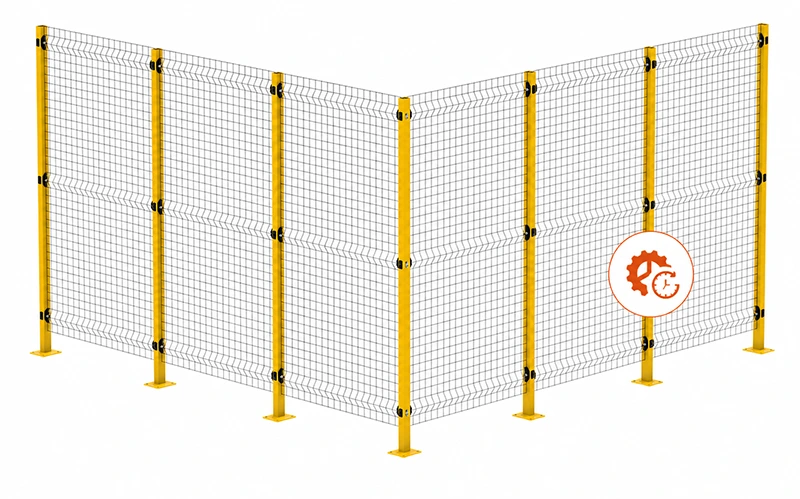
Where Mefence Frameless 3D Safety Fence Solves the Multi-Customer Segregation Problem
- Lockable tool crib and gauge cage enclosure on the EMS shop floor
- Customer material zone separation (Customer A / Customer B / Customer C) inside a shared warehouse
- WIP buffer and inspection lane demarcation between two adjacent SMT lines
- Clean / packing area partition that stays see-through for the supervisor walkthrough
- Temporary tool kiosk at a contract manufacturer’s NPI cell
- Reusable segregation layout for a multi-customer 3PL fulfilment floor
Across all of these uses, Mefence is sold for non-high-impact area demarcation, traffic guidance, and zone separation — not as a certified crash-rated machine guard. Where a customer program requires impact containment at a robot or conveyor strike point, that boundary has to be a higher-spec Machine Fence or Industrial Safety Fence line. For the tool crib, the material zone, the WIP buffer, and the clean-area partition, however, the frameless 3D mesh is the right tool for the job.
What to Confirm Before You Lay Out a Shared-Plant Demarcation Plan
For each tool crib cage, customer material zone, or WIP buffer lane, the buyer should confirm: which customer programs share the floor and how each customer audit wants its zone labelled; whether the tool crib needs a single hinged gate or a double-leaf gate for forklift access; the panel width (200 – 1400 mm), height (200 – 3000 mm), and post size (40 x 60 mm or 60 x 60 mm) that matches the existing rack footprint; whether the T-ridge cable channel has to carry scanner, MES, or access-control wiring; and whether the panel layout has to be re-cut on site around an irregular column or service pipe — Mefence is built for on-site cutting without welding.
Send Us Your Multi-Customer Floor Plan and Get a Mefence Demarcation Layout
Email or upload a simple floor plan with the customer zones, tool crib locations, WIP buffer lanes, and any existing posts or racks. We will return a Mefence modular layout with panel widths, post sizes, gate positions, and a T-ridge cable routing sketch, plus an indicative meter price — typically a fraction of a framed Troax-class cage for the same demarcation footprint.